
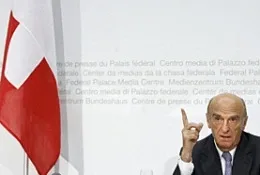
The President of Switzerland failed to resolve a long-standing dispute with Libya
On February 15, Libya announced a de facto refusal to allow Europeans entry into the country. The exceptions were non-Schengen countries and the United Kingdom, which has a special status. The first victims of the harsh decision immediately appeared — several Dutch nationals were not allowed to leave the airport in Tripoli, even without looking at their pre-arranged visas and the Netherlands' non-involvement in the conflict.
It would be fine if it only concerned tourists, but many Schengen countries have business ties with the North African state. The disruption of important negotiations threatens far more serious consequences than a failed vacation — after all, you can spend it at home, while many business matters are customarily discussed only in person. In particular, the suspension of visa issuance especially worried Italy, whose former colony is Libya, since Libyan oil is a strategically important resource for the Italian energy giant Eni.
The reaction from Europe's diplomatic departments was not long in coming. Already on February 16, the European Commission responded, expressing "regret" over Libya's decision. The executive body of the European Union, which, by the way, Switzerland is not part of, did not draw any conclusions and did not name those responsible for the situation. However, this omission was more than compensated by the officials of Italy and Malta.
The conclusions of the two states turned out to be extremely curious: the blame for all the difficulties that Schengen residents suddenly faced was placed not on Libya with its dictator Gaddafi, but on... Switzerland. In particular, Maltese Interior Minister Carmelo Mifsud Bonnici, in a letter to his Swiss colleague Didier Burkhalter, called the ban on entry into Switzerland for Libyan citizens and its consequences a "violation of the spirit of the Schengen Agreement."
However, Switzerland had not yet had time to absorb that very spirit, since it only joined the Schengen countries at the end of 2008. It was precisely Switzerland's accession to the Schengen Agreement that became the main cause of the scandal that erupted — if events had unfolded five years earlier, no one would have paid attention to the diplomatic squabbling between the country of bankers and watchmakers and a state whose foreign policy reputation was already dubious. And Libya, accordingly, would have had no grounds to impose measures against all Schengen area countries.
The existence of the ill-fated list of 188 Libyan persons non grata has not been officially confirmed, but the sharp reaction of Switzerland's Schengen partners leaves no reason for doubt. Given the fact that the Schengen Agreement implies a common border area for all its members, it turns out that any such "black list" can no longer be called an internal affair of a single country.
And it all began on July 15, 2008, when Swiss authorities arrested the son of the Libyan leader, Hannibal Gaddafi, and his wife on suspicion of beating a maid. The conflict was resolved out of court, but the residue, as they say, remained, and photos of Gaddafi's son behind bars did not disappear from the pages of tabloids for a long time. The photos, by the way, became another reason for Libya's claims — the country demands from Switzerland a thorough investigation of the circumstances of their leak to journalists.
Almost immediately after Hannibal's arrest, Libya imposed sanctions against Swiss companies operating in the African country and placed restrictions on the entry of Swiss citizens. Supplies of Libyan oil to the European country also ceased.
A good illustration of the changed relations was the quite serious proposal by Muammar Gaddafi to wipe Switzerland off the map in a geopolitical sense: to divide the country's territory between Germany, Italy, and France. His son went even further in his dreams and promised to destroy Switzerland with nuclear weapons when (and if) he gets them.
A year later, the countries still managed to agree on a certain normalization of relations and signed a corresponding official document. This was preceded by a rather humiliating visit by Swiss President Hans-Rudolf Merz to Tripoli, where he offered a formal apology for Hannibal's arrest. The step drew criticism from the Swiss press and public, as well as calls for his resignation.
Already in the fall of 2009, the agreement ceased to be in effect on Tripoli's initiative due to a scandal involving two Swiss businessmen accused in Libya of illegal business activities. They are still in Libya in an unclear status, either as defendants or political hostages.
Such rhetoric is completely atypical for relations between Libya and Switzerland. Since Gaddafi came to power in 1970, the countries had been building economic cooperation, and during the years of the embargo on Libyan oil, Switzerland was the only country that bought fuel from Gaddafi. Many Swiss companies, such as Nestle and ABB, had their representative offices in Libya, and the leader of the Libyan revolution himself preferred to keep money in Swiss banks, renowned for their reliability and anonymity. One of the first steps in the conflict between the countries, by the way, was Gaddafi's withdrawal of funds from Switzerland.
Resolution of the conflict, however, is not far off. At least in the area of visa restrictions. On February 18, the foreign ministers of Switzerland and Libya managed to sit down at the negotiating table on neutral territory — in Madrid. It is expected that under pressure from the Schengen Agreement countries, the unreasonable and essentially unnecessary demonstrative sanctions will be lifted.
If everything is clear with Libya in this situation — no one expected anything else from Gaddafi — then Switzerland found itself in an extremely awkward position. The country, renowned for its special neutral status and avoiding wars and conflicts, got involved in a game on someone else's turf and, in the end, instead of flexing its diplomatic muscles, only let its neighbors down.
Pavel BORISOV.
Lenta.ru