
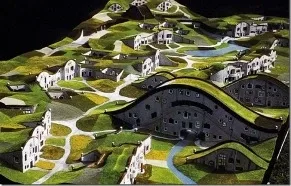
Model of Friedensreich Hundertwasser's "In the Hills of the Meadow" (1989)
Have you ever heard of such structures as the incineration plant in Vienna, or the Forest Spiral in Darmstadt? Their creator is an architect and artist with a difficult-to-pronounce name Friedensreich Hundertwasser. His life was so diverse that it is impossible to describe all the projects and all the fields he was involved in. He was interested in literally everything related to painting, culture, art, and religion.
In addition to his magnificent buildings, he organized various promo actions that drew crowds, wrote his own edition of the Bible, engaged in charity and educational activities. Like all famous and unconventional people, he never thought in stereotypes and did not live by generally accepted standards. His life was bright and full, his memory is forever captured in the centuries, thanks to his numerous projects and buildings around the world.
Special attention should also be paid to a talented person named Santiago Calatrava. This brilliant Spanish architect is hired when they want to build something that does not fit into the usual framework of existence, something that will be radically different from the surrounding environment and contrast with the dreary everyday views. Thanks to his extraordinary approach to form and composition, he has long since earned worldwide fame, and his numerous works are scattered around the world.
Many know him primarily for his single-mast cable-stayed bridges, the most famous of which are the Alamillo Bridge in Seville, the Bridge of Women in Buenos Aires, the Samuel Beckett Bridge in Dublin, the California Sundial Bridge, and the amazing David's Harp in Jerusalem. But Calatrava built not only single-mast bridges. For example, the "White Bridge" of Zubizuri in Spanish Bilbao has no supports at all – it is suspended from a steel arch that spans the entire bridge, and the James Joyce Bridge in Dublin has two such inclined arches – on both sides of the roadway.
Yes, Santiago built many bridges, but what is he known for besides them? One of his most famous creations is the telecommunications tower on Barcelona's Montjuïc hill, designed in the shape of an athlete's hand holding a torch specifically for the 1992 Olympics – it was on this tower that the Olympic flame was lit. Thanks to this "advertisement" of his talent, Calatrava soon received a commission to build a huge futuristic complex of the City of Arts and Sciences in Venice, the first of its five main buildings opened its doors to visitors as early as 1996, and the last was completed only in 2005.
The first work of the Spaniard in America was the amazing Quadracci Pavilion built for the Milwaukee Art Museum, which was completed in 2001. In 2003, Santiago Calatrava's 6-year project was completed – the Tenerife Concert Hall, which later became the undisputed symbol of the Spanish town of Santa Cruz de Tenerife. In 2005, construction was completed in the Swedish town of Malmö on the first skyscraper by the Spanish architect – the Turning Torso, which gained worldwide fame due to its twisted shape.
The last completed project of Calatrava to date is the train station building in the Belgian town of Liège-Guillemins. Unfortunately, if not for the crisis, the sky of the "City of Skyscrapers" – Chicago – would soon have been adorned by the unique Chicago Spire, the crowning achievement of the Spanish architect's creative thought. But who knows – maybe the project will be unfrozen... Anyway, we'll live and see!
_