
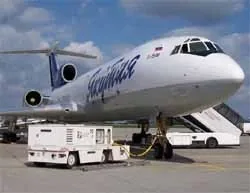
The International Air Transport Association (IATA), which includes about 250 of the world's largest airlines, published its annual report on flight safety. According to statistics, 2006 was the safest year in the last decade. Moreover, the rate of accidents leading to total loss of an aircraft is steadily declining. In 2006, this rate was 0.65 incidents per million departures – that is, essentially one incident per 1.5 million flights and charters operated by jet aircraft (it should be noted that only foreign-made aircraft are considered). According to IATA, these figures confirmed that air transport remains the safest form of travel. However, this conclusion can be applied to Russian aviation only with a stretch.
In the IATA list, Russia and the CIS countries rank first in terms of accident rate. According to the association, the accident frequency rate here was 8.6 per million departures. Recall that last year, during scheduled passenger transportation in the CIS countries, twice as many people died as in the previous ten years. The number of aviation accidents and disasters increased by 1.3 times compared to 2005, and the number of fatalities increased by 4.6 times. In 2006, an A-320 of Armavia airline of the Republic of Armenia, an A-310 of S7 Airlines of Russia, and a Tu-154M of Pulkovo Aviation Enterprise crashed (the latter case, however, was not included in the report). More than 400 people died.
In terms of accident rate for Western-built aircraft, the CIS countries are almost twice as high as African countries. The accident frequency rate in the CIS is 4.31. Third on the IATA list are airlines of Latin America and the Caribbean (1.8), followed by Asia (0.67), North America (0.49), and Europe (0.32).
The association's report also lists factors contributing to accidents. Thus, 43% of all accidents are related to incorrect actions by flight crews in adverse weather conditions; 38% of incidents occurred partly due to difficulties in communication between pilots or between pilots and controllers, for example, due to language barriers; one of the main factors in 33% of accidents was the crew's lack of proper skills in working with equipment – that is, a training problem.
The association also highlights three other factors of concern. In particular, IATA experts consider the condition of runways at many airports around the world to be potentially dangerous. In 2006, several serious incidents occurred for this reason, including runway excursions and mistaken runway identification. Another danger, according to IATA experts, awaits aviation on the ground. Incidents involving aircraft during repairs, maintenance, and refueling cost airlines about $4 billion annually in equipment losses alone, and $11 billion including compensation for injured or deceased persons. Finally, the third area of work for IATA is improving the safety of cargo aviation.
Given that air traffic volume grows by 5-6% annually, IATA seeks to reduce the number of accidents. According to the association's plans, by 2008 the accident rate should be reduced to 0.49. 'Our goal will always be a zero crash rate,' stressed IATA Director General Giovanni Bisignani.
In 2005, 111 aviation accidents were recorded, in 2006 – 77, of which 46 involved jet aircraft and 31 turboprops.