
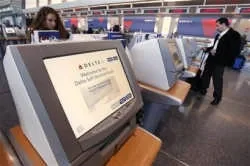
Self-service check-in kiosks are a maximally simplified procedure for identifying air passengers
Easy and quick
These kiosks, which resemble ATMs in appearance, are hard to miss. They are located in departure halls, near customs control or passenger check-in areas. Today, self-service check-in kiosks are installed in airport terminals in the USA (Washington, Los Angeles, Chicago), Canada (Vancouver, Toronto), Europe (Amsterdam, Vienna, London, Rome, Geneva, many cities in Germany), the Middle East (Dubai, Tehran, Kuwait), and Asia (Delhi, Beijing, Seoul, Tokyo). At McCarran Airport in Las Vegas, for example, more than 80 such machines are installed, and at the new Terminal 5 of London Heathrow – 96. Approximately 39% of passengers in North America prefer to check in independently, 25% in Europe, 18% in the Asia-Pacific region, and 7% in the Middle East and Africa. In Russia, this figure exceeds 20%.
Let's say right away: only holders of electronic tickets (e-ticket) can use the kiosks. Following the instructions of a user-friendly interface, you simply select the desired language, then proceed to personal data identification. Any credit card or a card from a frequent flyer bonus program (e.g., Aeroflot Bonus from Aeroflot, Miles & More from German Lufthansa, or Executive Club from British Airways) is inserted into the machine. Then, in the corresponding fields on the screen, you enter your last name, first name, ticket number, and booking code, and then you just choose the most convenient seat on the aircraft cabin map, receive check-in confirmation, and print your boarding pass.
If a person only has hand luggage, the check-in procedure, which takes about 1.5–2 minutes, is considered complete, and they can proceed to the customs control area. A passenger with suitcases, after receiving a boarding pass, goes to the fast bag drop counters (Fast Bag Drop), the numbers of which are displayed on the kiosk screens. In German airports (Frankfurt am Main, Munich, Hamburg, Düsseldorf, and Berlin-Tegel), it is even simpler: some kiosks are equipped with built-in conveyors, and after check-in, they issue a baggage tag. You attach it yourself to the suitcase and send it to the cargo compartment.
Additional benefits
Self-Service Kiosk Check-in is a benefit for the passenger. It is best to start self-check-in 24 hours in advance, but no later than one hour before departure. Then there is still a chance to make corrections to the check-in information if necessary (for example, change a seat in the cabin).
You can perform through check-in, receiving boarding passes for the first and all connecting flights simultaneously, and collect your luggage only at the final destination. If you plan to return within 24 hours and have only hand luggage, you can immediately check in for the return flight as well.
With automated check-in at airports in Hong Kong, Munich, Frankfurt, Hamburg, and Düsseldorf, you can use not only bonus or credit cards for self-identification, but also an ID card or passport. The machine scans the document, and then you enter the flight or booking number. This is very convenient for passengers traveling to the USA, Canada, China, and Korea, since personal data of arriving passengers is required for entry into these countries.
And what about Russia?
The first Russian self-service check-in kiosk appeared at Moscow's Domodedovo Airport in 2003 thanks to the efforts of British carrier British Airways. Currently, the airport has machines from British Airways, German Lufthansa, and the airline Transaero. The latter has equipped Novosibirsk's Tolmachevo Airport with five kiosks, and plans include launching accelerated check-in machines in St. Petersburg, Yekaterinburg, Khabarovsk, Vladivostok, Astana, Kyiv, Berlin, and Frankfurt am Main. As for Domodedovo, by the end of this year, the airport plans to install 12 self-service check-in kiosks. In two terminals of Sheremetyevo Airport, self-check-in has been operating since 2006, with kiosks from Aeroflot. In the coming months, self-service check-in kiosks will also appear at Moscow's Vnukovo Airport.
A bit of history and economics
The technology of common use self-service kiosks (CUSS) was born in 1998 thanks to the efforts of several airlines that are members of the International Air Transport Association – British Airways, Lufthansa, SAS, and Swissair. Since 2005, accelerated service machines began to appear en masse at airports around the world.
Currently, more than half of all airlines have already switched (some completely) to electronic tickets and are actively implementing CUSS technology. British Airways has equipped London Heathrow and Gatwick airports with kiosks. In Germany, all airports are equipped with self-service check-in kiosks. Passengers in Frankfurt, Munich, Berlin (Tegel Airport), Düsseldorf, Hanover, Hamburg, and Bremen on Lufthansa flights use quick boarding machines, where you can both check in and check baggage on your own.
The results of implementing CUSS technology are impressive. For example, British airline Virgin Atlantic, having installed 220 self-service check-in kiosks in 39 airports, increased passenger traffic to 675,000 people per month, and this is not the limit. It is expected that within a year, about 80% of all passengers will check in either via the Internet or using CUSS at airports.
Self-service check-in kiosks are a maximally simplified identification procedure (it is enough to have any credit or bonus card), saving time (only 1.5-2 minutes), the ability to independently choose a seat on the plane, make changes to registration information, get boarding passes for connecting flights and quickly check in luggage. Currently, kiosks are being opened not only at airports, but also in large hotels (for example, at hotels of the international chain Hilton), and in the future they will even be equipped in shopping centers.
Маргарита ЛИТОВКИНА.
«Новые Известия»