
Looking ahead, I'll say that all of this is, of course, true – this is exactly how Tunisia appears to the average domestic tourist. On the charter airline's plane, we were greeted by swollen faces of passengers with nothing to lose, and at the resort in Monastir, we were smileingly checked into a beautiful room at the 5* Amir Palace hotel with a panoramic view of the airport and the same smells and sounds. That one night we spent there, we both dreamed that silver jetliners were flying into our room through the balcony and taking off from there as well.
But never lose hope! At that very Monastir airport, we were met by a pre-rented Nissan Patrol, although produced at the dawn of the automobile industry, but still moving faster than a donkey (of which there are a majority on Tunisian roads). The very next morning, having loaded the car with the essentials, we headed south, into the Sahara Desert.
As a result, Tunisia became one of the most interesting and colorful trips of my life. It turned out that the Sahara is a unique culture, unique nature, and a mass of sensations that a person can only experience in a real desert – bright, silent, and endless.
And the people here are also different. In Tunisian cities, ordinary Arabs, primitive creatures, each of whom trades in something. They start any bargain at $50 and come down to $2-3 within ten minutes, but during those ten minutes you will feel years of fatigue. With such Arabs, the conversation is short:
- Hey, buddy, how much should I give you to part with this dagger in a snake-skin sheath?
- 50 dollars.
- Listen, brother, I know the prices and I speak French better than you. Let's not waste time.
- Okay, - he then replies, - 10 dollars.
You buy it for $5 and leave, leaving him in tears. In the neighboring shack, a couple of delighted tourists from some Tolyatti buy the same thing for a hundred.
I also can't help but tell a story about how Arabs trade lamb in roadside cafes. At the entrance, above the tables, hang two or three fresh lamb carcasses, terrifying even those who are indifferent to the animal world and the green movement. From the table, a sheep's head looks at you, and its expression is meaningful. When I, recovering from this sight, inquired about the menu, the Arab looked at me appraisingly and asked like this:
- A kilogram, two kilos?
- No, I want to have lunch, - I answered peacefully. - Well, eat something.
He leaves and returns with a man who thinks he knows French.
- Bonjour.
- Hello, can I eat here?
- You can. A kilogram or two? Try taking one and a half kilograms.
- One and a half kilograms of WHAT?
- Lamb.
I don't know. I have no idea how many kilograms of lamb I need. I take a piece of meat and eat it, I have never in my life thought about how many kilograms it is. In all restaurants from Reykjavik to Yogyakarta, they gave me a dish and named its price, and I ate it with more or less pleasure. But here I left – hungry and angry, and the sheep's head saw me off with a sympathetic look.
And in southern Tunisia, there are few Arabs; this is the homeland of the Berber peoples, one of which – the Tuareg – has made the Sahara their domain. That's where we headed – into the world of Berbers and Tuaregs.
A few practical tips along the way. First, spit on anyone who claims that you need a tourist voucher for Tunisia. An independent traveler does not need one. The entry stamp is placed at the airport without a sound, and no voucher or hotel reservation, which we were warned about at the Tunisian embassy, is required. Second: if you do rent a car, it should be an SUV. Yes, digging it out from under a dune is significantly more difficult, but the chances that it won't get stuck are much higher. After all, you don't drive on roads in the desert, do you?
Because in the Sahara there are no roads, but so-called pistes, trails that are more or less cleared of stones and serve as communication routes between oases. Like animal trails in a wild forest, pistes often bifurcate, narrow, and gradually dissolve into the desert, and without a compass there is nothing to do. Moreover, a sand dune of impressive size, brought by a recent storm, can suddenly appear in the middle of the road, and if it seems by eye that the car can overcome it, in reality it can turn out quite differently. Man is powerless against such an amount of sand.
That's exactly how we searched for Ksar Tarcine in the Sahara, the southernmost fort once founded by the Romans in these parts. At that time, for a Roman legionary, a business trip to Ksar Tarcine meant roughly the same as for us – a transfer to work in the town of Kovdor in Murmansk Oblast, with the only difference that people live in Kovdor, but in Ksar Tarcine there is no one. And if in the Roman era the local river Etaabin was still functioning, now only a dry rocky riverbed remains – in Arabic, a wadi. It was along this wadi that we had to get to the ruins – and only because my wife's keen eye spotted a rise in the distance, otherwise we might still be wandering around the Sahara to this day.
This wretched wadi will be remembered for a lifetime. Until this moment, I had practiced extreme driving only during rush hour on the Garden Ring, and I am unfamiliar with the experience of a sports professional. But at some point I felt that ahead of me were chaotic boulders of stones, behind me the same, on the sides dunes of fresh, loose sand, and it was too late to turn around. In those minutes, desperately spinning the wheel and jumping from stone to stone, I thought about which direction to walk the nearest 10 km for help, where to get 2 liters of water that a person should drink per hour while in the desert, and most importantly – did we have a jack in this crazy Tunisian car...
- Do you think there is a jack in this car? - asked Lyudmila at that moment, and I distinctly felt envy for bachelors.
When, contrary to all expectations, we finally reached the foot of Ksar Tarsin, we unexpectedly found people there. Three or four Italian travelers in an SUV had comfortably settled in the shadow of ancient Roman fortifications, set up a camping table, and were cutting a cucumber. They were seasoned people, and judging by their cheerful mood, their car had a jack, a reliable one that had been tested many times.
"Do you want to eat?" one of them asked phlegmatically, seeing the crazy expressions on our faces.
"No," I answered firmly, "we need to get out of here..."
The Italians politely unfolded a map and showed us the utter uselessness of the Lonely Planet guidebook that had led us to Ksar Tarsin to our doom. On the way back, however, we had to turn around several more times because most of the tracks were covered with sand.
There's only one alternative here: the dromedary, the one-humped native of these parts. Once, hundreds of these animals traveled from Ghadames to Timbuktu, and hundreds returned, crossing the desert with loads of ivory and foul-smelling spices, while shackled black slaves trudged alongside, descendants of whom can still occasionally be found on the streets of towns in southern Tunisia.
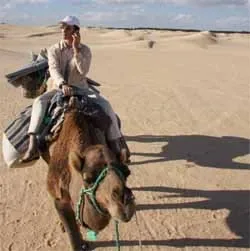
The journey to the gates of Timbuktu on a camel takes 52 days, and it's amazing how they endured that long — I mean the people, not the camels. I, for one, after two hours of riding this monster, felt as if I wasn't riding it, but it was riding me, along with all the baggage.
Besides, you can't reason with a camel at all. If the rope isn't tied to its nostril, it can turn toward the opposite end of the Sahara, look for (and find) edible thorns along the way, bother other camels, and generally behave insolently. We constantly had to appeal to Said, a Bedouin from Douz, who, to his own misfortune, volunteered to guide us into the desert for an overnight stay. This man turned out to be simply irreplaceable. The desert is his home. He managed to get brushwood for a fire, on which couscous and machouia — grilled lamb — were prepared for us. In everyday life, I'm more than indifferent to lamb and can't stand couscous, but that evening, I thought I had never eaten anything tastier.
Over a glass of cloying mint tea, whose aroma alone could knock you off your feet, Said sat comfortably and launched into a dreary Bedouin song. There was not a sound around. The camels, hearing the tune, wisely disappeared somewhere, so we had to search for them for half the morning. Pitch darkness, millions of stars at arm's length, soft sand, and a silent fire. I looked at my wife Lyudmila and realized she was thinking the same thing. Life has hardened us, made us wear business suits and taught us to determine the amount of dollars in a stack at a glance. We live in a consumer world of sex and money, and we think that everyone else in the world lives the same way. But no: Said doesn't care at all about the consumer world. He sings his songs, which completely kill the desire to live, drinks mint tea, and who knows what he thinks about.
To dispel the suicidal melancholy a bit, we burst into several spirited Russian folk songs, but either our choice was unfortunate, or (more likely) we sang them somehow wrong, but Said's face showed no emotion at all except slight bewilderment. He speaks French fairly well, but he navigates the intricacies of desert existence much better. For instance, he masterfully washes dishes with sand (and the Tuareg wash their hair with it too), he can make a camel kneel with a guttural sound, and he sleeps on the cold sand without covering himself.
Said also taught me how to catch a jerboa — an essential skill for life in the Sahara. The jerboa digs a hole in the sand and lives in it, but pouring water into it from a hose, as we all did as children, is pointless — it won't affect it at all. No, the Bedouin does it differently. He sticks his arm into the hole up to the elbow and "walks" along it, breaking the surface about a meter. The jerboa can't stand that, jumps out of the sand about two meters from its hole, and dashes away, and if you know the exact spot where it will jump out, catching it is easy as pie. But only the jerboa and the Bedouin know that spot — you and I do not.
Generally, the animal life of the desert is quite diverse. In the morning, when we rubbed our eyes and freed each other from our sleeping bags, we found that there were a great many tracks trampled around the tent.
"What lives here?" I asked Said.
"Jackals," he answered, spitting, "hyenas. Barbary sand mouse. Desert fox."
Indeed... If we trust the language of tracks, whole packs of jackals roamed around our tent during the night, hyenas and desert foxes wandered in families, and hordes of Barbary mice, as a further inspection revealed, were not shy about looking inside either. But everyone survived.
In their time, Arab nomads came to these lands, and the Berbers — the locals — were forced to leave the coastal areas and retreat into the desert. Thus appeared their unique settlements in southern Tunisia: the underground city of Matmata and the ksars of the Tataouine region.
An underground house is a curious and very logical structure. First, you need to dig a huge pit, the entrance to which goes sideways through an underground tunnel. The bottom of the pit is a 5 by 5 meter platform, and niches are made in the walls, serving as rooms, storerooms, and a kitchen. You can dig as many of these niches as you want and to any depth; there are even two-story underground houses. In the city of Matmata, several underground hotels operate, and one of them was used for filming the movie "Star Wars"; the sets still hang there for the amusement of the few tourists. Many underground houses stand abandoned, but most continue to be used, and small gardens are even grown at the bottom of the pits around the obligatory well. They say that in summer it is quite cool there and much more comfortable than in ordinary Arab huts. Many houses are even equipped with electricity. And above the entrance, a blue hand is always painted and a fish tail hangs - to ward off the evil eye. The same giant tuna tails are sold in abundance at local markets.
Even more colorful are the ksars - fortified multi-story villages on high hills in the vicinity of Tataouine. They were also built for defense, surrounded by monumental walls, and due to lack of space, they look like giant anthills consisting of small clay chambers. Today, few people live in the ksars, but the residents store grain, hay, and all sorts of things that we usually dump on the balcony, struggling with the inevitability of their destruction. Some ksars are locked, and we once raised the whole village, trying to get a key.
This is how it happens. You approach a walled ksar and pull the door. Locked. But in the immediate vicinity there will definitely be a person who has nothing to do that day except stand and watch your actions. You head toward him and in a convincing tone in French ask him to immediately get the key, otherwise something terrible will happen.
Even if he understands you, he won't budge. Instead, taking a deep breath, he starts shouting towards the other end of the village, where another such person is standing. Several residents respond to the shouts, and gradually a small gathering forms. The conversation takes place simultaneously among all participants - except you, since your Berber is still weak. Drivers and passengers of passing pickups and minibuses also join the conversation without stopping. Gradually, it becomes clear that the great hopes of those present rest precisely on that person in the distance, who all this time hasn't taken a single step forward.
- Now he'll go and check if there's a key, - they explain to you.
Five minutes pass. The people around are happy to have a chance to chat with each other and discuss the ridiculous outfits of white people. After this, you show the impatience typical of Europeans:
- Well, how? - you say, - five minutes have passed, and that person still stands in the same spot. Will he go for the key AT ALL?
- He'll go, he'll go, - they perk up and start shouting again, - Well, are you going for the key?!
You vaguely see that the person at the other end of the village suddenly stirs and starts running along a trajectory explainable only to him. After another 15 minutes, it turns out that the key to the ksar exists, but right now it's not there, because its owner went to the city and took the key with him. They offer you to wait for his return, after which you say goodbye to the hospitable residents and move on - in another village you will surely have better luck.
20-30 kilometers from Tataouine, what is essentially the real Middle Ages begins. Go to the village of Ezzahra yourself, and you'll see. There are more donkeys than cars, people wear national costumes, groups of colorful old Tuaregs or old women in bright red outfits with tattooed faces sit by the roadside. They understand Arabic, but their native language is Berber Tashelhit. These folks don't like having their photos taken, so you have to take pictures either for money or with a poorly hidden camera. A huge four-story ksar towers over the village, and you can climb to the upper floors using stones embedded directly into the outer walls. By retirement age, a Berber probably started dreaming of the first floor or stayed home forever, because there are no stairs here except for stones in the walls.
In abandoned ksars - and sometimes these are entire cities with hundreds of houses stretching along hillsides - millstones driven by donkeys and camels are still preserved, and the soot on the rock ceilings still retains the aroma of meals. In the largest of these cities, Chenini, in cave houses, the ceilings and walls are decorated with pre-Islamic style paintings: circles, dots, Tifinagh script inscriptions, images of hands and feet, and often a cross - a popular symbol among the Tuaregs, which somehow came to them from Christians who once lived here. Here, in Chenini, besides rare scorpions and even rarer tourists, there is no one, and the ancient Berber art is protected neither by the vaunted UNESCO nor by the Tunisian authorities. Sometimes, however, I think that's for the best.
Near Chenini, there is a beautiful, albeit somewhat crooked, mosque of the "Seven Sleepers" (Sept Dormeurs), where these seven are buried. According to legend, they fell asleep in the era of the early Christians and slept in this place for several centuries. All this time, their bodies grew, reaching 5 meters. Then they woke up - only to find themselves in a world of Muslims, become surprised, and die. True, the legend specifies that they also managed to convert to Islam just in case.
On the way back from the Sahara to Monastir, we decided to wash off the sand and stopped to spend a couple of days in a quality hotel on the island of Djerba. By this time, sand was everywhere. It generously poured out from the depths of the camera and crunched pleasantly between the teeth, got into the mouth with any food and served as the main element of any liquid consumed. Pockets and shoes were extremely rich in sand, although we spent only one night in the desert, and the rest of the time we washed up in more or less decent hotels.
Tourists on Djerba lead a vegetative lifestyle, despite the fact that the island is also rich in history. The Ibadis, representatives of a moderate sect of Islam, who were driven out of the continent by their more radical brethren, live here. The military-field lifestyle is felt in everything. Most of the island's population still lives in menzels - fortified farmsteads that flicker among the date groves and fields of the island. In the south, a unique underground mosque has been preserved, built for secret prayers by the Ibadis, and if not for the keen eye of my wife, we would not have found it. But there are also about a hundred ordinary, above-ground mosques on Djerba, and there is even one synagogue where 60 families of Jews, who have lived here since time immemorial, pray to their god. Perhaps the synagogue is the only place where tourists are taken, because in the absence of public transport, a private car or taxi is the only way to see all the uniqueness of the local civilization.
Within Tunisia, we counted at least five such civilizations, and each deserves not just a short essay but a large study. About the people, monuments, customs, and languages of these places. About the traditions, history, and mysteries of the distant past. About the wildlife, underground lakes, and red rains of the Sahara Desert. About everything that a caring person can see in Tunisia.
No, after all, only by visiting 60 countries do you begin to realize that you have still not seen the world...
Kirill BABAEV.
babaev.net