
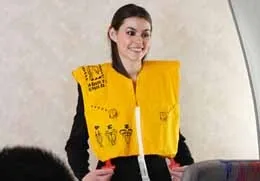
The flight attendant's task is to convince passengers of their professionalism, to clearly and plainly demonstrate what to do in an emergency situation
Now, let's be honest: what do you do, for example, when flight attendants show how to put on life jackets? Personally, I have only once seen a lively interest on a passenger's face. It happened in India on a domestic flight. A fellow passenger, an Indian (apparently an engineer by profession), watched the demonstration attentively, studied the instructions, checked that the jacket was in place, and only then nodded with satisfaction. I realized: if something happens, I need to do as he does, and then I'll be saved.
Aviation safety experts say that most passengers need additional motivation to pay attention to the safety demonstration. Modern people are accustomed to dynamic television images and quickly click through news on the Internet, so they poorly perceive written instructions. The traditional appearances of flight attendants in life jackets have become too familiar. That is why people get confused in emergency situations.
The UK Air Accidents Investigation Branch (AAIB), for example, found that once the cause of panic among Airbus A320 passengers during cabin depressurization was a simple mistake: people pulled the dropped masks too sharply and tore them away from the oxygen supply source. At the same time, passengers are now frightened: news of plane crashes stresses a person who has settled into an airplane seat. And they increasingly do not believe that the proverbial jacket with a whistle can save them.
To attract travelers' attention and instill useful information in their minds, airlines have recently had to work more creatively. Western carriers produce cartoons and clips featuring famous personalities, devise funny texts. And flight attendants are turning into actors: they rap, dress up as clowns, and sometimes even strip (such a show is offered in New Zealand).
According to psychologists, information should engage, amuse, and perhaps even shock. As a result, on one airline, the captain announces: "Hello, before me I see beautiful flashing lights, many switches, and funny buttons. This is my first time sitting behind the instrument panel of a jet… The first time today. Actually, I've been flying jets for 20 years. Now that I have your attention, please pay the same attention to the safety equipment demonstration."
On Western airlines, such announcements are no longer rare. "We have no verified data on passenger attentiveness, but from our point of view, a humorous approach to this topic is fully justified," says Elena Sayers, Marketing and Communications Manager at Austrian Airlines.
What about Russia? Our stewardesses have not yet been seen topless, and aircraft commanders are absolutely serious. There are two reasons: first, Russian airlines are only mastering new methods; second, not everyone believes that jokes and safety issues can be mixed.
One of the first domestic carriers to allow humor on board was Sky Express. "And now, finally, the time has come for what many people take airplanes instead of trains – the demonstration of the aircraft's safety equipment," say the flight attendants of this company.
"A common reaction of an experienced passenger to the safety demonstration is to bury their head in a newspaper and ignore what is happening. However, there is mandatory information that we must convey to clients – about safety measures, smoking bans, so we went for unconventional solutions," says Sky Express Service Director Elena Semenova. "Once, I asked a person not related to aviation to recount the safety measures in their own words and was amazed at how their account differed from the standard texts. We started creating our own and immediately noticed a reaction. People put aside their crosswords hoping to see something unusual."
Psychologists generally view such innovations positively. "Before a flight, a person falls into a light trance, and some experience serious stress. In such a state, it is impossible to absorb information; the ability to learn is reduced," explains Alla Kechedzhan, vice-chair of the Mutual Aid Movement and one of the developers of aerophobia training. "But humor helps relieve tension and relax."
Many passengers note that the cartoons shown on monitors on Western airlines are well remembered: first, the characters are cute and constantly flash before the eyes, and second, they skillfully emphasize important points – how to take out the vest, what pose to assume, etc. The amusing is imprinted in memory.
Jokes aside, flight attendants face the delicate task of not offending passengers while conveying important information. For example, there is a headache for all airlines – theft of life jackets. Meanwhile, a seat without a vest underneath no longer meets safety rules; that seat is blocked for sale and cannot be occupied.
According to Elena Semenova, after much deliberation, the company came up with this text for flights to southern destinations: "Dear passengers! We must warn you that swimming in life jackets taken from the airplane is bad luck! But if you don't believe in omens and still decide to take the jacket, be prepared to pay its cost (€200 at the exchange rate in rubles on the day of theft) to the security staff who will meet you at the exit of the plane! We hope that nothing will spoil your impression of the flight, because serving such passengers was not only an honor but also a pleasure!" Such announcements have been played on the company's aircraft for about a month, and thefts have decreased significantly.
Of course, non-standard approaches to on-board announcements are perceived ambiguously. After all, you cannot rely on all passengers having the same sense of humor. Moreover, frequent travelers on the same route quickly tire of repetitive jokes, and some are simply in the mood to think about serious matters during the flight, rather than feeling as if they have been kidnapped by a gang of cartoon characters.
“I have a negative attitude toward on-board shows,” says Indiana Talypova, deputy head of the flight standards and professional development department of the Aeroflot on-board service complex. “Our goal is to create an atmosphere of safety and comfort for customers. To show that no situation can take the crew by surprise. And when beautiful, stately flight attendants come into the cabin, they already attract attention; their job is to convince passengers of their professionalism, to clearly and clearly demonstrate what to do in an extreme situation.”
When going on a flight, of course, no one is one hundred percent insured against the occurrence of that very extreme situation. It is only in such cases that you can check how well the material presented by the flight attendants has been absorbed. My acquaintances, for example, were on a plane that, after landing and the passengers’ applause, suddenly caught fire. They still have their melted suitcase, and they remember with gratitude the flight attendant who led them clearly, helped them down the inflatable slide, and did not let them panic.
Of course, the image of a kind of spider-man saving people while simultaneously telling jokes is least suitable for flight attendants. And in general, some experts believe that flight safety is not a topic where there is room for jokes. But what can you do if the safety instructions placed in the seat pocket are rarely looked at by anyone?