
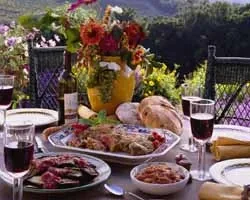
Russian Abundance
The concept of the "Russian appetizer table" has firmly established itself in all European cuisines, up to haute cuisine. This style was adapted by French chefs of the 19th century, who first cooked for Russian nobles (and even tsars!) and then brought the secrets of Russian hospitality to their native soil. Before their innovations, each dish of a classic dinner was served separately, in courses — and light "entremets" as well.
The Russian tradition, which all the great chefs of the last two centuries, from Carême to Bocuse, have paid tribute to, involved serving cold appetizers simultaneously on the table. And everyone helps themselves! Moreover, in Russian "haute cuisine" this tradition dates back almost to the 15th century. At least, it is known that the "travel" provisions for envoys of the Grand Prince of Moscow setting out on long journeys included sauerkraut, salted cucumbers, salted mushrooms (mainly "slimy" saffron milk caps — truly, kings among pickles!) and pickled apples. Plus dried raspberries and dried blueberries, strawberry fruit leather and gingerbread. The latter, of course, are in no way related to the appetizer table, just like pickled lingonberries, which became more of an additional garnish for game than an independent product. Be that as it may, it was precisely all sorts of pickles — plus caviar (both black and red), lightly salted fish, smoked meats and all kinds of pies, the main ones of which, of course, are "rasstegai" — that created the fame of the Russian appetizer table. An ideal combination for vodka, something foreigners do not understand, who still try to find an adequate wine accompaniment for "our everything." For example, the very good, world-famous London chef Peter Goldwin recommends serving New Zealand Sauvignon Blanc with "pancakes with dill, smoked salmon, chum salmon caviar and crème fraîche" (crème fraîche is something like our sour cream, only worse). No, gentlemen, vodka — and only vodka!
Their Customs
However, the proud Brits now have their own appetizer table. True, it is served not with vodka or even wine, but with the famous "five o'clock," the classic afternoon tea. The standard has been refined over centuries — the tradition of an intermediate tea between lunch and dinner was introduced by Anna VII, Duchess of Bedford, in 1840.
The classic set of dishes for "five o'clock" was polished over decades. In the golden times of Queen Victoria's reign, it consisted of buttered toast, hard-boiled eggs, cinnamon toast, barley cakes, biscuits, cakes, crumpets, and butter buns — with clotted cream and berry (redcurrant, gooseberry, cranberry) jelly. Now the classics are small triangular sandwiches with cucumber (a must!), ham and cheese on a bed of lettuce leaves, smoked salmon, scones, crumpets, various jams and inevitably sweet whipped cream for the last two items. Plus champagne. As a result, in one round of "five o'clock" you can load up as much as if you were experimenting with the Russian version.
Let's leave aside the French with their snobbish hors-d'oeuvre. Who cares about tiny but very expensive canapés with foie gras or quail eggs baked with truffles? Let's reject the Germans with their sausage platters à la "Bayerische Platte." Who brought appetizers to absolute perfection — that's the Spanish, just look at their salad recipes with photos. Their "tapas" tradition seems to me absolute perfection.
Originally, "tapa" was the name for a plug for a wine jug made of dough: in olden times, travelers weary from a long journey and scorching sun would refresh themselves with a sip of wine and immediately snack on it, breaking off pieces of this peculiar "cork." Later, "tapas," in the plural, came to refer to all appetizers in general, and now it is even more than just food — rather, a lifestyle.
A "tapa" can be anything — a crouton with a small spicy chorizo sausage, a small heap of salad, a few olives, a few slices of ham, a couple of cuttlefish on a skewer, fried shrimp, squid rings in batter, small fish, a piece of tortilla — even trivial cheese sandwiches! Here, the composition is less important than the quantity, and it must be small. However, in any tapas bar you can order a "ración" — a portion of the same set but roughly doubled in size. But then the fun is lost.
And for a Spaniard, the point is to spend the evening, after finishing work, moving from one tapas bar to another, drinking a small glass of wine or beer ("small," if not "tiny": a 125-gram glass of light beer amazed me to the depths of my soul in a Madrid tapas bar), snacking on the most appealing "tapas" (that's where variety is important!), chatting with acquaintances and — moving on. The number of tapas bars on the way home can vary from two to seven, but no dinner is required after them — nor any additional evening stroll.
Oriental Tale
Characteristically, both the Russian and Spanish appetizer tables come from the same root. And that root is clearly of Eastern origin. That is, in the beginning there were meze, and then they multiplied and spread around the world.
What is meze? A selection of small — literally one bite — appetizers served before the main course throughout the Eastern Mediterranean. The origin of the word itself is mysterious, but the most convincing version to me personally is that it derives from the Persian "maza," meaning "taste," "flavor."
Incidentally, for Muslim gastronomic culture, it is not typical that appetizers are designed to stimulate appetite: food is given to a person to be satiated, nothing more. But, on the other hand, the Prophet Muhammad taught - without resorting to exact quotes from the Koran - that small portions of food allow you to satisfy hunger without leading to gluttony. And therefore, even now in the countries of the Arab world, meze can quite replace a full meal: although the portions are small, there are many dishes themselves. For example, your humble servant, on a tour of the Emirates, after a meze table, didn't want anything else: no couscous, no roasted lamb - just let me lie down somewhere.
Even a simple listing of dishes of this kind would take too much space, especially since they vary from one country to another. For example, in Turkey, it cannot do without dolma and its relative sarma, small stuffed cabbage rolls in grape or cabbage leaves. In Syria and Lebanon - without hummus, a thick mixture of ground chickpeas, sesame paste, lemon juice, and various spices. In Greece, they will certainly serve as meze small grilled octopuses, and in Bulgaria - some hard smoked meat products, like sucuk cut into thin petals.
What will definitely be presented at any meze table is freshly baked flatbreads from unleavened dough (no matter what they are called, lavash or pita), olives, and pickled vegetables - cucumbers, peppers, okra, garlic. As a rule, simply monstrously spicy.
Chinese Syndrome
In the Far East, there are their own traditions. On the one hand, almost any meal in Chinese style, when many small bowls with all sorts of things are served simultaneously on the table, can be called an appetizer table. On the other hand, the chefs of the Celestial Empire have a special term for a table with appetizers, different from the large formal dinner table. This term is dim sum.
From the Cantonese dialect, 'dim sum' is literally translated as 'touch the heart', but it specifically means 'small food', 'snack'.
The set of dim sum dishes can be very diverse - here you have vegetables, meat, and all kinds of seafood. The main thing is that all five tastes are organically combined, and the dishes themselves are small, one-bite. Classics are baozi buns, jiaozi dumplings, and mantou steamed buns. All this splendor is served on the table in the same bamboo steamer in which it was steamed, piping hot, accompanied by vegetables steamed in the same bamboo container. And the range of possible fillings for dumplings and buns simply amazes the imagination of a white man!
Of course, Japanese sushi with sashimi can also be classified as appetizers. Especially since the tradition of serving them quite coincides with our topic.
P.S. And in the author's opinion, there is no better appetizer than Parma ham with melon... It's very simple: the main thing is to take authentic products. So, you've splurged on a piece of Italian prosciutto and a bright orange cantaloupe. Then you peel the melon, cut it into small slices, and place on each slice a very thin slice of prosciutto. Sprinkle a little balsamic vinegar, lightly dust with freshly ground white pepper - and eat with undisguised pleasure with a good red wine. In Italian, this appetizer is called 'prosciutto con melone'.