
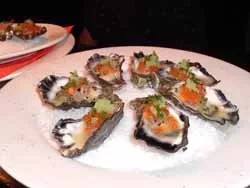
«Я попросил официанта принести дюжину португальских устриц и полграфина сухого белого вина. Я ел устрицы, сильно отдававшие морем, холодное белое вино смывало легкий металлический привкус, и тогда оставался только вкус моря и ощущение сочной массы во рту; и глотал холодный сок из каждой раковины, запивая его терпким вином, и у меня исчезло это ощущение опустошенности, и я почувствовал себя счастливым и начал строить планы».
Ernest Hemingway,
"A Moveable Feast".
Where did the "growling" rule come from? It's quite simple: oysters, like any other seafood, tend to spoil quickly, and therefore the hot summer months are not the best time for them. Nowadays, with the development of various refrigeration technologies, it has become possible to keep shellfish alive for a long time. In earlier times, cases of poisoning from stale shellfish were so frequent that in some parts of Europe, and even in certain regions of the recognized gastronomic leader - France - oysters were "outlawed" in summer.
But it's not just about poisoning. In summer, oysters reproduce - consequently, all the juices and strength of their organisms go into creating new baby oysters. Gourmets - even if they are not concerned with the moral and ethical issues of eating future fathers and mothers - have to be content with the lean meat of mollusks exhausted by reproduction. And in autumn, winter, and early spring, oysters are incredibly fat and tasty.
All this - both the problems with maintaining product quality and the loss of taste - was first noted by the Englishman William Butler. In 1599, he published a booklet "Dietetic 'Dry' Dinner", in which he postulated: oysters should not be eaten in months whose name does not contain the letter "r". And so it went...
Rules for Oyster Eaters
And so for four centuries, gourmets, regardless of any changes in technology, eat oysters only in autumn, winter and early spring. Moreover, they eat them according to a special, age-old method. Namely: by the dozen (standard serving unit), with minimal accompaniment. Everything has been tested many times over: the best wine accompaniment is Chablis or dry champagne; the oysters themselves need only lemon juice and, perhaps, a little freshly ground pepper. For a side dish - lightly grilled pieces of baguette and salted butter for them. Culinary nature-testers can try replacing lemon with a pepper sauce, such as "Tabasco". Or sprinkle the oyster with finely chopped shallots and add literally a drop of red wine vinegar. But it's better not to experiment too much, so as not to destroy the delicacy of the oyster flavor.
And so a traditional dozen (or two) of oysters lies before you in a deep dish on ice. From there it's simple: you take a shell, squeeze a little lemon juice onto the oyster's muscle, and - suck out the contents of the shell. A slight slurping sound is allowed even by the strictest etiquette! Opening the shells - only by yourself, using a special knife with a short, thick blade and, if possible, protecting your hand with a chainmail glove (Jack London likened this procedure to cracking a bank safe). However, such a glove is more the domain of amateurs: a gourmet seasoned in oyster matters won't cut themselves even without it...
As I wrote a little above, oysters will not squeak. But they will shrink a little from lemon juice - and if not, then again you have not the best quality product. Because oysters are eaten alive - yes, cruel, but oh so tasty!
Freedom on the Barricades... of Shells
Oysters as a symbol of freedom... There is definitely something in that. Just think, fifteen or twenty years ago the phrase: "Garçon, a dozen oysters on ice and a bottle of Chablis!" seemed like a daring challenge to the very foundations of a state of developed socialism. If only because oysters were nowhere to be found in our culinary repertoire at that time. Meanwhile, before the revolution, Crimean oyster beds were valued on par with those of Brittany, Ireland, and Portugal.
But I will not now go into the specifics and details of oyster typology. Let us leave the identification of subtle differences between "gravette" from Arcachon and "marennes" from Oléron to narrow professionals. What is important for you and me to know is that oysters come in only two types: fresh and stale. We indignantly refuse the latter, and eat the former with poorly concealed pleasure.
Moreover, we have been eating them for millennia: archaeologists know that coastal Paleolithic and Neolithic sites are marked by literally mountains of empty shells. Oysters - first and foremost. Because in ancient times, the delicacy shellfish were found literally throughout the inhabited Oikoumene - from the Baltic to the Red Sea. Oysters were revered in both Ancient Greece and Ancient Rome.
This kind of bacchanalia continued until the dawn of modern times. And then... The famous French gastronome Brillat-Savarin wrote at the end of the 18th century in his culinary masterpiece "The Physiology of Taste": "My God! Those oyster breakfasts, which were so frequent and cheerful, where oysters were eaten by the thousands, have completely or almost completely disappeared. Those times passed with the abbots and chevaliers, who never swallowed less than 12 dozen at a time!" The tasty shellfish were consumed, without the slightest exaggeration, by the ton – the sea could not replenish stocks fast enough.
But the real catastrophe happened in the last century. Items of European culinary pride were generally unlucky: if the vineyards were struck by the phylloxera epidemic, then in the 70s the delicious shellfish were almost completely wiped out by the "oyster plague". To restore the population, oyster spat even had to be imported from Japan (where they had also been caught and farmed since time immemorial) and the famous Atlantic beds were replanted.
Where are you from?
Thank God, the consequences of the «plague» were to some extent mitigated. But to this day, European restaurants more and more often serve deep Japanese giant oysters Crassostrea Gigas or flat Portuguese (Portuguese beds suffered the least from the scourge) and again Japanese Ostrea Edulis. In general, there are more than fifty species of edible oysters in the world.
But in this case we are talking about restaurants located far from the sea. Because in every self-respecting establishment, lucky to be near some named oyster «bank», in season, you will certainly be served the freshest local «specialties».
In Brittany - «prat-ar-coum» and famous «belons». On the English shores - «dorchester» and «colchester». In Ireland, recognized as the mollusk Mecca of Europe - simply «flat Irish». In Arcachon, another oyster capital of the Old World, you will be offered «marennes-oléron» and «gravettes». In Australia - «Sydney rock», in Japan - «kumamoto».
And yet, the best of the best are considered oysters from Irish Galway, Belgian Ostend, and only then from the coast of La Rochelle, from Arcachon. By the way, in all three places, special festivals are dedicated to mollusks.
Festivals and Fireworks
The main oyster festival takes place in Galway on the west coast of Ireland in September - early October. It has been held since 1954 and in recent years has been accompanied by a powerful jazz-rock concert. But Galway's main «attraction» is, of course, the oysters themselves. Unsurprisingly, the town's population multiplies tenfold during the festival! Ireland's closest neighbor and main rival, England, is not far behind. There, the main oyster festival will take place on the southwest coast, in Falmouth, from October 19 to 22.
Oyster opening competitions are also held in the New World - for example, in Florida, on Isle of Pines, it will take place on September 23: the organizers threaten to amaze all participants with a wonderful tasting menu. But overall, oyster «fests» in America, South Africa and Australia suffer from a disregard for seasonality: for some reason, most of them are scheduled for June–August.
Breach of Traditions
Oysters are, of course, not only consumed fresh and raw; there are countless ways to prepare them around the world. One can recall the signature English oyster soup, an indispensable dish at a classic Christmas meal. Canadians prepare their signature cocktail «Bloody Caesar», the northern answer to «Bloody Mary», based on oyster juice and ground shell powder.
And finally, one must not forget about «Rockefeller» oysters, invented either in New Orleans or San Francisco, and now wildly popular throughout America. These are shells thickly covered with a mixture of spinach or watercress, seasoned with cream sauce and breadcrumbs, and baked under the grill. Although the French version - «Bienville», where oysters are baked under béchamel sauce with mushrooms, shrimp, onions and garlic, sprinkled with sherry over all this splendor, is more interesting. But the best way to eat sea delicacies is «au naturel», with lemon and with Chablis. That's the right way! Just master the art of shucking shells...