
Southeast Asia
When next time before leaving you will be closing your armored doors in Kyiv, forget about home food. Because Vietnamese cuisine is considered one of the healthiest in the world, largely due to the fact that products are not subjected to prolonged heat treatment. But with all its advantages, some dishes smell very sharp. One of the most pungent can be called fish sauce "nuoc mam". Lovers of Asian cuisine know what we are talking about. The sauce is very tasty, but the smell is a test.
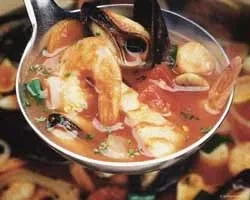
In general, in terms of the number of seafood dishes in the national cuisine, Vietnam can quite compete with Japan. Judge for yourself: fried rice with pieces of fish, crab meat soup "cua", seafood soup "lau", shrimp fried in sauce "mam tom", and many combined dishes in which seafood is mixed with ordinary meat.
The basis of Taiwanese cuisine is also fish and other seafood. For the first course, they prefer oyster or shark fin soups, and almost every home has its own recipe. Next comes eel cooked in pepper sauce, or boiled fish, fried shrimp with cashew nuts or small fish fried in peanut sauce, jellyfish salad or omelet with shellfish, etc. There are many cooking recipes. The fundamental difference lies, perhaps, in the spices that are added to a particular dish.
When it comes to cooking seafood, Indonesians show amazing ingenuity. Of course, in local restaurants you can order simply fried fish or boiled shrimp. But it is much more interesting to try fish baked in a banana leaf or shrimp fritters sprinkled with aromatic spices, or tuna puree proudly called "president". In Indonesia, mackerel is preferred smoked, sharks (more precisely, their fins) boiled, crabs baked, frog legs fried in batter. The fate of cuttlefish is to be boiled and served with cheese and herbs. Large sea turtles did not pass by (or rather, did not swim past) Indonesian chefs either. They make soup, roast, and stew from them. Stew with soy sauce is considered the most delicious.
In general, sauces are very respected here. Not a single dish is complete without sauces, often unusually spicy for a European. Most often, restaurants serve ginger, curry or soy sauce, and the most popular seasonings are cinnamon, nutmeg, cloves, various peppers, peanuts, and garlic.
Africa
From a culinary point of view, South Africa is capable of stunning the imagination of even the most sophisticated gourmet. Here the traditions of the East, European countries and, of course, the local population come together. Moreover, no matter what part of the world a recipe comes from, over time, distinct "African notes" begin to appear in its preparation.
Residents of South Africa take seafood from two oceans at once: the Atlantic and the Indian. So here you can try to figure out how mussels, lobsters, squid, oysters and various types of fish caught in different waters differ. In coastal areas, one of the main local dishes is considered Malay-style eel and the famous kingklip fish. Halibut is prepared very originally: it is smoked in the smoke of aromatic herbs, and seafood is also served as a pâté.
In the same Africa, Kenyans, for example, are proud of their ability to cook turtle soup. And not without reason, because it is really very tasty. The favorite of local chefs is octopus. Tourists are most often offered a stew from it.
Australia
The national Australian fish dish is barracuda, and trout is held in high esteem. It is, of course, consumed in various forms, but restaurants most often offer it baked in coals and herbs. This recipe is considered classic and traditional.
However, Australians cook not only trout and barracuda, but also barramundi fish, and salmonids from Tasmania, and many other species that are boiled, fried, dried, smoked, baked. Fish with chutney sauce is especially tasty here. It is made from apples, wine vinegar, ginger and cloves.
Shrimp, oysters, crabs, scallops, mussels and other seafood are not ignored. Australians have many ways of cooking them, but recently they more and more often prefer Asian recipes, which imply two extremes: the product is served either almost raw, or cooked in such a way that it is not immediately possible to understand what ingredients formed the basis of the dish.