
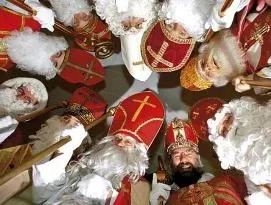
Around religious holidays, politicians play their 'games of tolerance'
Every year, attacks on Christmas in Europe and America increase. Former Western empires, feeling a guilt complex towards their former colonies, try to melt the 'newcomers' in this politically correct way. Migrants, however, stubbornly refuse to assimilate, trying to aggressively impose their own cultural traditions on the indigenous population of the Old and New Worlds.
UNCHRISTMAS
The precedent was set in 1998 in Birmingham, when Christmas was renamed Winterval. This case can be considered the beginning of the 'Christmas war'. A few years later, Fox News television journalist John Gibson described this phenomenon in his book The War on Christmas. In the UK, zealous bureaucrats tried to ban school plays on Christmas themes, serving turkey for lunch, decorating offices with Christmas tree branches... And each time, respectable reasons were found (meat is unhealthy, toys can maim, cutting down trees is bad). As a result, the holiday of hope and love for one's neighbor acquired a new attribute – a scandalous halo.
Thus, the authorities of American Denver decided to organize a 'Parade of Lights' instead of Christmas, which was supposed to show the national and cultural diversity of the city. Of the traditional holiday, only gingerbread cookies and Santa Claus remained, and added to them were... gay parades, belly dancing, and a ceremonial Chinese dance to expel evil spirits... However, the tolerant Christmas pleased no one: the event outraged not only Christians but also representatives of other faiths. The scandal was hushed up. This year, the authorities of the Scottish city of Dundee tried their luck and instead of 'banal Christmas' organized a 'Night of Winter Lights' with a fairy on stilts as the main character. But shortly before the celebration, the anti-Christmas concept had to be abandoned under pressure from outraged public opinion.
Konstantin Bendas, a member of the expert council under the State Duma Committee on Public Associations and Religious Organizations, believes that all attacks on Christmas in Europe are nothing but a triumph of anti-religious forces: 'Such a "castrated" Christmas, when the president is urged to say "I congratulate you on these winter holidays," looks wild. We must call things by their names. Basically, the rhetoric of the disputes around Christmas is the same: people who do not believe in the birth of the baby Christ may be offended. Excuse me, but consider the Santa Claus situation – after all, there comes an age when children are told that it was not St. Nicholas but their own dad with a cotton beard. And we do not perceive that as an insult to religious feelings...'
Meanwhile, people find it hard to believe that a holiday could be sacrificed for tolerance. And experts see a marketing ploy in the hype: 'I am inclined to think that in Dundee it was an attempt to attract tourists – like, we'll have a special holiday, not like everyone else's,' says Sergei Knyazev, general producer of an events and holidays agency. 'I am currently working in France, Denmark, Italy, Switzerland and I can say that these anti-Christmas actions are not widespread. I have organized holidays for representatives of various national diasporas many times, and the only thing they refused was Ded Moroz. But the Christmas tree was a must...'
But there is another opinion: the 'anti-Christmas conspiracy' is just beginning, and soon we will see the world give up the Christmas tree, nativity scene, and Christmas goose. To avoid sin... Evidence? Please: in 2006 at Seattle airport, on the eve of Christmas, a rabbi was outraged that there were Christmas trees in the building but no symbol of Hanukkah – the menorah. The administration decided to simply remove the trees. This started a guerrilla movement: employees of one company put up their own Christmas tree at their counter in protest, then another... Can people raised in the Christian cultural tradition defend Christmas themselves, or do they need someone to help them?
POLITICAL CORRECTION
The answer to this question apparently depends today on secular and religious authorities. If a clear position is required from the former, then from the latter... tolerance. In Russia, things are not so bad in this regard. 'I assure you that Christmas symbols do not offend our religious feelings in any way. We are as tolerant of the holidays of our Orthodox brothers as they are of ours, such as Hanukkah,' Zinovy Kogan, head of the Congress of Jewish Religious Organizations and Associations of Russia, told Itogi. 'As for New Year, which is a civil holiday in Russia, we consider it our holiday as well. We also feel warmly towards Orthodox Christmas – especially since these are common days off. Many Jewish children love to decorate the Christmas tree and dance around it...'
It is noteworthy that the heads of religious associations in Russia take a unified position on the issue of Christmas (like, we respect), and their flock does not protest publicly either. 'I think that such speculation on religious feelings and Christmas symbols is, to put it mildly, inappropriate,' says Abdul-Vahed Niyazov, president of the Islamic Cultural Center of Russia. 'You could go to the absurd and demand, for example, a ban on the fairy tale "The Three Little Pigs" on the grounds that Muslims do not eat pork...'
However, our situation differs from that in the West. There, Christian traditions were unshakable and inviolable for centuries. In Russia, they were uprooted for decades. The generation of forty-year-olds remembers how on Easter night, forbidden 'melodies and rhythms of foreign pop music' were broadcast on TV, and discos boomed in palaces of culture – just to distract young people from the thought of going to church. Now, however, we have swung to the other extreme: Easter broadcasts are live with the participation of top secular officials. But let us hope that the pendulum of change will sooner or later stop swinging and we will learn to render unto God the things that are God's, and unto Caesar the things that are Caesar's.
In short, in Russia it is much easier for the infant Jesus to celebrate his birthday than in the West, which has caught the virus of political correctness in a particularly acute form.
What is frightening is not even the 'conspiracy against Christmas' itself, but the fact that Western society is meekly surrendering the citadel of its indigenous values - bastion after bastion. The authorities of a united Europe simply have no coherent position on this matter. And that is not a figure of speech. Many modern trends arose from one-off actions, later becoming social norms. For example, at first the antics of the 'greens' also frightened few. And now environmental organizations have turned into a 'world government' capable of blocking the construction of the century or lobbying any bill.
The 'Christmas conspiracy' does not frighten Western bureaucracy. It never tires of calling on native Europeans to be tolerant. But if political correctness in this version prevails, it will only be a victory of an imported cultural tradition over the indigenous one. After all, tolerance is a two-way movement of cultures towards each other. When one has a green light and the other a red light, a universal 'traffic jam' is inevitable.
Vita MACH,
Anastasia REZNICHENKO.