
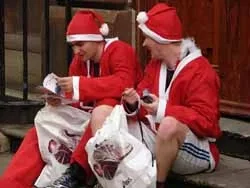
Stop. No Christmas trees, garlands, or other tinsel in the workplace. At least, in the UK. Three-quarters of British companies have banned decorating their offices for Christmas. According to a public opinion survey conducted by the law firm Peninsula among 2,300 respondents, 74% of employers believe that decorating offices for Christmas could offend people of other - non-Christian - faiths. And this, in turn, could lead to a wave of lawsuits from offended employees against company management.
Furthermore, employees might accidentally fall off a chair or table they've climbed onto to attach a Christmas bauble - again a lawsuit and damages. The Royal Bank of Scotland, foreseeing this situation, banned its employees from climbing on office furniture. Finally, 50% of respondents surveyed by Peninsula believe that decorations give offices an unserious look.
The last point is hard to argue with. From a professional standpoint, Christmas is a holiday for clergy. Let churches decorate. Oh well. After all, no one except employees goes into offices. It's a different story with the brightly lit windows of big stores and the stalls of Christmas markets. Sometimes there, as for example in the Galeries Lafayette in Paris, they put on entire performances on Christmas and simply fairy-tale themes. Little mechanical figures of gnomes mining gold, the Magi standing around the manger with the infant Jesus, a toy Santa Claus racing on a sleigh to give children presents.
He is not racing. And if he is racing, it's not to Austrian children. This year, in Austria, images of Santa Claus are officially banned at Christmas markets. According to opponents of Santa Claus, this symbol has been appropriated by the Coca-Cola company and has long been associated not with the holiday of Christmas but with the company's products. For example, at the Christmas market in Vienna, visitors will not see a single Santa Claus. Representatives of the Vienna city hall warned traders that if this vulgar advertising character is found among the goods, trade will be stopped. Other cities in Austria and neighboring Germany followed Vienna's example.
However, Coca-Cola is small potatoes. Under the guise of a kind old man with a white bushy beard and a bag on his back, something worse could be hiding. Customers of the Rossmann retail chain in Germany noticed that a small wooden Santa was somehow strangely holding his hand up. If not for their vigilance, Santa Claus would have managed to slip in an apology for Adolf Hitler under the cover of Christmas, because this gesture, it turns out, mimics the fascist salute. The management of Rossmann tried, as usual, to wriggle out: 'We were extremely surprised by such a reaction from customers, it seemed to us that Santa Claus was just pointing to the sky from which he had just arrived,' said a representative of the chain, which includes 1,200 stores throughout Germany. But it didn't work. All the Nazi Santas were removed from sale and destroyed along with their shoulder bags.
In short, Santa Claus turned out to be a rather controversial figure, prone to provocations and greedy for profit. You can't surprise adults with this, but children... Many of them sincerely believe in Santa Claus and eagerly await gifts from him. But it turns out that for the sake of the children themselves, they need to be protected from this Santa as much as possible.
The Vienna municipality took a salutary decision in this regard: to ban Santas from appearing on St. Nicholas Day as well as at Christmas celebrations in municipal kindergartens. According to Vienna city councilwoman Greta Laski, the ban is justified by 'pedagogical considerations', as Santa Claus allegedly sets a bad example for children - teaching them to take gifts from a stranger's hands. Laski believes that the often-repeated postulate - 'if you behave badly, Santa won't bring you a gift' - also causes great trauma to children. Because of this, many children are afraid of Santa Claus and experience stress during his visit. To protect children's psyche from unnecessary shocks, one of the teachers will dress up as Santa, but she will not even enter the room, just knock on the door, leave a bag of gifts on the doorstep, and quickly leave.
The Viennese authorities, however, did not limit themselves to Santa Claus alone; his closest sidekick, the faithful servant Krampus, also came under the ban. This folkloric character with horns and a hairy body resembles a devil, but actually serves good forces by driving away evil spirits during the Christmas holidays, and is very popular in Austria. By tradition, he appears together with Santa Claus on St. Nicholas Day. However, partly because of his appearance and partly because of his friendship with a highly suspicious Santa, entry to kindergartens is now also closed to him.
Meanwhile, some Austrian psychologists point out the falsity of claims that children are afraid of Santa. 'For children, the kind and cheerful Santa who brings sweets is more of a positive father figure, not a threat at all,' believes child psychologist Theresa Herbst. 'Even many years later, they will remember this with joy.' For their part, representatives of the opposition FPO party saw in the decision of the Austrian municipality a failure of the integration policy pursued by the ruling socialist party. 'This is yet another expression of so-called political correctness,' says party leader Heinz-Christian Strache, 'which prevents immigrant children and other representatives of national minorities from learning the traditions of the country in which they live.'
The previously mentioned researchers from the law firm Peninsula also point to "political correctness" as the main reason for banning office decorations before Christmas. The desire to please representatives of various minorities in everything, so as not to be perceived as a racist, chauvinist, militant homophobe, or religious fanatic, has become one of the dominant behavioral drivers for a number of European politicians and public figures, and from them it spreads to ordinary Europeans. French philosopher Alain Finkielkraut explained this by saying that Europe has moved from the era of "heroes" to the era of "victims." Self-abasement, a guilt complex, repentance for things not done, seasoned with a fair amount of self-admiration and self-congratulation for being "good," are its inherent features.
The passion for political correctness is beginning to frighten even representatives of minorities themselves. It has reached the point where in the UK, leaders of the Muslim community have demanded that the authorities not strip Christmas of its Christian symbolism. In an appeal from the Christian-Muslim Forum, organized under the leadership of the head of the Anglican Church, Archbishop of Canterbury Rowan Williams, and with the participation of UK Prime Minister Tony Blair, it is stated that depriving Christmas of its religious content is offensive to both communities—Christian and Muslim—and also provides grounds for talk of Islam's encroachment on British culture. "Those who hide behind pluralism to sever the link between Christianity and British society are acting in the interests of right-wing extremists. They provoke antagonism toward Muslims and representatives of other religions," the statement says.
At the same time, the management of Channel 4 of the UK's central television decided that a Muslim woman in a niqab will congratulate its audience on Christmas. As representatives of the channel claim, they made this decision in connection with "the acute debates in society about the right to wear religious symbols, the Pope's statements about Islam, and the cartoons of the Prophet Muhammad."
However, Christmas is a holiday that, it turns out, even infringes on the rights of Christians, at least those who are forced to work on these days. In France, a scandal is flaring up over the question of whether stores should work on Christmas Eve (which, as luck would have it, falls on a Sunday this year) or not. Some trade unions have sharply opposed, stating that opening stores on December 24 and 31 is an exclusively "consumerist approach" to Christmas. The French Confederation of Christian Workers in Paris appealed to consumers to boycott large stores that work on these days, as they violate the staff's right to family life.
• It turns out that the most popular container for packing Christmas gifts are corrugated paper boxes. They can hold almost any present—from electronics to confectionery. Fortunately, modern corrugated boxes are manufactured in any variation, and the technology allows any designs to be applied to the surface.
Christmas is the perfect time to challenge ingrained prejudices. In particular, the attachment to Christmas trees. For example, on December 2, a group of unknown individuals used a chainsaw to cut down a huge tree at Bellevue Square in Zurich. Police arriving at the scene found the felled tree and a neat bare stump. The perpetrators fled. Most likely, it was simple hooliganism. Although it would seem quite plausible if some group of conifer preservation activists claimed that they were thereby protesting against felling them for Christmas.
If you sum up all the described pre-Christmas "initiatives," you get a rather amusing picture. In offices - no garlands, no conifer wreaths with red ribbons, golden cones, and Christmas bells. In stores and at Christmas markets - no Santa Clauses, lest any of them inadvertently shout "Heil!" In kindergartens on St. Nicholas Day and Christmas holidays - no Saint Nicholas or Santa, only a timid knock at the door and a bag of gifts that the all-too-familiar teachers will routinely distribute to the children. Gift shops are closed, and salespeople sit at home watching TV, where a woman in a niqab congratulates the public on Christmas. Christmas trees remain in their place in the forest. There is no snow, because of global warming.
Fortunately, these are only isolated episodes. Most Europeans, as is proper, will celebrate Christmas in the old way.