
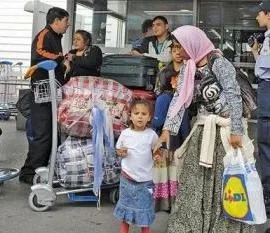
And even with closed borders, the European Union has plenty of problems with illegal immigrants
The Obvious
First, about the subject of the dispute itself. According to polls, a small percentage of Russians understand that it is not at all about free crossing of the border with the EU for any period one wishes. According to Deputy Foreign Minister Alexander Grushko, visa abolition means that citizens of Russia and the European Union will have the right to stay on each other's territory "only 90 days every six months and without the right to work."
Moreover, the authorities will have the right to refuse entry to anyone if they consider them an undesirable element. Of course, this requires grounds. And, of course, there is a list of persons whose entry into our country and EU countries is limited or even prohibited. As a rule, these are criminals, as well as persona non grata, for whom crossing the border is prohibited for political reasons. For everyone else, visa abolition means no need to visit consulates, undergo interviews, and pay for a sticker in a foreign passport. But it is by no means unhindered entry into the desired country.
As Mikhail Tyurkin, First Deputy Head of the Federal Migration Service (FMS), explained to Itogi, after the abolition of the visa regime, the main burden of checking and controlling entrants shifts from consulates directly to the border. According to him, the border regime becomes stricter: "If now a border guard sees a visa and does not particularly think about who is in front of him, because this person has already been checked, then in the case of a visa-free regime, the entire burden of responsibility will fall on him, and he will obviously be stricter."
In short, a Russian will be denied entry into Europe or an EU citizen into Russia not based on a passport but on appearance. And also based on secret bulletins stored in the border guard's computer. What if you are wanted for non-payment of alimony or once caused trouble in the country you are about to visit again? As for illegal immigrants, according to experts, after the abolition of visas, there should be even fewer of them. And all for the same reason – increased vigilance at the border.
So why, despite all the advantages of the new order, are both sides – the EU and Russia – dragging their feet on visa abolition?
According to Andrei Klimov, Deputy Chairman of the Duma Committee on International Affairs, one of the reasons is the weak protection of Russia's southern borders. The South is one of the main routes not only for illegal migration but also for drug trafficking. In Brussels, it is understood, they fear that all this undesirable element – both people and drugs – will become, if not a threat, then a constant headache for European law enforcement.
The second technical problem is the degree of security of Russian passports. Today, according to Klimov, the state is not able to provide all Russians wishing to travel abroad with biometric passports. And their presence is a requirement of the European Union.
However, "patching up" the southern borders and issuing biometric passports is not so difficult. Another matter is political obstacles. Decisions of this kind, such as the introduction of a visa-free regime with Russia, are taken in the EU by consensus. Meanwhile, not all EU member states are ready to vote "for" today. This concerns primarily the Baltic states and some Eastern European countries.
"There are opponents of a visa-free regime with Russia, but they can be counted on one hand," Grushko reassures. Persuading European dissenters is not that difficult. These countries are in a deplorable economic situation, and the European heavyweights can force them to compromise. However, on the path of Russians to Europe and Europeans in the opposite direction, there is another, more significant obstacle.
The Obvious Incredible
The main concern is uncontrolled migration. Officially, it does not come up during negotiations. As Deputy Minister Alexander Grushko assures, "there are guarantees that neither Russia nor the EU will be flooded by flows of migrants from each other's territory – because before the EU expansion, a visa-free regime operated between Russia and Eastern European countries, and there were no waves of migration." All true, except that visa-free regime – from the early 1990s – came at a period in history when Russians were mostly immobile, and Europeans did not consider Russia a desirable place to live. Since then, many migration flows have passed.
Such a phenomenon as a "pendulum" lifestyle has become a stable sociological term: in Europe, millions of people travel for work not just to another city but to another country, and return home for weekends. For example, several million Germans live in this rhythm. The EU is continuous Brownian motion: Poles go to work in Germany, France, Sweden; Czechs and Slovaks work in Austria and Italy; Estonians in Finland; Bulgarians in Greece.
Eastern Europe has long been emitting migration waves of varying frequency and magnitude. For instance, Czechs and Hungarians have migrated minimally, while a significant number of Bulgarians have left their homeland, even more Romanians and Ukrainians. In the case of Moldova, about half the population permanently resides abroad. Currently, the flow of migrants to the EU has stabilized at about 200 thousand people per year. For comparison: over 12 years (1990-2002), Russia accepted 8 million migrants.
According to Konstantin Poltoranin, head of the FMS press service, even now under the visa regime, there are not so few labor migrants from EU countries coming to Russia – about 10% of the total flow. In 2009, 12 million foreigners crossed the Russian border, of which three million were "transit passengers", seven million were labor migrants, and about two million were tourists and those arriving on private invitations. Accordingly, 700 thousand citizens came to us from the EU for work. And this does not include Moldovans, many of whom also have Romanian (EU) passports, but when coming to work in Russia, they of course present the "visa-free" Moldovan one.
Statistics do not provide exact figures on labor migration from Russia to EU countries. The Federal Migration Service (FMS), citing recruitment firms, reported that 70 thousand Russians went to work in Europe last year. That is ten times fewer than the number of EU citizens who came to work in Russia! Even if unorganized labor migration from Russia is taken into account, it still turns out that several times more Europeans come to work in Russia than our people go to the EU.
Apparently, it is the globalization of migration flows that frightens politicians. Not only European, but also Russian. After all, according to the readmission agreements that Russia concludes with all EU countries, we and united Europe must take back all our illegal migrants. However, in each case it will be necessary to prove the fact of violation of the border crossing regime. Moreover, the identification and deportation of illegal migrants is an extremely labor-intensive and expensive matter. It is not surprising that Moscow insists on maintaining internal 'visas' – registration at the place of stay.
After all, what is the result? The rules of the future visa-free regime with the EU are identical to those in effect between Ukraine and Russia. Ukrainian citizens can freely enter our country, but to get a job they are required to obtain a permit from the FMS and a migrant worker card. However, far from everyone does this. According to estimates from the migration service, there are 3-4 million illegal migrants in Russia.
According to the director of the Center for Migration Studies, Zhanna Zayonchkovskaya, highly qualified personnel continue to leave our country, so 'opening the borders will stimulate the authorities and businesses to pay Russians adequately for their labor.' However, everything is relative. Unemployment in Russia is significantly lower than the European level (in Spain, for example, it is 20% of the working-age population). And the incomes of Russians, as Rosstat assures, have reached the average European level and noticeably exceed salaries in many countries – new members of the European Union.
A tricky question: where will the same Romanian and Bulgarian Gypsies end up after the abolition of visas, because of whose expulsion the President of France, Nicolas Sarkozy, had a huge row with the EU leadership? After all, what could be easier for holders of EU passports than to come to Russia and then disappear into its vast expanses.