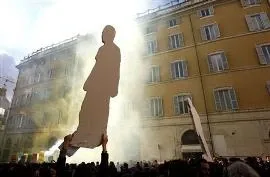
Italian Parliament Approves Education Reform
Even opponents of the specific measures that Silvio Berlusconi's government managed to push through agree that reforming Italy's higher education system is necessary. These measures include, in particular, reducing the number of university courses, merging small universities, cutting grant amounts, increasing the role of the private sector, and limiting the term of rectors in their posts.
All would be well, but ultimately the government intends to save about nine billion euros through such measures. Opponents of the plan emphasize this, noting that Italy already spends less than 5% of its GDP on education – less than many other developed countries. Such savings, it is feared in Italy, could lead to the loss of 130,000 jobs in the education sector.
There are indeed grounds for concern. According to the Organisation for Economic Co-operation and Development (OECD), Italy spends $8,725 per student, while the United Kingdom, for example, spends $15,447. However, if there is no money, this indicator can be increased by reducing the number of students. That, apparently, is what the government is aiming for, openly stating its intention to close the small universities that have proliferated in recent years. In the UK, too, it should be noted, not everything is well.
The Italian government simply has no other choice but to cut public spending by all available means – in 2011 the country's debt will reach 118% of GDP. This is the worst indicator in the eurozone after Greece. Cutting education spending is only part of the measures being taken in this area.
But it is not only the desire to save money that explains the persistence of Berlusconi's cabinet in pushing through the reform. The government intends to change the very philosophy underlying the country's higher education system. According to Education Minister Mariastella Gelmini, it is necessary to restore respect for university degrees, to ensure that their holders are once again valued on the labor market. Currently, many graduates take years to find a job (youth unemployment reaches 25%).
Italian universities, frankly speaking, have long not been considered advanced in Europe. Their overcrowding also contributes to this. According to the OECD, Italy has 19.5 students per teacher, while the average for OECD countries is 15.3.
To change the situation, the government, as Gelmini emphasizes, intends to base its approach on the principle that universities will be supported according to their performance. Teachers around the world are not very fond of such an approach. One can recall the dissatisfaction of unions caused by Barack Obama's intention to make teacher salaries at least partially dependent on student achievement.
The fact that Berlusconi managed to push through the reform is obviously explained by Italians' awareness of the crisis in which higher education finds itself. The higher education system in European countries has long turned into something incoherent – 30-year-old students surprise no one. What they study is not always clear, and it is hard to understand why they do it. The connection between education and the labor market becomes hypothetical. To call a spade a spade, universities are turning into some kind of holding tanks for unemployed youth who do not want to take on the dirty work that falls to immigrants. Diplomas cease to have any meaning at all. This phenomenon is not unique to Russian reality.
From a political point of view, the adoption of the reform is a notable success for Silvio Berlusconi, who has recently undergone difficult trials.
There is hardly any doubt that other developed countries will have to follow Italy's example – both reducing education spending and restructuring the system itself.
Timofey ZABRODOV.