
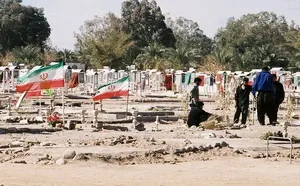
Earthquake victims are still being buried
If you consider yourself a strong person, it is easy to test yourself in such a place. The city of Bam in Iran's Kerman province after the earthquake is one big mass grave, a pile of remains of homes and belongings: furniture, pieces of clothing, children's shoes, dishes - everything is exposed to view. Nothing is left. The pearl of Bam is gone too - the famous Arg - e - Bam fortress, which stood for almost 2,500 years - the earthquake destroyed everything.
Rescuers say that even now, after a month of recovery work, people are most likely still under the rubble - they certainly no longer have any chance of survival.
The earthquake struck on Friday, around six in the morning, when all residents of the city were sleeping peacefully. At that time, men were at Friday prayers in mosques - which, by the way, withstood - while wives and children perished in shabby mud houses that collapsed from the very first tremors. When you look at the city (or rather, at what is left of it), you understand why the tragedy is so large-scale: the people of Bam are poor, they built their homes from whatever was at hand. The city is very old, so it could not withstand such a powerful blow from the elements.
But the most terrible sight is the city cemetery. They are planting weeping trees and covering everything with chlorine because the characteristic smell of corpses makes it hard to breathe. On the Muslim graves there are flags - colorful and large. On these symbols of death, relatives write what they did not have time to say to their loved ones during their lifetime - poems, wishes, and confessions. Almost every grave has a peculiar glass birdhouse, where flowers and candles are placed; there are thousands of such markers here. And in every grave there is a whole family. Some contain up to 30 people - from grandchildren to grandparents.
• By the way, on the specialized portal http://safetyplanet.ru you can view current news and photo reports about emergency events from different parts of our restless planet. The information will be especially useful for those who are planning a trip abroad to these regions.
Blood transfusion near telephone booths
Rescuers from the Ministry of Emergency Situations of Ukraine arrived in the destroyed city on the second day after the earthquake. The UN took over coordination of the work; each rescue group submitted reports on its sections in the evening. According to the rescuers, it was hard to work primarily psychologically - the Ukrainians never found anyone alive under the rubble. By the way, there were also Americans among the rescuers, despite their tense political relations with Iran.
On the third day, Ukrainian doctors from the mobile hospital of the Ukrainian Ministry of Emergency Situations arrived in Bam. "What I saw from the bus window I will never forget: a completely destroyed city!" recalls the head of the hospital, Sergei Zabashtanov. "And the scene near the ruins of the local hospital is still before my eyes: blood-stained blood transfusion sets hanging on a telephone booth - people were given emergency care right here on the street..."
The doctors set up the mobile hospital in a few hours, although many problems had to be solved before that - choosing a location, lighting, water supply. The necessary conditions, however, were not provided immediately - a few days later shower cabins were installed, and local authorities provided lighting and water supply. Another problem was sand. There is no such sand as in Iran even in the desert - it is clayey and dense, making it hard to breathe and see. But this problem was also solved - they covered the area with gravel.
The doctors were also provided with necessary medicines and equipment - the Ukrainian government allocated 260 thousand hryvnias for this. Operations were performed in our hospital, women gave birth here, X-ray examinations and ultrasounds were conducted. There was also a laboratory, gynecology and pediatrics departments, and an intensive care unit. The doctors mainly dealt with injuries from the rubble, but people also came with old ailments - bronchitis, pneumonia, ulcers. Often Ukrainian medics corrected the defects of poorly administered first aid. "With our hospital, we ‘prosthesized’ Bam’s healthcare system," says Sergei Zabashtanov, "because the city’s medical infrastructure is completely destroyed, and almost all doctors have died."
We also visited one of these tent camps: several thousand "houses" provided to Iranians by the Red Cross, in which 1,200 refugees currently live. They sleep on damp and cold ground together with children. Food and humanitarian aid are also brought here - ranging from brooms to simple furniture and blankets. Each victim is given bread, tea, and essential items by coupons.
Iranians refused treatment and children
The Ukrainian doctors fulfilled their mission to the end: immediately after their arrival, people started coming to them, having learned about their attitude to work and experience. Every day they received 200-300 patients. In total, over the month, the doctors helped 7,304 victims. But the most pleasant thing was the birth of 29 Bam infants.
"I understood the full importance of my role in this hospital," says Farigos, one of the Iranian doctors who, living in Ukraine, went to their homeland as volunteers at a tragic moment for it. "It happened that from the shock they had experienced, people did not want to live any longer, refused to take medicine, and women did not want to take their newborn children, saying that they had no one left and nowhere to go. Most of all I will be proud that I convinced these unfortunate people of the importance of their lives. And I succeeded!"
In Iran, as is known, abortions are prohibited, but our doctors had to hear requests from local women to terminate pregnancies. They did not want to give birth to children. But the doctors, after consulting with local authorities, were forced to refuse.
By the way, there are babies left in Iran named after Ukrainians - Nastya and Artyom. "Nastya was born with us," says Lyudmila Andrienko, an obstetrician-gynecologist, "her mother, unfortunately, died during childbirth - the injuries were too severe. But the girl was born healthy. We looked after her and fed her. And when the deceased's sister came for the baby, she wanted to give the girl a Slavic name and chose Nastya."
The second hero is a two-year-old toddler who was admitted to the hospital with a broken hip. He didn't have a name yet because the boy hadn't undergone the circumcision ritual. "The cast was put on the child very poorly; he cried constantly," says Professor Sergey Guryev, deputy director of the State Disaster Medicine Service. "My sister and I spent three days correcting the deficiencies of the first medical aid, and when the boy's father came for him, he asked what the nurse's son was called. Upon learning that the boy was named Artyom, he replied that he would name his little one the same."
Diplomatic mission of doctors
Our medics are treated very well here - Iranians, despite their stern appearance and innate tactlessness, smile and constantly say words of gratitude. They saw off the doctors with whole tent villages. It is because of this that Ukrainian journalists are now also treated well. We weren't even searched, although this is a mandatory procedure. Upon learning that we are from Ukraine, they only offered to take pictures. And American rescuers, as it turned out, were not favored. Iranian authorities even noted that despite their help, the local population's attitude toward Americans remains the same. US dollars are not even in use here - in protest, the Bam residents use only their own money.
Already today, Ukrainian diplomats acknowledge that after the work of our doctors, many contracts with Iran are signed without problems. Ukrainian doctors were even offered work in Tehran, but they refused. And at the site of the Ukrainian hospital, local authorities have already decided to build a hospital - after all, the old one is completely destroyed.
According to the doctors, they will receive nothing from Iran for their work - Ukraine will pay for their stay in this country: regular salary and daily allowance - $32.
Decorations - medicine boxes
The doctors do not complain about everyday problems; they had no time for that. They took everything they needed with them. They also set up a field kitchen on the hospital grounds. Cook Sergey Paramuda, who had previously 'been through' India and Turkey, cooked every day with assistants for 120-150 people. They boiled rice, buckwheat, and potatoes. All products - stew, cereals, sugar, tea - were brought with them.
"It was unusual to celebrate New Year in such heat," recalls Anna Ruban, an obstetrician-gynecologist. "We put up a Christmas tree in the waiting room and decorated it with medicine boxes." Local residents came to congratulate the Ukrainians (who, by the way, are now in November 1382), bringing fruit and flowers. It is customary for them to give women two flowers each.
These strange Bam residents
We arrived in Bam when the pain of loss among local residents had subsided a bit, and only the ruins of the city reminded of what had happened here more than a month ago. Now the Bam residents are returning to their former life and are preparing to rebuild their homes. Very often here you can see women doing manicures right on the ruins of their houses, or men who, true to their habits, smoke hookah and read the Koran. And children run around in a crowd, seemingly having completely moved on from what happened. The attitude toward Bam's children among the local population is rather strange - they grow up on their own. In winter, evenings in Iran are cold, and during the day it is very hot - the little ones are dressed in winter jackets, but their feet remain bare. That's why the children often get sick.
They say that everyone here smokes opium - from seven-year-old boys to old men. And mothers expose their babies to smoke to make them sleep more soundly. The Bam residents themselves are like children - naive, kind, and a little cowardly. They still don't know what to do with the destroyed city - many no longer want to live in this village of death, where so many people died and so many terrible memories remain.
Marina TKACHUK.
Kyiv - Bam - Kyiv.