
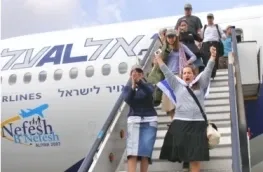
A million Russian-speaking immigrants changed the face of Israel
'Having integrated, they became an important element of all aspects of the country's life – economy and security, science and medicine, sports, culture and arts. Looking back, we can confidently say that this wave of repatriation became one of the greatest miracles that happened to the State of Israel,' the prime minister said recently at a government meeting.
'In Israel, there are entire professions that cannot be imagined without people from Russia and other CIS countries – these are doctors, scientists and teachers,' Knesset member from the Kadima party Marina Solodkina told Vremya Novostei. 'Native Israelis always admit that the best math and music teachers are Russian-speaking repatriates.'
According to official statistics, among the million immigrants from the former USSR who arrived in Israel, there are 110,000 engineers, 50,000 teachers, 23,000 doctors and 2,000 lawyers.
Russian-speaking repatriates also contributed to the development of the Israeli army. At the government meeting, Defense Minister Ehud Barak proudly noted that 21% of Israel Defense Forces soldiers are repatriates, of whom 65% are from the CIS countries. According to him, repatriates from CIS countries helped renew the armed forces, but at the same time the army itself became a kind of bridge for their integration into Israeli society.
Not everyone managed to settle in Israel. About 6% of repatriates from the former USSR, that is, about 60,000 people, left the Jewish state. Russian-speaking elderly are also dissatisfied with their situation, yet, according to statistics, 261,000 people arrived in Israel at or near retirement age. In Israel, pensions are accumulated over a person's entire working life, so a person arriving at retirement age can only count on an old-age allowance of about $330. The state does help such people with rent and utilities, but this allowance is not enough for a decent life.
Immigrants of the first wave in the early 1990s like to tell how, to emigrate to the Jewish state, they stood in line at the Israeli consulate around the clock for weeks – since 1989 it had been located in Moscow on the grounds of the Dutch embassy. This happened before the restoration of diplomatic relations between the two countries in October 1991.
The Jewish Agency 'Sokhnut' has been and still is involved in helping people who decide to repatriate to Israel. It also conducts active public activities in various countries, finances the publication of Jewish newspapers, Hebrew language courses, and organizes seminars on Jewish traditions. According to Sokhnut, there are currently about 800,000 people in CIS countries who are eligible to move to Israel. But now they no longer have to stand in line – on the contrary, it is the Sokhnut employees who have to persuade Jews to move to their historical homeland.
Sometimes the methods of agitation turn out to be unsuccessful. Recently, a scandal erupted in Israel over an advertising campaign by the Office of the Prime Minister of Israel and Sokhnut against the assimilation of diaspora Jews. In the video presented, all those who married a non-Jew were compared to missing persons. Voices of protest first appeared on the Internet, then in Jewish publications worldwide. Jews living outside Israel considered this video a personal insult of a racist nature, since the agitators essentially denied the right of a Jew to marry a chosen one. The outrage was so strong that the head of Sokhnut, Natan Sharansky, a former Soviet dissident, had to shut down this initiative. 'Strengthening ties between world Jewry and Israel helps fight assimilation, but insults to diaspora Jews should be avoided,' Sharansky said.
Repatriation of Jews is still necessary for Israel. 'The country largely lives off it. It took native Israelis a long time to understand the potential Russian-speaking repatriates bring to Israel's development. Eventually, they realized it,' Marina Solodkina noted.
'The best thing that happened to the State of Israel is that million Russian-speakers who decided to come here for permanent residence,' said a Tel Aviv taxi driver named Tsahi to reporters. At the same time, he asked: 'Don't you have another such million there?'