
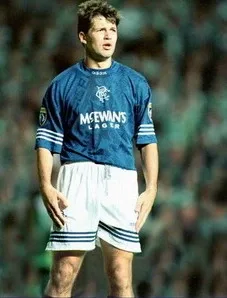
Record-breaking footballer: Oleg Salenko sent 5 goals into the Cameroon team's net at the 1994 World Cup
And from 1985 onward, for ten years, Salenko's career was on the rise. Its peak was the 1994 World Cup, where Oleg showed phenomenal scoring prowess in the match against the Cameroon team, sending five (!) balls into the Africans' goal. Such generosity allowed him to share the title of the tournament's top scorer with Bulgarian football star Hristo Stoichkov. After that, it seemed that the most promising horizons lay before the 25-year-old forward of the Russian national team. But, alas, things did not work out for Salenko at Spain's Valencia, he was forced to move to another club, marking the beginning of the end...
It is probably difficult to assess how fully Oleg managed to realize himself in big football, but I think many will agree that the product of Leningrad football did not even reach the 50 percent mark. Despite winning the Golden Boots of the youth and senior World Championships - a more than solid achievement!
Now Salenko, who has long settled in Kiev, is in business, occasionally playing beach or indoor football with friends. He sold his house in Valencia, keeping only an apartment near the beach. Sometimes he briefly goes to Spanish soil - relaxes, meets acquaintances, visits Valencia's camp, gives autographs to those football fans who still remember the forward Salenko.
"Together with partners, I own a small wellness complex with a swimming pool, Finnish sauna, bar," says Oleg. "Since I am now involved in beach football, I plan to equip playing areas there in the future. Naturally, these services are not free, but our people seem to have matured enough to pay for comfortable recreation. It is clear that first and foremost one must think about profit. Football life is over, you need to invest money somewhere, earn a living. You can't live on coaching work these days..."
Well, sooner or later every footballer comes to the question of ending his career. But in this case, one wants to exclaim: "How wonderfully it all began!"
Oleg was clearly lucky with coaches, and there was no shortage of good teams willing to invite him. He played for all the national teams of the country that there were. And this is not surprising: if you look at the footballer's performance statistics for the USSR youth team, it immediately becomes clear that it was simply impossible not to notice a guy who scored 37 times in 34 matches.
After one of the trips with the youth team, Salenko was already expected at the Zenit base. It was 1985. In the main team of Leningrad, which had won the USSR championship the year before, there was a place for a striker who showed great promise. The 15-year-old footballer was added to the lineup for a union championship match against Minsk Dynamo just three days later. And on March 1, 1986, at the age of 16, Salenko made his debut in the top league in an away match against Moscow Dynamo. And what a debut! Getting 20 minutes of playing time with the score 3:3, Oleg managed to score a goal and bring victory to Zenit, becoming the youngest scorer in union championships.
In that season Salenko scored three goals, and after seven goals in the 1988 USSR championship he received an invitation from Kiev. "As you know, not just anyone is invited to Kiev Dynamo," says Oleg. "However, this was a very responsible and difficult step. Naturally, in Kiev one could not count on repeating the Zenit career, where, bypassing the reserve team, I immediately got into the main squad. At that time, at least two dozen players in Dynamo really claimed a place in the starting lineup, among them 15 national team players. Therefore, training sessions were even more intense than matches of the union championship - everyone wanted to be among the 11 best. But no matter how hard it was to withstand Lobanovsky's loads, those years are pleasant to recall. Especially our golden double in 1990. Then we added the USSR Cup to the championship, in the final of which we thrashed Moscow Lokomotiv 6:1, and I scored a hat-trick. By the way, this is also a record - no one before had managed to score three goals in decisive matches for the crystal trophy."
In 1991, Salenko continued his scoring streak, sending 14 goals into the opponents' net in Dynamo's last USSR championship. And already in 1992 he was scoring in the Ukrainian championship. Oleg recalls that time with far from the warmest words. Like, after matches with Moscow clubs and teams from other union republics, he had to travel to cities whose teams had played in the second league just a year earlier. The level of the championship dropped sharply, and Salenko wanted to go West. After working through one championship, he announced his desire to the management and... for six months he did not play football at a high level at all. But still he got his way - he moved to Spain, to Logroñés. The only thing that bothered him was the club's status as an outsider.
Although, as it soon turned out, this even benefited him - Salenko took on the heavy burden of saving the team from relegation and for a season and a half successfully coped with the task he set for himself. "The obvious modesty of Logroñés did not bother me. It was compensated by the strength of the Spanish championship, where, unlike Ukraine, teams fight in every match - regardless of the opponent's titles and honors. Playing in a strong championship is difficult but interesting - you give a hundred percent and sometimes you do something you wouldn't expect from yourself. I pulled the team out of the relegation zone and became its top scorer. Offers? Of course they appeared, but I then decided to stay in Logroñés for another year in order to finally adapt in Spain. After all, I was on a horse there, I knew that under any circumstances I would be in the starting lineup. And I did not regret it, because at the end of that season I signed a contract with the titled Valencia."
And it was already 1994, the year of Salenko's greatest rise. A contract with Valencia, a goal spree at the World Cup as part of the Russian national team (by the way, in 1992 Oleg played in the debut match of the Ukrainian national team, but soon moved to the Russian team's camp).
But to the striker's misfortune, another man appeared at the Spanish club, for whom 1994 would be remembered for life – the head coach of the Brazilian national team, Carlos Alberto Parreira, who won first place at that World Cup.
"My relationship with the coach just didn't work out from the start. At one point he put me on the bench altogether with the Serb Predrag Mijatović, preferring to play without strikers. I couldn't take it, lost my temper, and told the press everything I thought about the Brazilian mentor. After which he promised to make me rot on the bench. But it so happened that at one moment almost half the team was injured, and Parreira, under pressure from the press and fans, had to remember me. And I went and scored two goals against Real Madrid. We won 2:1, and Parreira was forced to include me in the lineup. And I began to score, got goals against Tenerife and Celta, and was named the team's best player for two months. But I got injured at a very inopportune moment, underwent surgery, after which I decided it was time to leave Valencia. I wanted to play, not sit on the bench."
This is how it all started. Despite the fact that Valencia changed coaches (Luis Aragonés came in instead of Parreira), who tried to convince him to stay, Salenko had already decided to move to Glasgow. Now he admits he made a mistake, but at the time it seemed to him that Rangers, which had tempted him with the promise of Champions League football and good bonuses, was the optimal choice. By the way, there were other options at that time: Spanish Sevilla and Zaragoza called, and he was invited to Japan for good money. But the Scottish champion looked preferable against this background.
In reality, everything turned out to be far from so wonderful. And despite the good team, Salenko did not last more than a year in the Scottish champions' lineup. By the way, in Glasgow Oleg met one of the most colorful figures in football history – the Englishman Paul Gascoigne, famous for his wild temper and inability to follow a sports regimen, at least in our understanding.
"Life is life. Everyone, everywhere breaks the regimen," the footballer believes. "But some can really 'light up,' while others don't allow themselves anything like that. That's the main difference between our football and Western football. When you're locked up at a training base for a week here, and then let out for a day of leave, you can easily go off the rails. In the West, life itself excludes such a need. No one watches how much beer you drink, no one bursts into your apartment at night to make sure you're sleeping in your bed. You're a free person and you control yourself. And Gascoigne?.. Believe me, it's all journalists' inventions. Their job is to dig through dirty laundry. The newspapers compete to trumpet what a drunk and brawler the Englishman is, but he, by the way, is a perfectly normal guy with his pluses and minuses. At least in the Union, judging by how much he drinks, he would be considered almost an outright teetotaler."
Oleg said goodbye to Glasgow in the middle of the season, moving to Istanbul to one of the local clubs – Istanbulspor. But here, too, things didn't go well for Salenko – injuries and the negligent attitude of the club owners made themselves known. And the Turks, having acquired the rights to the player, began to demand several million dollars for him, but for some reason there were no takers willing to part with their money. He had to wait for the contract to expire. Then there was the Polish club Pogoń from Szczecin and its president, who deceived the players and supported the team in exchange for the municipality's promise to allocate him a parking lot. The site was not allocated, and the money instantly ran out. It was in Pogoń, which had a very real chance of becoming the national champion, that Salenko played his last official match at the highest level...