
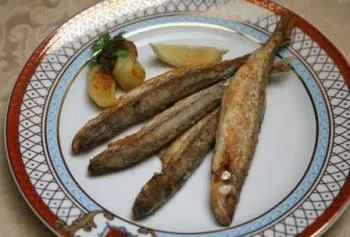
The famous smelt has become tiresome: Russia's Northern capital is looking for new gastronomic brands
Sergei Markov, Deputy Chairman of the Committee for External Relations of the Government, reported that the idea for the brand emerged about a year ago, but now, in the context of import substitution, it has gained special appeal for the city. In his opinion, the project will greatly help regional producers and provide serious support to local businessmen in the current difficult economic conditions.
According to Yulia Demidenko, Deputy Chairman of the Museum of the History of St. Petersburg, previously the original St. Petersburg dishes were mostly fish dishes – sterlet in champagne, smelt, vendace, and Ladoga whitefish. However, as Markov noted, by now St. Petersburg has only smelt left among its colorful products, and the assortment needs to be expanded, specifically with something “deep and historically filled.” “It is necessary to revive the historical cuisine of St. Petersburg, to make it something that a tourist considers an obligatory part of the program of stay in the city. It is a pity that other cities have long had such brands, while we are rushing into the embrace of Western values and traditions, forgetting our own history.”
According to experts, currently out of 1,200 restaurants in St. Petersburg, no more than five establishments can truly be attributed to Russian cuisine. However, from books of the 19th-20th centuries, we know that in St. Petersburg, among all classes except the aristocracy, it was already customary to dine out, “in society.” In restaurants, people not only satisfy hunger but also socialize. Hence the term “public catering,” and its origin is attributed specifically to St. Petersburg.
Through the window to Europe cut by Peter the Great, many foreign culinary traditions penetrated Russia – German, Dutch, Italian, French. However, it would be a mistake to assume that the formation of St. Petersburg cuisine was determined solely by foreigners. Builders, merchants, artisans, innkeepers from Vyatka, Volga, or Pskov lands, who came to the banks of the Neva, also brought their culinary tastes. St. Petersburg Russian cuisine is a multifaceted, complex element of our national culture.
If in the early to mid-18th century taverns prevailed in St. Petersburg, by the end of the century and the beginning of the 19th century, the city already had many restaurants, cafes, inns, and eateries. Moreover, inns combined the functions of drinking establishments and coaching inns – something like modern hotels with restaurants. It is precisely with the development of the inn trade and restaurant business that experts associate the formation of traditional St. Petersburg cuisine.
Participants of the round table on December 22 recalled dishes closely linked to the city's history: Leningrad-style rassolnik, Guryev porridge, Arina Rodionovna's pancakes, and Skobelev patties, and came to the conclusion that what matters to a tourist is the legend, the story of the dish, a kind of myth that can be beautifully presented. In Russia, for example, as in other European countries, there was a fashion for eponymous dishes. Their origin is usually associated either with famous gourmets, inventors of a particular dish recipe, or with some historical figures, heroes of their time.
A typical example is Skobelev patties. Although there is no reliable evidence that Lieutenant General Mikhail Dmitrievich Skobelev, a native of St. Petersburg, had any relation to this dish. The famous Russian general, who spent almost his entire life on campaigns and battles, earning combat glory in the Khiva campaign, the battles of the Russo-Turkish War (1877-1878) at Plevna and at Shipka-Sheinovo, had no time for inventing culinary recipes.
By a curious coincidence, Skobelev's wife – Princess Maria Nikolaevna Gagarina, who was the great-granddaughter of Finance Minister Count D.A. Guryev – is indirectly associated with another eponymous dish, the famous Guryev porridge. The serf cook of the Guryevs, Zakhar Kuzmin, created this culinary masterpiece in the early 19th century. Emperor Alexander III was a great fan of this dish. The recipe for semolina porridge with cream, dried fruits, and apricots in syrup penetrated all aristocratic homes, found its way into cookbooks, and became famous even beyond Russia.
Another eponymous recipe proposed by the departments for consideration is Arina Rodionovna's pancakes. Small, pinkish – the nanny was ready to bake them for her “angel Alexander Sergeevich” at any time of day. According to legend, Arina Rodionovna baked them from a couple of pounds of wheat flour, eight egg yolks, a piece of good country butter, and sour milk. Having stirred the mixture, for extra fluffiness, the poet's nanny added whipped egg whites. Alexander Sergeevich, a recognized gourmand of his time, could eat up to three dozen of these pancakes at once. It was customary to serve melted butter, sour cream, and gooseberry jam with the pancakes.
Elgiz Kachaev, head of the Committee for the Development of Entrepreneurship and the Consumer Market, suggested that native St. Petersburg residents share unique family recipes. It is planned that a special section will be opened on the official website of the committee, where recipes sent by city residents will be posted. Perhaps among them there will be unique ones, passed down from generation to generation, kept in home cookbooks. The first entries have already appeared on the committee's website: “I want to share my family's favorite dish – pancakes with brains. The recipe was passed down to me by my grandmother. Fry the pancakes and stuff them with filling: brains diced, fry with onions for about ten minutes. Add salt and pepper to taste. Pour sour cream over the stuffed pancakes and bake in the oven. Kira Iosifovna.”
Elgiz Kachaev believes that recipes can also be invented, creating something new that will give the city's culinary brand freshness and originality. According to this principle, for instance, a well-known dish of the Soviet era was created – rassolnik Leningrad-style. One of the most convincing versions of its origin was voiced by Margarita Nikolaevna Kutkina, head of the department at St. Petersburg State University of Trade and Economics, a veteran of Soviet public catering, and author of numerous books on the technology and history of public catering.
According to her, this recipe belongs to the famous chef Nikolai Alexandrovich Kurbatov. As a ten-year-old boy in 1905, he trained under cooks in a tavern in St. Petersburg, and immediately after the revolution he worked as a technologist in the Central Commission for Combating the Consequences of Famine under the All-Russian Central Executive Committee ("Posledgol"), on the basis of which Narpit (the public catering trade union) was later founded. In 1918-1919, together with his colleagues, he invented rassolnik, later known as "Leningrad-style". Moscow-style rassolnik, a characteristic dish of restaurant cuisine, was prepared with chicken broth, giblets, and kidneys. The dish is not very high in calories, but, as is customary in all rassolniks, it includes pickles. Kurbatov added potatoes, carrots, and grains (rice or pearl barley).
Some St. Petersburg restaurateurs, who have practical rather than theoretical experience in public catering, view the idea of St. Petersburg officials with some skepticism. They point out that the most popular dishes among tourists are already time-tested beef stroganoff, borscht, and pelmeni, which are not at all related to St. Petersburg cuisine. And smelt has long been an established symbol of the Northern capital, and of course, this must be taken into account. Restoring historical recipes is of interest to cultural scholars but has little to do with actual demand.
Victoria TOKAREVA.
«Lenta.ru»