
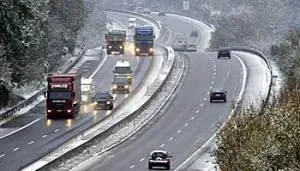
German officials are considering four options for autobahn tolls
Germany has been and remains the only country in Europe without speed limits, and it also remains one of the few countries with toll-free roads for passenger cars. Nevertheless, as the ubiquitous newspaper Bild has found out, the Ministry of Transport is considering four options for introducing road user charges.
'There can be no bans on thinking,' confirmed Federal Minister of Transport Peter Ramsauer, acknowledging the existence of a document titled 'Various scenarios for introducing electronic payment for the use of federal autobahns and intercity highways.'
All options do not involve per-kilometer payment, as in Italy or France, but the sale of vignettes, following the example of other nearby neighbors – Austria, the Czech Republic, or Switzerland. In those countries, it's a sticker on the windshield; in Germany, it would be a progressive electronic toll, and the process of obtaining it could be integrated into the existing system for collecting tolls from truck drivers on the autobahns.
According to the first ministry scenario, with an annual vignette costing 80 euros, a two-month one 30, and a ten-day one 10 euros, the treasury could count on 3.41 billion euros annually. The second option is very similar to the first, only the annual vignette costs 100 euros, and the state budget receives 760 million more. The third option provides for an annual vignette cost of 155 euros, a two-month sale for 50, and a ten-day for 17 euros – if such fees are introduced, Peter Ramsauer promises the state 11 billion euros per year.
Finally, there is a fourth option, which reporters have called extreme: complete abolition of the vehicle tax and its replacement with a paid right to use roads for 365 euros per year.
Two months of driving would then cost 125 euros, a ten-day transit 45. Motorcyclists would also be called upon to restore the balance of the state budget, which lost 9 billion euros due to the abolition of the vehicle tax: the cost of road use for them is set at 30 euros per year or 10 for two months.
The last time the Ministry of Transport and its newly appointed head Peter Ramsauer raised the issue of introducing tolls was at the end of 2009, hinting that it is not right to give German roads over to transit foreigners – at least not for free. The largest German automobile club ADAC immediately countered that at most five percent of foreign drivers on the country's roads would bring the treasury 150 million euros, and the sought-after billions would have to be collected from their own citizens.
Overall, domestic automobile clubs representing the interests of millions of motorists are sharply negative towards the idea of making roads toll-based, no matter what infrastructure improvements politicians promise using the proceeds. In fact, the very promises to introduce a vignette on German autobahns, despite the obvious greening of the German political landscape, are still nothing more than reflections. They are indeed not forbidden.
Cost of road use in neighboring countries:
AUSTRIA: Use of autobahns and expressways is tolled. A vignette for 10 days costs 7.60 euros, for two months 21.80, annual (including December of the previous year and January of the next) 72.60. Separate tolls are charged for passing through most Alpine tunnels and passes.
BELGIUM: Roads are free, all autobahns are lit at night.
DENMARK: Roads are free, except for the Storebælt Bridge between the western and eastern parts of the country and the Øresund Bridge leading to Sweden.
NETHERLANDS: All roads are free, except for a few bridges and tunnels.
POLAND: Only some sections of autobahns are tolled, the cost does not exceed 3 euros.
FRANCE: Practically all major autobahn segments are tolled, the average cost is about 5 euros per 100 kilometers.
CZECH REPUBLIC: The vignette required for driving on the country's autobahns costs about 6 euros for 10 days, 11 for two months, and 29 euros for a year.
SWITZERLAND: The only payment option – an annual vignette – costs 40 francs (about 31 euros) and is valid, as in Austria, from December of the previous year to January of the next. The government is discussing doubling the cost from 40 to 80 francs.