
Good Savvas
Renting a car in Cyprus is terribly illogical. First, there is left-hand traffic, second, right-hand drive, and third, a lot of wine. No, no, no, it is incompatible and also extremely dangerous. Only the left-hand-driving British can allow themselves such liberties! However, spread a map of the island on the floor and you will see that it is covered with markers for “museum”, “archaeological excavations”, “ancient ruins”, “medieval fortresses” and “monasteries”, with “mountain peaks”, “beautiful views” and simply villages in between. Clearly, one cannot get around in this terrain without a car!
Renting a car in Cyprus presents no problems at all. You need to find an office with good prices, some “Savvas and Sons”, or “Dimitros and Sons”, or “Apollo and Company”, hand over simple “cash” and receive in return something like a financial document - for example, the owner’s business card with his signature and a date. Cypriots take paperwork lightly: Savvas is Savvas, after all, who doesn’t know Savvas from Paphos? Or Apollo from Limassol? And besides, everyone has telephones, just in case!
Along with the car, Savvas will give practical advice: “The main thing is don’t speed up. Drive slowly, quietly. And in the left lane. Quietly-quietly, and to the left. Okay?”
Roads for Donkeys
As the map of Cyprus assures, roads on the island are divided into red - main roads, yellow - secondary paved roads, and gray - country lanes. There is also a blue, like the sea and sky, highway. Reality resists this primitive classification. A main road marked in red may in fact turn out to be a modest country lane, a secondary road - a rocky trail suitable only for jeeps and ubiquitous peasant “Mitsubishi” trucks. And for donkeys, of course. A country lane sometimes turns into a highway, but less often.
Cypriot roads live their own special life that only they understand. You choose a splendid route through picturesque places along a “red” road, check signposts and maps, perhaps even ask a local farmer for directions - and you drive comfortably on smooth asphalt, enjoying the views and even whistling a tune. A couple of kilometers later, on a steep mountain slope, the asphalt suddenly ends. Without any visible reason or warning signs. An unpleasant serpentine with potholes and the consequences of rockfalls begins. Its width is equal to one lane for traffic in both directions. A “road narrows” sign, placed another couple of kilometers later, brings a bitter smile and justified pessimism: so what next, only on foot? However, contrary to the laws of nature and human logic, the unsurfaced country lane, like a submissive Cinderella, again turns into a good highway. After a while, everything repeats.
The Left Side
Left-hand traffic in Cyprus is not scary at all. Tourists in rented cars with red license plates drive slowly and carefully, and Cypriots on the road, as in life, have good manners. Cypriots remember that there are countless clueless tourists around who constantly stray into the right lane; stand like sheep in front of signposts to grasp their vague meaning; stop like idiots at a “stop” sign and always wait for the green light, even when there are no cars around at all.
The spell “quietly-quietly and to the left” works flawlessly; you just need to keep an eye on the signposts.
Signposts
Oh, Cypriot signposts! Sagas, heroic ballads and epic poems could be composed about them. They are unpredictable as clouds and fickle as the wind over the sea. They are treacherous and changeable, and the word “logic” in front of their blue or green visage simply fades, turns into nothing.
What words can be found for the sign indicating the turn to the village of Peyia, which stands after the turn? What to say about a sign pointing the only true way to Tsada, placed so deftly along the road that you can only notice it after driving past and, naturally, missing the turn?
How to describe a sign at a fork of three roads, where the right arrow asserts: “Paphos 32 km”, the left arrow echoes: “Paphos 32 km”, and nothing is said about what lies straight ahead? Only a random tourist who believed the right sign, as well as a random tourist who believed the left sign, can rightfully claim that a single road leads to the glorious city of Paphos - specifically the one that lies between them. There are no words in this case, but there is the right to choose and a reason to test one’s own intuition.
The names of populated areas and distances to them on signposts are, to put it mildly, not accurate. Three times we tried to reach the village of Empa. “Empa 4 km”, it was written at the right turn. Two hundred meters later the direction changes, the distance turns out to be one kilometer, but there are still no signs of the village. Several times, turning onto Empa according to the signposts, we ended up either in Tala, or in Lemba, or in the cottage paradise of Argaka. And only the third time, whistling breezily through a field planted with vineyards and orange orchards, we noticed a farewell greeting from the mystical village - a sign “leaving Empa” with a touching little poster “Happy journey!”.
A special kind of signposts are the so-called “spinner” signs, where you need to follow the arrows and then guess which road you have ended up on. On the way out of Limassol toward Paphos there are four of these. At one of them it is easy to end up in the port instead of the highway. But that is nothing compared to the “spinners” at highway junctions in mountain villages! You cannot stop in front of a sign, and it is impossible to figure out where you are, because the arrows show the same village in different directions.
The most luxurious roundabout hospitably welcomes tourists in Prodromos, on the way from the famous Kykkos Monastery. It is very artistically integrated into a steep bend, aesthetically planted with flowers and entwined with bindweed so that it is impossible to read anything on it. As a result, very good cars end up not on the highway, but on a rocky dirt road near Ayios Dimitrios. Sometimes they gather in flocks, tourists get out and, pointing fingers at maps, argue about how to get out. They get out along the serpentine, across picturesque old bridges - there is nowhere to turn around.
Most of all it resembles a game of cops and robbers: you follow the arrows, not knowing where you are going.
But what large and bright signs direct travelers to fish taverns, to family restaurants, to luxurious villas waiting for their buyers! There is no need to look for Aristo on the map - it is not a village, it is a developer selling villages, sea air and mountain views.
Another surprise from the signs: villages have one name on maps, and another in real life. The same Peyia is called "Pegia" on maps.
The Road to Akamas
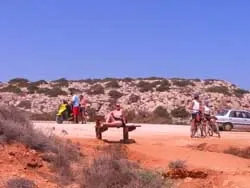
Not every tourist gets to the middle of the Akamas Peninsula. If only because the asphalt road leads only to the Avakas Gorge. Further on, it is better to spare the car, unless, of course, you came on a tractor. In Avakas, travelers are greeted by a quiet bay, a wonderful sandy beach with crystal-clear water and white cliffs, with tattered umbrellas and rusty sunbeds. From time to time a guy on a motorcycle drops by and collects one and a half dollars for the facilities. This is Kostas, the owner of a small restaurant nestled right there in the gorge, who spoils visitors with fresh trout. By the way, you can park your car in his yard, in the shade of trees, so that it does not heat up in the sun.
The next bay is adorned with a sign reading "The Last Castle". A too grand name for a half-ruined shack serving as a bar and the last outpost of civilization on the wild Akamas, which resembles Crimea, Greece, and the windy side of the earth on the first day of creation. In this bay, old George from a nearby ranch bathes his horses, but that is quite another story.
If you want to drive through beautiful villages, you should choose the southwest of Cyprus or the Troodos Mountains. For example, go from Paphos along the road to Polis through Stroumbi, Pano Arodes and Kato Arodes, Drousia, Prodromi to Neo Chorio. They are located in stunningly beautiful places, and the gentle curves of the Paphian hills with terraces of vineyards, distant mountains and the distant sea are worthy backdrops for these lovely little villages. Stroll through them at leisure, drink aromatic coffee in a coffeehouse, talk to a hermit monk and with dignified old men always sitting with a cup of coffee - these will be the best moments in Cyprus, and the strongest impressions you will take away with you.
Another beautiful route from Paphos: turn off Stroumbi onto Polemi to reach the glorious Chrysoroyiatissa Monastery through charming Pano Panagia, and from there return along the yellow road through Ayia Marina. This is one of the most beautiful roads on the island. The way back passes through the picturesque surroundings of the Xeros Potamos River, through small half-abandoned villages.
Problems
Of course, accidents do happen in Cyprus. For example, if it occurs to you to make a U-turn at a fork in a narrow road, and at that very moment an old Cypriot in an old Mitsubishi decides to reverse from that same fork. Of course, he won't look back, because, well, what ass would think of driving along this microscopic road from Tsada to Polemi?
Problems of this kind are solved simply, but not quickly. Because you have to wait for the policeman to arrive. And the policeman at that moment may have more important things to do: maybe he is just sitting down to lunch, maybe he has lain down for a rest. But in the end, the policeman, as a rule, arrives at the scene. He measures everything that is required with a tape measure, writes down everything that is required in a notebook, and demands the car rental document. Even if you only have Savvas's business card - no problem, you just need to stop by the station and call this Savvas so that he confirms it all. And he calls, and Savvas confirms that everything is insured, and that there are no problems, and there is nothing to worry about.
That is why you should take out a fully comprehensive insurance policy together with the car. And as for the "big paper", which is the official rental form - with taxes and other formalities, the Cypriots, like true Greeks, couldn't care less about papers and formalities. If it exists - good, if not - it will do. The main thing is that Savvas confirms it.
On Foot
For those who prefer to travel on foot, Cyprus has all the possibilities. In summer it is better to walk in the shade than in the scorching sun, so walks in the Troodos Mountains are especially pleasant. Convenient trails with special markings are laid here, and it is impossible to get lost on them. At any tourist information office you can pick up a booklet describing both these trails and the plants and animals found in the mountains. The trails lead through amazing places, past whimsical rocks, thickets of juniper and groves of strawberry trees, through pine and cedar forest, up into the sky, to the top of the cozy Cypriot world.
The Chromion Trail, 10 kilometers long, starts near the village of Troodos and leads to Prodromos. On the way you will come across a spring with wonderful water and abandoned copper mines.
The Makria Kontarka Trail, three kilometers long, starts in Troodos near the cafe "Meli" and passes through very picturesque places.
The Krios Potamos Trail, seven kilometers long, starts near the summer residence of the Cypriot president, three kilometers from Troodos. This building was built in 1880 for the British governor. The architect was the poet Arthur Rimbaud. The trail leads along the river to Caledonian Falls. Further on you can walk to the excellent restaurant "Psilodendro" near the village of Pano Platres, famous for its fresh trout dishes.
The five-kilometer circular route around Mount Olympus starts and ends on the road from Troodos to Prodromos, at the place where a signpost for the turn to the mountain stands.