
Golden Sands
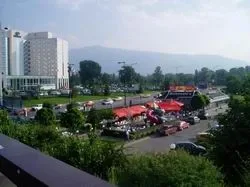
Located 18 km from Varna, this resort speaks for itself with its name. The sand here is truly golden and, despite the fairly dense coastal hotel development, clean. In general, these beaches are no different from other European ones - neat sunbeds and umbrellas, beach bars, catamarans and banana boats. Most of the hotels have been reconstructed, and almost nothing here reminds one of the Soviet past - except that some hotel categories seem somewhat overestimated by Western standards, and public toilets sometimes let you down. But in terms of the rest of the infrastructure, Golden Sands will give a hundred points head start to many Western European resorts. The place is fun and fashionable; the number of restaurants, disco bars, cafes, shops and stalls per square meter is simply off the charts. In the evening, a second life begins here.
Moreover, credit must be given to the Bulgarians, who have not forgotten their own traditions in the pursuit of Euro standards. Any resort in itself levels out nationality, but here you still feel local color: everywhere you can taste Bulgarian cuisine (more on that a bit later) and gawk at waiters in national costumes, and in some places even see a traditional Bulgarian dance on hot coals (they say there are not many skilled dancers left in the country). Restaurant prices are also pleasing: for $7-10 you will be served a real delicacy with excellent wine.
There is one romantic place on the coast where divers gather - a wild beach near the village of Shabla. The ambiance here is completely different: huge dark rocks, high foaming waves - Hawaii, nothing less! Not far from the shore lie fragments of military ships that sank during World War II. True, it is recommended that only very experienced divers dive here. But on the way back, you can stop at a restaurant that serves the best mussel soup on the coast (it is called "Dalboka"). There are very few tourists here, but among Bulgarians the place is very popular. The terrace is located on a steep shore right by the sea, and from a table you can see a small plantation where shellfish are grown.
Plovdiv - Kazanlak - Veliko Tarnovo
Plovdiv is a kind of Bulgarian St. Petersburg, the second cultural capital. Life here is unhurried, and everything around breathes art: concert posters flirt from ancient walls, ethnic musical instruments peek through the windows of an art workshop, seemingly ready at any moment to sound as a single orchestra, near an antique shop on the stone pavement a bearded craftsman concentrates on repairing an old ornate chair, in the lacy shade of a giant linden tree a boy plucks the silvery strings of a cimbalom, and from the window of a nearby music school come the trills of a Chopin waltz... The main scene completes the series of pictures: an ancient Roman amphitheater built 19 centuries ago by Marcus Aurelius. Of course, in such a place the theater could not simply turn into a museum: nowadays opera is performed there.
Kazanlak is notable primarily for the fact that in its vicinity, between two mountain ranges - the Balkans and Sredna Gora - lies the Rose Valley, where the famous Kazanlak rose grows, the main tourist fetish and almost official symbol of the country. Its fragrance has been replicated throughout the world by the traditional Bulgarian craft of rose oil. Five centuries ago the rose was brought from Syria and Iran, and since then this variety has been cultivated only here thanks to the unique microclimate that has developed in the valley. Against the background of blue mountains, covered with a light haze and slightly colored by miniature peasant houses, giant (100 hectares!) plantations of pink and white flowers stretch out, along the roadsides elegantly interspersed with wild scarlet poppies. On a hot afternoon, it seems the air has thickened with fragrance and you could drink it like a sweet cocktail. You stand in the middle of this splendor, and only bumblebees hum busily around - they have work too, they are brothers in trade with the rose pickers!
Here there is also a perfume factory - you can look into the massive vats where distillation takes place, and even watch a technologist who will make a fragrant (and most importantly, natural) gel-cream right before you. Based on rose water, they make literally everything - from foot cream to shampoo. All this wealth in simple plastic jars is sold in a shop at the factory and costs mere pennies, $2-3. By the way, from three tons of roses you get only a liter of oil, and only petals picked before 11 a.m. are suitable for production, as they are believed to have the most lasting fragrance.
Another place near Kazanlak that must be visited is the village of Shipka, where the Shipka-Buzludzha National Park-Museum is located. It was built in memory of the Russo-Turkish War (during which the Turkish yoke fell in Bulgaria), right on the site of the military actions of the Shipka epic of 1877-78. Personally, no war memorial (neither the Place de la Bastille, nor Pearl Harbor, nor Poklonnaya Hill) impressed me as much as this textbook monument of Freedom with a proud bronze lion on a pedestal. Perhaps it is so simple and ingenious because the Bulgarians had to wait as long as five hundred years for the moment of liberation from the Turks.
The next point of our journey was the ancient Bulgarian capital Veliko Tarnovo. The history of this city began back in the Bronze Age, in the third millennium BC. Later it was populated by Thracians, then Byzantines, and from the 7th century AD by Bulgarians, as evidenced to this day by a mass of historical monuments, the main one being the archaeological reserve of Tsarevets. A very colorful fortress rises on the hill of the same name, crowned by the high belfry of the Patriarchal Church, and to this day it is the face of the city.
Be sure to climb up and walk along its carved walls, savor this austere stone aesthetic, admire the view of the city and the high banks of the Yantra River. Inside the reserve there are many Orthodox churches, restrained and noble, without the blinding golden Byzantine excesses.
Tsarevets is a spectacle not only by day but also by night, and we are not talking about banal illumination. Several times a month, on the roof of one of the old houses on Piccolo Street, from where the entire fortress is visible as if on the palm of your hand, the "Sound and Light" show takes place. Its plot is dedicated to the struggle of the Bulgarians against the Turkish yoke. To the sounds of ethnic music, the labyrinth of fortress walls together with church domes alternately lights up in different colors, illuminated by the most powerful searchlights. For this reason, lighting on the surrounding streets is completely switched off, and everything around is illuminated by the play of laser beams. The uniqueness of the project lies in the fact that the searchlights are installed directly near the walls and are controlled remotely from a single point.
In general, Veliko Tarnovo is unique in its originality: the palette of its appearance whimsically mixes Slavic, Balkan, and Asian colors. You walk through the center - old cobblestone neighborhoods look primly European; you turn a corner - there is an Orthodox church, slightly resembling a mosque in appearance, and the banks of the Yantra are already layered with whitewashed houses hanging over the abyss - careless and carefree, with laundry "paintwork" like you only find in the south.
Lyuta Chushka - Pink Vodka
I won't be disingenuous: Bulgarian cuisine is not the most refined in the world, and therefore not so popular. But being in Bulgaria, you will most likely come to like it - if only because the Bulgarians themselves are its great patriots. The vast majority of local restaurants (mehanas) are decorated in the national style (the stripes of homespun napkins and rugs in red tones will for a long time afterwards evoke Pavlov's dog reflex in you) and offer national dishes.
Here they like to serve meat in pots with assorted vegetables and abundant gravy. Moreover, soaking up this very gravy with a piece of bread is not only not shameful, but customary. They say this custom appeared centuries ago, when families were large and there was not enough meat for all eaters. Perhaps that is why Bulgarian hits are still not meat dishes, but above all shopska salad (tomatoes, cucumbers and grated feta cheese under olive oil and vinegar sauce), an appetizer with a name funny to the Russian ear, 'lyuta chushka' (pickled, very hot peppers), banitsa - a most tender layered pie again with feta cheese. On the tables there is always sharena salt - a seasoning based on red pepper, thyme, turmeric and coriander.
Wines deserve a separate story. Bulgaria has a unique climate for winemaking - from one hectare of vineyards here they harvest up to a ton of grapes, while in France only 500-600 kg. Traditional wine varieties are Mavrud and Gamza (red), Misket and Demet (white). Almost all of Europe, Japan, China, Korea and even Latin America drink them. But in Russia, as we were assured at one of the old private wineries, Bulgarian wine in mass retail is not among the best. Another traditional local drink is rakia, grape vodka, as winemakers say, the cousin of cognac and armagnac. Of course, the Kazanlak rose could not help but make its mark in the local alcohol assortment - they also distill rakia from it, as well as liqueur. But these are already very specific drinks: after tasting the samples I brought, colleagues here joked for a long time - well, they say, we drank perfume too. But what fresh breath!