
WHEN PIZZAS ARRIVE
Italy is a great gastronomic power. Like any great power, it has many regions, each with its own traditions. In the north of the country they eat risotto, in the northeast - polenta made from corn flour, in Umbria and Piedmont you can try truffles, in the south you can feel the influence of Arab cuisine with all its almond-honey sweets. But there is something that unites all Italian regions, all islands and peninsulas: pasta.
In Italy, the word pasta refers to a variety of dishes: macaroni, dumplings of all kinds, and lasagna. Any pasta is by no means a side dish, but an absolutely independent dish. It is eaten instead of soup as a hot appetizer (in Milan they prefer rice) or as a main hot course. Italians are less interested in meat prices than in the availability of pasta in the nearby store. If pasta is served at a dinner party, know that it's just the beginning!
The history of pasta is the history of Italy in miniature; it has its own conquerors, its own heroes and commanders. Therefore, every Italian knows everything about pasta. Or almost everything. Each region of Italy has its own face, and the main feature in its portrait is pasta. Half a century ago, pasta was made at home by hand; each city and each family had its own signature dishes. Spaghetti and macaroni were invented in Naples, cannoli in Sicily. Also from Sicily come involtini - rolls of dough filled with spinach or meat.
There are two types of pasta: for one, the dough is kneaded from flour and water, for the other, from flour and eggs. Egg pasta is not dried; in supermarkets it is kept in refrigerators. “Water” pasta is made throughout Italy, while egg pasta is made in the Emilia-Romagna region. Fresh egg dough is called “sfoglini”. From sfoglini they make tagliatelle, tortellini, tortelli, tortelloni, strozzapreti, ravioli, passatelli, garganelli, cannelloni, mistocchine, cappelletti, cappellacci, maltagliati, magliatelli, anolini, and lasagna alla bolognese. All these dishes, including the sauces served with pasta, “ragù romagnolo” and “bolognese”, were invented in Bologna.
BOLOGNESE FLATBREADS
The Emilia-Romagna region is considered the gastronomic center of Italy. There, the great Po Valley proudly unfolds like a banner of haute cuisine - the birthplace of Parma ham, tender as Parma violets, and Parmigiano-Reggiano cheese, hewn from rock, and pink Bolognese sausage, and balsamic vinegar from Modena. There, in lush gardens, sweet pears ripen, ripe figs burst on the branches, and green kiwis fill with juice. And in deep cellars, in the dungeons of castles shrouded in legends, tender cheese matures, and velvety dense Sangiovese wine matures, to accompany it at the banquet table.
The main city of Emilia-Romagna is Bologna, which is called the culinary capital of Italy. Back in the Middle Ages it received the nickname La Grassa - “Fatty”. Even Bologna's main square has a gastronomic name: residents call it “crescentone”, like a large flatbread with filling in the middle. In Emilia-Romagna, not only pasta but also piadine are held in high esteem - flatbreads that are eaten instead of bread, cut into small sandwiches, or wrapped with filling and folded in half. Establishments that serve flatbreads are called piadinerie. Piadine were made back in Byzantine times. In addition, polenta is popular on the Po Valley - porridge made from corn flour. It is served as a side dish, mounded up like mashed potatoes. Porridge made from chestnut flour is called polenta dolce, while polenta nera, that is “black”, is buckwheat porridge. But the basis of Emilia-Romagna cuisine remains pasta.
IN THE MOUNTAINS AND BY THE SEA
Since Italy is a country not only of great gastronomy but also of great history, many restaurants and trattorias in historical places and ancient villages offer “medieval-style” dinners. There they serve stewed meat with wild herbs and fresh chicory, rabbit fried in spices. In Italy, meat primarily means veal and lamb. Sheep are grazed in the Apennines by natives of Sardinia. They also make caciotta cheese and prepare delicious dishes such as lamb chops with garlic and rosemary.
There is an unwritten gastronomic law: in the mountains you should eat meat, and by the sea - fish. Italy has four seas altogether, so its cuisine is inexhaustible. Fish here is grilled, added to frittata omelette, marinated, fried in olive oil. Most often the menu features red triglia, also known as red mullet, tender sole, sea bass bronzada, and sea bream orata. The people love “St. Peter's fish” - a variety of sea bream, and cannocchie shellfish - “little fingers”.
In the mountains, on the plains, and by the seashore, the fundamental principle of Italian cuisine remains purity of genre. That is, the creation of very simple dishes prepared from very high-quality ingredients. Fish here is always fresh, just caught; piadina flatbreads are freshly baked; pizza is straight from the oven. In any country trattoria, the products will be freshest, without any freezing.
Wine selection is taken very seriously in Italy. With meat they order only red, with fish only white. Italian wines that accompany the pure genre of the Mediterranean meal include the famous Chianti and Valpolicella, the excellent Sangioveze from the Sangiovese grape (the best is La Levata with a rooster on the label). In Ferrara they make a red wine Bosco Eliceo - “Elysian Forest”. They say that in this wine you can taste the flavor of the stars. With fish they serve, for example, Alcea Vivace from the cortese and chardonnay grapes.
GASTRONOMIC MONT BLANC
France is a country of haute cuisine. Its gastronomic peaks tower over the rest of Europe like an unshakable Mont Blanc. Here food is a way of life and is elevated to the rank of art, and great chefs are awarded the title of academicians and awarded the Order of the Legion of Honor. When Charles de Gaulle reflected on the unity of the nation, he said: “No one can unite a country that has 265 varieties of cheese overnight.”
When the English say “lunch hour,” the French are puzzled: “What do you mean, an hour? Only an hour for lunch?” Nevertheless, the French are the “thinnest” European nation. In this country of gourmets and gourmet restaurants, only 7% of the population suffers from overweight, and cases of obesity are practically unheard of. There is no contradiction here. The French simply treat food as an art. And you don’t get fat from art.
In France, as in Italy, any journey becomes a gastronomic one. A route along the Atlantic coast promises endless delights of seafood cuisine. The Côte d’Azur is fragrant with all the spices of sunny Provence, and light Mediterranean cuisine gives way to more substantial Alpine fare. Fresh salmon from the Loire, mushrooms from Saumur, game from Sologne, foie gras from Gascony, truffles from Périgord, Cavaillon melons from Orange, Bayonne hams, Alsatian meat stews — all this makes a stay in France true bliss for gourmets. Here you can travel the routes of Alsatian wines and Savoyard cheeses, the roads of cognac and the wine châteaux of Bordeaux. What about a trip through Champagne, Roquefort, Munster, Calvados, Cognac, Foix, Chablis, a walk through the Beaujolais hills, or a cruise along the Burgundy Canal!
Sea Delights
The Mediterranean coast of France embodies all the joys of life, including gastronomic ones. On the Côte d’Azur, which borders Italy and was once part of it, Italian culinary influence is still felt today. Here they eat gnocchi dumplings, pasta, and pizza, and adore pesto sauce made from basil, garlic, and olive oil. In France it is called “pistou.” Basil is included in all dishes that have the word “pistou” in their name: vegetable soup, macaroni, pâté.
Mediterranean cuisine is considered the healthiest in the world, practically dietary. In France it is more elaborate than in Greece, Italy, or southern Spain. The most famous cookbook of this region, “The Cuisine of Nice,” was written by the former mayor of Nice, Jacques Médecin. Needless to say, among its recipes there is a Niçoise salad with tuna and anchovies. This dish is found everywhere, unlike mesclun salad, which includes leaves of dandelion and bindweed.
In Provence and on the Côte d’Azur there are many famous restaurants, such as “La Chèvre d’Or” in the village of Èze or “L’Oustau de Baumanière” in Les Baux-de-Provence. But after a period of culinary experiments in the fusion style, chefs have returned to traditional local recipes, only slightly reinterpreted. The local cuisine is so good, the products are so fresh, and the vegetables are so aromatic that you can count on a tasty lunch anywhere — from a roadside diner to a café on the embankment. The cuisine is particularly good in the “hotel-restaurants” that thrive in the region. However, places in these hotel-restaurants are best booked in advance, especially on weekends.
The Côte d’Azur is a delightful combination of the sea and fragrant Provence, saturated with sun and the smells of herbs. “Herbes de Provence” have become a popular European seasoning, but only here do they appear in all their glory. The mixture of herbs, which includes thyme, rosemary, marjoram, oregano, and basil, is added to a wide variety of dishes, meat and fish.
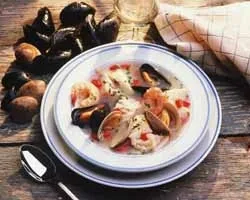
The most famous fish dish on the coast is the fish soup bouillabaisse. It is a giant bowl in which various whole fish, langoustines, and shrimp stand vertically. One serving of bouillabaisse is easily enough for two.
The proximity to Spain is felt only in Languedoc. It is not even proximity, but an inner kinship with the most “Frenchified” part of Spain — Catalonia. Here, grilled vegetables, garlic sauce aioli, and salad with bacalao (soaked dried cod) are held in high esteem. The ordinary French crème brûlée is called “crema catalana” here, and restaurants bear the names “Catala” and “Canigou” — the latter is a mountain peak in the Pyrenees, a symbol of Catalonia.
Tasty Legends
In the eastern regions of France, the influence of neighboring Germany is still felt — hearty, meat-eating. Burgundy is famous even in France for its food and its attitude toward food. Its inhabitants say that “paradise begins in the kitchen and ends in the wine cellar.” Another local saying is “better to eat well than to dress well.” In Burgundy, legendary wines are aged and legendary cheeses mature — for example, Époisses from the town of Époisses. Dijon mustard also originates from these places.
In the village inns of neighboring Alsace, they still make “baeckeoffe” — a stew of beef, lamb, pork, and potatoes that horrifies adherents of healthy and light food. And the capital of the province is famous as the birthplace of the Strasbourg pie. The inhabitants of Lyon also live according to the culinary clock. After a light French breakfast, a substantial meat lunch follows during the day — “mâchon.” This is a feast of all kinds of sausages, salami, stuffed hams. Lyonnaise meals are famous for their abundance and are accompanied by Burgundy wines and Beaujolais.
Another gastronomic paradise in France is the lovely green Périgord. Among the hills of Périgord stand fortress-towns called bastides, the Dordogne River flows, and ancient castles are reflected in its calm waters. Here they gather truffles and chestnuts, and the king of local cuisine is the pâté of goose or duck liver, foie gras.
Ocean Delights
Summer is first and foremost the sea, so summer France is associated with a light breeze and sun glints on blue waves. Of course, you can eat fish or shellfish in Paris too, but it is still more pleasant to sit in a small restaurant on the seashore. Or even on the ocean shore. The Atlantic coast attracts oyster lovers. Connoisseurs eat them only in months with the letter 'r', from September to April, and everyone else - all year round. The Oyster Museum is located in the town of Bourcefranc in Charente-Maritime, in a citadel built by Vauban. But the best oysters in the world are grown in Arcachon, a small town in the Art Nouveau style near Bordeaux. The Arcachon embankment is overgrown with tamarisks and huge plane trees, and there are veranda restaurants on it. When the sun sets into the ocean, the molten gold of the waves mingles with the gold of the skies, and blue shadows grow at the pier where fishing boats sleep. Until late at night, an old carousel spins, and painted horses carry riders into childhood.
Cheese lovers go to Normandy, famous for its Camemberts and apple wine Calvados. The signature dish of these places is tripe, cooked on a spit or stewed with Calvados. And in the north, they eat not only crêpes, but also buckwheat pancakes - 'galettes'.
To the south of the Atlantic coast lies the French Basque Country. The local cuisine resembles Spanish: Bayonne is famous for its 'jambon' hams, similar to Spanish jamón. Saint-Jean-de-Luz is the main tuna port; here it is prepared in all ways.
The main dish of the coast is the 'plateau de fruits de mer', a plate of seafood. Its size is worthy of Gargantua, and its content embodies the boldest dreams of gourmets.
WINE TASTING
If you go crazy at the smell of appetizing meat sizzling on coals, and the words 'shashlik' and 'kebab' have a special meaning for you, your direct road is to Cyprus. The island's cuisine has Mediterranean and Eastern origins with some features of English influence. However, both a seafood lover and a convinced vegetarian will feel at home here. Cypriots are proud of their cuisine, but they are even more proud of their wines.
The popularity of Cypriot wines grows every year. Today Cyprus is among the top five world wine exporters. Here they produce not only excellent table wines, but also brandy, liqueurs, sherry, cognac spirits, and grape vodka. But still, it is wine that brought fame to this Mediterranean island, whose production tradition here dates back more than 4,000 years. Even Egyptian pharaohs drank Cypriot wine, and King Solomon sang its praises in his poems.
On the outskirts of Paphos, not far from the old lighthouse built by the British, is one of the many ancient sights of this island - the ruins of a huge villa made of tufa, destroyed by an earthquake in the 5th century BC. In 1962, a peasant tilling the land here came across a huge mosaic panel depicting the revelry of Dionysus, the god of wine. Thus this dwelling received the name 'Villa of Dionysus'. The mosaics found here confirm the ancient history of Cypriot wines.
The island also loves rosé wine. It is pleasant and light to taste. But still, the most famous Cypriot wine, described by Homer, is the strong aromatic 'Commandaria'.
Now no one can say exactly when it appeared, but in Europe 'Commandaria' became known during the Crusades, when Richard the Lionheart sold Cyprus to the order of the Knights Templar. Cyprus began to be called 'Commanderies', and then this name passed to the thick and sweet wine produced here.
And today 'Commandaria' is made using an ancient technology: first, grapes of the 'Mavro' and 'Xynisteri' varieties are dried in the sun for two weeks to acquire a mature taste, then they are placed under a press and the grape juice is left to ferment in huge jugs until fermentation reaches 18% alcohol. Ancient winemakers, when it was time to bottle the wine, always left a little at the bottom of the jug, and the old wine helped the young one mature. 'Commandaria' is bottled after 10 years of aging.
His Majesty Meze
Cypriot wines cannot be separated from Cypriot cuisine. Eating on the island is a very important pastime. One can talk about Cypriot dishes a lot and for a long time, but every tourist is primarily struck by meze. It is difficult to explain in one word what it is. Simply put, it is a series of national dishes that are prepared in a particular tavern and are continuously served to the table. All this is considered one dish. The serving begins with all sorts of appetizers, of which there can be from 10 to 50(!). These include 'tahini' paste made from sesame seeds, 'talattouri' - chilled yogurt mixed with mint and finely chopped cucumbers, and 'hummus' made from peas, sesame paste, parsley, and olive oil. It is good to dip warm crispy pita into it.
When the turn comes for meat dishes, fried meat, spicy meat, smoked meat appears on the table; here you can also try 'himomery' - pork marinated for 40 days in red wine and sea salt, and then placed under a press.
Meze can be not only meat, but also vegetable and fish. Seafood goes very well with 'Tisbe' - a light white semi-dry wine with a fruity note - it is interesting because the grapes for it are harvested early to achieve a low sugar content in the wine. Set apart is Cypriot white cheese 'halloumi'. It is made from goat's milk with the addition of mint and is always served at the table. Plates with fried halloumi slices can be found at any meal. It is both simple peasant food and a matter of national pride.
On the matter of national pride. If you were to name the three main brands of Cypriot cuisine, a Cypriot will surely say: 'Commandaria, halloumi, zivania'. Any islander will first of all try to treat you to a shot of grape vodka - 'zivania'.