
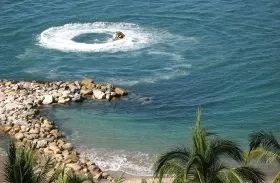
Tourists from all over the world come to Puerto Vallarta to admire the whales swimming into the local bay
The layout of Vallarta is extremely simple – it's a long road along the coast (22 km), to which hills covered with dense jungles have directly approached. The space between the shore and the hills is narrow, only six city blocks. Further, the hills turn into mountains so impassable that for about thirty kilometers to the east there is not a single settlement. In a word – the Cordilleras!
Until the 16th century, Indian fishermen quietly lived on the site of present-day Vallarta. Then the Spaniards came, tried several times to found a city, but somehow it didn't work out. Things got going after the Sanchez farming family settled at the mouth of the Cuale River in 1851.
In 1918, Vallarta received city status. Now it is a very popular resort, visited by 2.5 million people annually (and, by the way, only 1 million of them are foreigners). The city got its name in honor of the governor of the state of Jalisco – Ignacio Luis Vallarta.
Tourism began to develop in Vallarta in the mid-60s. The impetus for this was given by Hollywood – director John Huston filmed his 'Night of the Iguana' here with Elizabeth Taylor and Richard Burton. And this couple had a whirlwind romance during filming. At that time, Taylor weighed about thirty kilos less than now, so there was something to attract Burton. All this caused a scandal – Burton was married, moreover from a strict Catholic family, plus morals were less free then... The city was flooded with paparazzi who kept a close watch on the couple. Filming ended, the stars left, but Vallarta's reputation as a romantic place remained.
And that's when they started building roads, shopping centers, banks, restaurants, nightclubs and discos. Americans began coming to personally visit the place where Liz gave herself to Dick. And filmmakers continued to court Vallarta with their attention: in the mid-1980s, the current California governor, and then just a good guy Arnie Schwarzenegger (in the film 'Predator'), climbed trees here with monkey-like agility.
You can get to Vallarta by bus: from Mexico City in 13 hours, from Guadalajara in 5, from Acapulco in 18. By plane from Mexico City – 2 hours. There is no single bus station; each bus company has its own stop. A bus ride from the airport to the center costs $0.3, by taxi – $7. Travel within the resort, i.e. along the coast – also by taxi or bus. On all buses, the sign shows the names of hotels and beaches. There are water taxis (boats), but they are less popular.
The season in Vallarta is clearly divided into two parts: Mexicans come here in summer, foreigners in winter. Summer is rainy, winter is dry, but mornings and evenings can be cool. The opening of the season in November is marked by the Sea Festival (exhibitions and sailing regatta), a fishing tournament, and a national culinary fiesta (second decade of the month, specifically gathering 20 thousand people).
November 22 is City Day. And just at that time, humpback whales arrive to breed – right from the promenade you can see fountains of sperm above the water. And the season ends with Easter, at the end of March.
Shopping is not Vallarta's strong point. In small shops, not particularly necessary and interesting trinkets are sold, on the beaches low-quality silver and all sorts of tinsel are offered at cheap prices. Huichol people walk the streets with their colorful handicrafts. For them, Vallarta is the main opportunity to show themselves and sell their goods.
_