
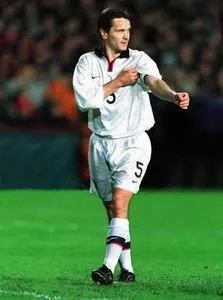
However, we have no business with the future Mourinho for now. Today it is much more important to note that one of the main protagonists in the Champions League final against Monaco was Russian midfielder Dmitry Alenichev. He came on as a substitute at 1:0 and took part in two more scoring attacks - he provided a goal assist, and a little later he 'signed' into the opponents' goal himself, 'shooting' at close range the Monégasque goalkeeper who had lost his composure.
Something similar was observed a year earlier in the UEFA Cup final, in which Porto's opponent was Scottish Celtic. The Portuguese won 3:2, and Alenichev was remembered not only for his bright play, but also went down in history by scoring a goal and making an assist.
And yet, once upon a time, a native of the town of Velikiye Luki, located in Pskov Oblast, did not even dream of such success. At the age of 10, he and his older brother Andrei signed up for a football section. Both set themselves the goal of breaking into the team of the regional center. Andrei conquered that height, but Dmitry, having made it into Pskov's Mashinostroitel, did not rest on his laurels.
Later, answering journalists' questions, Alenichev recalled: "I was born in a small provincial town, and there was nothing else to do there but football. My brother and I constantly kicked a ball in the yard, and one day a children's school coach noticed us. Life in Velikiye Luki was slow and calm: school, training, home. There were no entertainments in our town - just a simple village life. A desire to escape the village? It existed, but it appeared when I was already playing in Pskov, in the second union league. In general, now I understand that what I had planned many years ago came true. I am very grateful to fate for its gifts. Once I wanted to go to Moscow, then the desire to play in Europe appeared. Fortunately, that is how it turned out. I was invited to Lokomotiv, and later to Spartak."
Interestingly, the Lokomotiv coaches went to watch a game of the Pskov team with the aim of seeing not Alenichev, but another footballer. They returned home with a firm intention to get their hands on a young midfielder with a bright creative head. Then there was a three-year stint at a Lokomotiv that at that time lacked stars, and then - the dream of most Russian footballers of the early 90s - an invitation to Spartak.
At first, it was difficult for Dmitry to break into the starting lineup, because Valery Karpin played in his position on the right flank of midfield, but soon he left for Spain, and Alenichev made a strong start to the 1995 championship. He started... and relaxed. He broke the regime and ended up in the reserves. As the footballer himself says, these are mistakes of youth. "Moscow is Moscow. When a young provincial unmarried guy comes to the capital, the wind blows in his head. He wanted to go to a bar and a disco. I partied a little, but it's good that I stopped in time."
Oleg Romantsev carried out educational work, and Alenichev, whom life had taught from childhood to endure hardships and train frenziedly (his family was modest: his parents worked at a factory and knew the value of a hard-earned penny), regained the coach's trust.
In 1997, he was the best player in the country, demonstrating brilliant football on all fronts - domestic and international. His 20 assists in a season is still an unsurpassed achievement. In the summer of 1998, the celebrated Roma became interested in him. The Italians paid $8 million for Alenichev, but the Russian legionnaire did not settle in the Roman team. Although coach Zdeněk Zeman personally insisted on his signing.
In Italy, Alenichev liked everything - the people, the amazing football atmosphere (even respectable matrons are not averse to chatting about Roma's chances for the title), the climate, the unique architecture. He lived in a spacious three-room apartment almost in the very center of Rome. There was an opportunity to settle in a villa of an extraordinary country club, in a quiet green corner, but according to Dmitry, the quiet and sleepy coziness of the Roman outskirts is not for him (apparently, he had had his fill of it in Velikiye Luki). Alenichev preferred to feel the rhythm of life. He quickly learned the language, brought from Russia a bunch of videocassettes with domestic films, installed a satellite dish that allows him to watch Russian TV channels. In addition, his girlfriend Nastya moved to the Italian capital with him, and soon became his wife. What more does a person need for happiness?
But football matters did not go as desired. Zeman preferred rigid tactical schemes to improvisation, and Alenichev, accustomed to a different style of football, could not find himself in Roma. Moreover, the role of playmaker and improviser in the Roman team was given to the idol of the local public, Francesco Totti, while the rest of the outfield players had to blindly carry out the tasks assigned by the coach. The Russian did not lose heart: "Everything will be fine. With a serious attitude to football, I will certainly start playing. Not making the lineup? I was sure it would be like that at first. Things cannot always and in everything go smoothly. In Spartak, too, I didn't make it right away..."
It turned out that under Zeman, Alenichev's affairs in Roma were still going very well. A change of coach occurred after an unsuccessful season, and the titled Fabio Capello took the reins of the team, who was an even more scrupulous tactician than Zeman. After 20 matches in the first Italian season, Alenichev played only seven in the second. The opportunity that arose in the middle of the championship for a swap between Roma and Perugia was used to the maximum by the Russian player. His agent agreed on the transfer of Japanese player Nakata to Roma, whose place in Perugia Alenichev was to take.
By that time Dmitry was clearly dissatisfied with his position: "When I left Russia, I clearly realized that in Roma, by and large, I would have to start my football career anew. Thanks to Tetradze and Kolyvanov, who were playing in Italy at the time, for saving me from many illusions. It was they who helped me understand: in this country few care that Alenichev is a four-time Russian champion. In the opinion of tifosi and journalists, that is certainly good, but there is very little left - to prove that you can play at the same high level in the local championship. I can't say that I succeeded. Although I don't feel disappointment: I did score three goals and give six assists. Not such a bad indicator."
Do I consider myself offended? No. Should I be angry at the whole world and tell in every interview what a bad and unfair coach I have? But we have excellent relations. The only recipe is to come to training earlier than your partners and leave later.
Not everyone manages to get an offer from an Italian club. It is hard to resist the temptation to play in the strongest national championship. But who could have guessed then that everything would turn out this way? After all, I was taken at the insistence of the coach, who preferred me to his compatriot, and that says a lot..."
Things did not work out for Dmitry at Perugia either. As it turned out, the Russian midfielder was simply imposed on the team's coach Carlo Mazzone. The club's president, the unpredictable Luciano Gaucci, agreed to invite the player, and the coach had to obey. But Mazzone could not find a place in the team lineup for Alenichev. Or did not want to, which, in principle, no longer matters.
In the summer of 2000, the Portuguese approached the boss of Perugia with a request to sell Alenichev. At first Gaucci agreed, having agreed on the buyout amount, but then suddenly stalled the process. The Russian was in shock: "A stupid story with secrets of the Madrid court. One moment Alenichev is leaving Perugia, the next he isn't. Portuguese and Italian journalists were ready to eat me alive. Thank God, everything was decided within two or three days." As a gift for the beginning of a new stage in his career, his wife gave Dmitry a daughter, who was named Polina.
It is worth noting that after this a clear run of good luck began in Alenichev's career. The Russian player's family initially settled on the ocean shore. "It turned out that the weather in Porto is absolutely unpredictable," says Dmitry. "One day the sun is shining, and the next day it may rain and a terrible wind may blow. Near the ocean these phenomena are very significant. So after a year we decided to move and now we live in a four-room apartment in the city center. But I am not going to stay there. Because I decided to return to Moscow after finishing my career."
Apparently, Alenichev will not be ashamed of his performances in the West. After all, which of the Russian football players can boast of winning the UEFA Cup or the Champions League? And Dmitry won both...