
Voluntarily-Compulsorily
In his student years, the author of these lines, like millions of Soviet students, went to harvest potatoes. Today, living in America, I recalled that invaluable and paradoxical experience of voluntary-compulsory labor when I was drafted to work in a court. The judicial system in the States is structured so that the vast majority of cases, both criminal and civil, are heard by juries. There are hundreds of courts of various levels, thousands of cases are heard daily, so a constantly replenished legion of jurors is needed. Where to get them? From the thick of the masses.
Every US citizen is a potential juror. Except for people over 70, firefighters, doctors, nurses, lawyers. And, of course, criminals. Also those who care for young children and the elderly, those without a car and unable to use public transportation. They may accommodate a manager or entrepreneur if he proves that, say, a week's absence would cause his business to collapse.
Although it is not advertised, the jury selection net is not blind at all; it scoops up masses from existing lists of registered voters and motorists. Thus, people who are initially socially passive and the horseless rabble are cut off. The latter is fair only for America with its almost 100% motorization. As usual, there are those dissatisfied with this selection: they say, I go vote, and for that I am also dragged into jury duty. Nevertheless, Americans faithfully fulfill their sacred duty.
From the list, jury selection is done by the electronic "poke" method - the computer selects candidates. Some are lucky, some are not. One person never gets a summons in his life, another gets one every five to ten years. Mistakes happen too. My wife had just served her duty when a year later she received another summons. She had to call. They apologized. Under New Jersey state law, there must be a pause of at least five years between calls to jury service.
But you cannot escape fate and the eye of the authorities. So I recently received a short notice by mail. I was invited to come to the New Jersey state court as a candidate for jury duty. The word "invited" should not be misleading. Just try not to show up without a valid reason! You don't mess with courts in America. They won't throw you in jail right away, but they can easily hold you in contempt of court and fine you.
Natural Selection
At the appointed morning hour, I find myself in Paterson, where I arrived, like the vast majority of my fellow "lucky" ones, by car, which is left in a special free parking lot for jurors. What can be said about Paterson? In its center stand pompous administrative buildings, including a state-level court, a legacy from the time when the city was wealthy and prosperous. But then something went wrong. The people here now are mostly poor, immigrant. The crime rate is high. On some streets, a white person is not recommended to walk even during the day. Some of the terrorists who attacked America on September 11, 2001, lived here for a time. By the way, the action of John Updike's new novel "Terrorist" also takes place in Paterson.
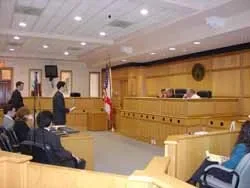
From the parking lot, we are taken in government buses for about ten minutes. They let you into the court like an airport. You go through a metal detector, and put your belongings on a conveyor belt with X-ray. But the atmosphere is more relaxed: the cops joke, smile. Formal routine, of course. We go up to a large hall. A podium, rows of seats, a huge TV on the wall. The crowd is diverse, about two hundred people. A court speaker, and then the county sheriff, greet the crowd of potential jurors with routine words that have more cynicism than pathos. By the way, Americans at the grassroots level cannot stand propaganda claptrap, and try to speak with humor about official but unavoidable things.
We are called by last names and distributed into several groups. Each group is to go to a specific courtroom where the selection will actually take place. A criminal case needs twelve regular and two alternate jurors. A civil case needs six regular and the same two alternates. If you are not selected right away, you immediately go home. But you come back to court for the next two days, going through the same procedure. If the finger of fate does not point to you even on the third try, consider that the torpedo has passed you by - for several years. Actually, that's what happens to most people who get summonses. Three days of appearing in court, and then free again. I, however, was "lucky": I was chosen for the jury in a civil trial. And without quotes, really. Sitting for many hours over an entire week is, of course, a tedious affair and not good for your health, but you get a most interesting experience.
The jurors were selected by the attorneys of both sides under the supervision of the judge who was to handle the case. The judge briefly outlined the essence of the conflict. A woman is suing her former employer for wrongful termination, in her opinion. Here and henceforth we will not name names for reasons of confidentiality. One female candidate for jury duty excuses herself: she personally knows a party in the conflict. A man says that he himself was recently fired and cannot be objective. The judge does not require any proof from them and lets them go. The rest are interrogated one by one according to a standard scheme: first name, last name, education, marital status, profession, place of work. The attorneys decide whether the candidate is suitable or not. All too young and all poorly educated were turned away.
And so the eight are formed, and the bailiff immediately escorts us to a room adjacent to the courtroom. The bailiff, who is also the duty police officer, oversees the jurors and maintains order during the trial. In addition, he also functions as a gofer for the judge, for example, when it is necessary to bring physical evidence into the courtroom. But most of the time, this cop sits on a hard courtroom bench, earning seniority and hemorrhoids.
The jury room has a Spartan atmosphere: no windows, a table, chairs, an indispensable coffee machine, water, and two toilets at the back. Remember the film and play "12 Angry Men"? Fifty years ago, that's how it was: jurors were all white men. Today it's Noah's Ark: an Italian, a Mexican, a Filipina, an Indian, a Jew, a half-Irish half-Italian, another lady—I couldn't figure out her lineage, seems Eastern European. And I am a Russian—in America, everyone from the former Soviet Union is called that. Age: roughly 35 to 65. Occupations: a contractor, a medical office worker, a programmer, a high school teacher, a bus driver, a college dean, a saleswoman, a journalist.
Over time, we got acquainted, in a purely American way, that is, superficially, without delving into each other's souls, understanding that we'd soon wave goodbye. Two men started playing cards, one woman immersed herself in a textbook, the dean chatted endlessly on her cell phone. The rest read newspapers, ate sandwiches, chatted about this and that. Television and radio are prohibited in the jury room.
Thus began the daily routine of our jury, seven full working days, from Monday to Wednesday of the following week (Friday and weekend off). You ask: what about regular work? Nothing: the law releases the juror from his "workstation" for the duration of the trial. And the employer is powerless to do anything—cannot fire, cannot punish—no way! Some pay the absent employee in full, some deduct the amount the juror receives from the state for court service ($5 per day for the first three days and $40 for each subsequent day), and some pay nothing at all. My neighbor on the court bus complained that this honorable duty was costing him dearly. He owns his own business and is losing money catastrophically. But he didn't try to dodge or lie to get out of the unprofitable "potato." In general, most of my fellow jurors took their mission seriously.
Kindergarten
But the case we got—you couldn't make it up! The judge, venerable age, well over 70, in a black robe, speaks slowly, quietly, at times seems to be dozing off, but sees and notices everything. The plaintiff, a black woman about 40, large build, eyes sparkling. The defendant, head of a large organization, an elderly, lean man with silver hair, with a frozen look of astonishment on his face: as if to say, why me? But they are only formally the main characters at this festival of Themis. The lawyers for both sides run the show. For the defendant, a tall, dignified gentleman with a perfectly styled haircut and a manner of looking at everyone sideways, as if his neck is stiff. For the plaintiff, two young ladies—one older and more biting, the other very young, clearly not catching mice, but at least not making faces. I give not the most flattering descriptions very confidently because I observed this "mask show" forcedly attentively for long, long hours.
The plaintiff claimed she was fired out of revenge. She managed a kindergarten that was part of the defendant's multi-profile organization. An incident occurred. The little ones in the younger group were scuffling on the floor. A girl of about three complained to the teacher: "Johnny (name fictitious) touched me." And pointed her finger somewhere down, at her skirt. The teacher took the girl to the restroom, made sure she was okay, and returned. As required by the instructions, the woman described the incident in a report. The report went up the chain of command, which considered the incident closed. The plaintiff was on a business trip, and when she returned, she made a scene: why wasn't she informed of the incident, why wasn't the report shown to her? She made noise, demanded a detailed investigation, and in a conversation with the director, the future defendant, she threatened to complain to the proper authorities if she was not shown the report. In short, one thing led to another, and the situation escalated.
The incident itself is not worth a dime. Johnny is four years old; whether he touched the little girl or not, no one knows. And even if he did touch... He's not some hardened pedophile, but an innocent, foolish child.
But the threat to call the oversight body that investigates cases of sexual violence or harrassment (how to translate that—intimidation, maybe?), combined with the dismissal that followed a couple of weeks later—that can be used as grounds for accusations of revenge against a truth-seeker. The claim: the plaintiff sought the truth, but the bureaucrat tried to sweep things under the rug. And punished the employee by firing her. In America, they often go after whistleblowers, who, like the honest parrot from Khazanov's monologue, shout to the whole world: "The tigers aren't being given their meat!" And the American judiciary, along with the press, vigorously defend the right of brave souls to air the dirty laundry of any scale, be it the FBI or some corporation.
Formally, as the two female lawyers for the plaintiff tried to prove, this was precisely a case of retaliation against a truth-seeker. So now let the respectable organization fork over a couple of million in compensation for the humiliation and suffering of the unemployed kindergarten director.
At this point, I must mentally applaud the defendant's lawyer. In an elegant manner, he dismantled all the arguments of the opposing side. Practically all the witnesses called, who were questioned alternately and together by the lawyers, involuntarily succumbed to the logic of his clearly formulated questions. The real picture of what happened became clearer to us eight lay assessors with each passing hour and day. And it turned out to be not at all what the defense of the fired woman had passionately described.
We returned for short breaks and lunch to our windowless room. For lunch, you could eat what you brought or go to the court cafeteria or the little restaurants on the neighboring streets. Although formally, until the end of the hearings, jurors are forbidden from discussing the case, we of course discussed it quietly. And we came to a unanimous opinion: the lady decided to make easy money, and the director was right to fire her, because, due to her obviously unbearable character, she had quarreled with all her coworkers.
So, when the tedious questioning of witnesses ended, to everyone's relief, everything was resolved very quickly. Before sending the jury to the deliberation room, the judge, at his own discretion, chose six out of eight as the main jurors and sent two to sit on a bench in the hallway. Alas, your correspondent ended up being left out of the final discussion. You might ask: why bother dragging people around for nothing? Just in case: if one of the main jurors suddenly falls ill, they must be replaced by someone with the same volume of information about the case being heard.
The Filipina woman and I didn't sit on the bench for long, about half an hour. In court practice, deliberations sometimes drag on for many hours or even days. But in our case, everything was crystal clear. We were invited into the courtroom, where the judge asked everyone to stand, and the jury foreman, a Mexican, read the verdict: 6:0 in favor of the defendant. If you add our votes, it would have been 8:0. The lady lost but was smiling. The lawyers were smiling. But the victorious director was sad; apparently, he was tired of the litigation.
Exhausted and therefore silent, we got on the bus, rode to the parking lot, and dispersed. I thought about what a rich and unreasonably generous country America is, if a single phrase from a three-year-old child is enough to set in motion the huge and expensive machine of Themis. Just imagine: a judge with a substantial salary, lawyers with their fees, a bailiff, a stenographer, external security, the rental of the courtroom, the maintenance of the courthouse, eight of us jurors taken away from our jobs for a week. So, hundreds of thousands of dollars went down the drain on a case that, in my amateur opinion, should never have been accepted for consideration as it was initially frivolous. But on the other hand, the spirit of Vasily Lokhankin suddenly spoke in me: perhaps in this extreme sensitivity to the slightest threat to personal freedom lies that great humble truth?