
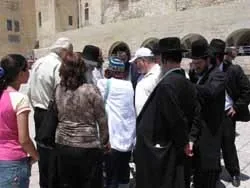
Valery Dubinin came to Israel seven years ago. He speaks Hebrew fluently and, according to him, has settled well in Israel. He did not go into detail about his life but admitted that he could not have imagined that his documents confirming Jewishness would raise doubts among officials and be sent for handwriting analysis. "I am a Jew. Israel is my land and my country, and I will live only here," the Israeli newspaper Jerusalem Post quotes Valery as saying. For him, being recognized as a Jew has moral significance. The Interior Ministry's decision also shocked the rabbinical court judges. "There is no doubt that in heaven he will be considered a Jew. I would be glad if Valery prays in my synagogue," one of the rabbis said.
This case is far from the only one where immigrants from CIS countries have to prove their Jewish origin in court. In the USSR, Jews often had to hide their nationality; many burned relatives' birth certificates or bribed passport office employees to write "Russian" in the nationality field. The situation changed after 1989, when many wanted to "become Jews" and gain the right to live in Israel. Therefore, the Israeli Interior Ministry thoroughly checks those who raise even the slightest suspicion. Sometimes these checks take years.
At the Israeli center "Shorashim" ("Roots"), which helped Valery Dubinin gather documents to confirm his Jewishness, they said: "Despite the rabbinical court's decision, the Interior Ministry may not recognize a person as a Jew. Such cases have happened more than once. The Ministry's conclusions are based on documents whose origin and content are not disclosed by the Ministry's staff." As a rule, the rabbinical court's decision is recognized by the Ministry. But in this case, the Interior Ministry has information refuting Dubinin's Jewish origin. The Ministry does not intend to disclose this data, as the information is of a private nature.
Based on the Interior Ministry's decision, a person or an entire family may be deported. Moreover, the Ministry does not always bother with a thorough check. For example, about a year ago, all of Israel was shocked by a story in which a landlord in the city of Dimona, wanting to evict his tenants before the agreed term, wrote an anonymous letter to the Interior Ministry claiming that the family had come to Israel with forged documents. Without investigating, officials from the local Interior Ministry branch demanded that the family leave the country immediately. The situation was saved by journalists who intervened in the conflict in time.
Valery Dubinin, unlike other former USSR citizens suspected of forging documents, is not threatened with deportation. The Interior Ministry only doubts his Halakhic Jewishness. Halakha is the religious norms according to which nationality is passed through the maternal line. At the same time, according to the Law of Return, Jews, as well as children and grandchildren of Jews, have the right to repatriate to Israel. In other words, if a person's mother is Russian and father is Jewish, he is not considered a Jew in Israel, but he has the right to live in the country and receive all benefits, including 1,430 shekels ($317) per month for six months.