
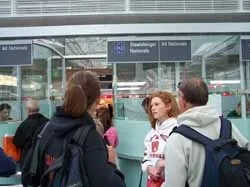
Perhaps the only settlement that became famous in the world not for involvement in military history, but for a completely peaceful, though no less grand event, was the tiny Luxembourgish village of Schengen: it was here in 1985 that the European agreement on the abolition of internal borders was signed.
Since December 21, Schengen has expanded: eight Eastern European countries, as well as Malta, officially joined the Schengen area. Border control at the 'internal' borders has been lifted and replaced by selective checks on the roads, and duties for crossing borders have been abolished. For this occasion, in the German city of Zittau, located at the intersection of the borders of Germany, Poland, and the Czech Republic, a celebration was even organized, similar to the one that took place when Eastern European countries joined the European Union in 2004. Exactly at midnight, the skies lit up with fireworks, thousands of people began to wander back and forth on foot with delight, asserting their right to visa-free walks across borders, and on the road leading to Germany, a traffic jam even formed: about two dozen drivers almost fought for the right to be the first to cross the now completely open border.
A world without borders, freedom of movement – the dream of many generations of cosmopolitans is coming true today, at least within Europe. With the accession of Eastern European states to Schengen, borders are disappearing almost everywhere – from Russia to Gibraltar. The exceptions are perhaps Cyprus – on its own initiative, and Bulgaria and Romania – in the hope of joining as soon as possible.
Border structures at the borders that are now becoming internal are being dismantled, most of the border service employees who served there are being transferred to other places, and the remaining ones will engage in selective checks and so-called 'indirect control' – covert surveillance of movement that does not require checking visas, permits and other red tape. Instead, the external borders of Schengen are being additionally strengthened – with countries not included in the European zone of free movement.
This is already being felt by many residents of CIS countries: getting a visa to the Czech Republic, Poland, the Baltic states has become much more difficult than before. In Kyiv, queues at the consulates of Poland and the Baltic countries have significantly increased, many complain. A group of students who wanted to celebrate the New Year in Vilnius are disappointed: the Lithuanian consulate refused them this opportunity. 'Shuttles' commuting between Ukraine and Poland are frightened: there are rumors that strict restrictions on the import and export of cigarettes and alcohol will be introduced. All these restrictions are not the own initiative of the states that joined the Schengen area, not a desire, as many believe, to 'curry favor with Europe' or 'wipe their feet on neighbors'. Such are the common requirements of the countries parties to the agreement: internal borders disappear – external borders are strengthened. So we still have to live to see a 'world without borders'.
Many residents of Western European countries express concern about the openness of borders to the East. They believe that the police and customs services of the Schengen newcomers will not be able to cope with controlling the movement of illegal migrants, traders of unlicensed goods, and other lawbreakers. Their concerns are justified to a certain extent, but the paradox is that the law enforcement agencies of Eastern European countries have actually turned out to be better prepared for the opening of internal borders than their colleagues from Western Europe. For example, the German border service stated that it does not have sufficient resources to effectively control the border space with Poland and the Czech Republic, and the Austrian authorities officially warned that the opening of Austria's eastern borders is forcedly postponed – for technical reasons.
It did not go without curiosities. Residents of the small village of Eberswalde, located right on the Polish border, frightened by rumors of an invasion of thousands of Eastern European criminals and illegal migrants, set up their own border instead of the disappeared state border: they put up barbed wire barriers at the entrance to the village, next to which a homemade 'people's volunteer squad' armed with hunting rifles stood for several hours. The police who arrived at the scene sent the 'border guards' home not so much by force as by persuasion, and the mayor of Eberswalde appealed to journalists, begging them not to publicize this stupid incident.
Moreover, the border guards themselves were dissatisfied with the new transparency of borders. While the employees of customs and border services of Eastern European countries were almost in full force thrown into strengthening the external borders (except for those who will now be part of international patrols on the 'former border'), their Western European colleagues were not so lucky: 40% of the personnel were suddenly laid off. Most of them either way expected to retire due to age, but there are also those who lost their jobs not of their own free will.
German firefighters are even more unhappy with the opening of borders. According to them, in the pre-New Year period, tons of unlicensed rockets, firecrackers, poppers, and other explosive materials come from Poland to Germany every year. Now, when border controls have been lifted, the amount of 'New Year's ammunition' that does not meet German standards and is banned for sale in Germany could increase tenfold. So the German authorities quite officially, on television, addressed the country's residents with a warning: remember – fires resulting from the use of 'Schengen' New Year's rockets will not be paid by any insurance company. Not to mention possible injuries. So now all hope rests on the Polish police, who reported their full readiness for Schengen.
Boris ALTNER.
IA Rosbalt