
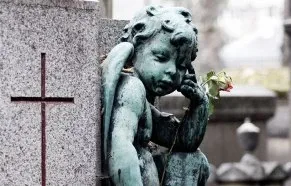
Père Lachaise is the most famous cemetery in Paris
And even if one slightly tempers the romantic agitation, for many, cemeteries still have a special semi-mystical aura, especially those where the greatest of the great have found their final resting place.
Every big city has its own cemeteries, but only in Paris are they surrounded by such reverent love, and only in Paris are they visited by such crowds of tourists. It is not surprising: an incredible number of celebrities are buried here, and this puts Parisian cemeteries completely beyond competition.
• When going to Parisian cemeteries, many Parisians and guests of the French capital bring flowers, ritual wreaths made of artificial or fresh flowers. In this way, anyone can honor the memory of the great people buried in Parisian cemeteries.
Père Lachaise
The most famous cemetery in Paris is, without a doubt, Père Lachaise. When you get here, you get the complete illusion of a city within a city. The cemetery is surrounded by a mighty wall, beyond which there is absolutely no city noise and complete tranquility reigns, interrupted only by visits from noisy admirers of one of the residents. This wall, by the way, has repeatedly served as a shelter during various historical cataclysms: for example, Napoleon's defenders of Paris hid behind it, and the Paris Communards held their defense here (they were also shot here).
The history of Père Lachaise began a long time ago and at the same time relatively recently. The cemetery itself was built in 1804 on the initiative of Napoleon Bonaparte, who generally liked to deal with issues of urban planning, including cemetery affairs. And before 1804, the site where the cemetery now lies belonged to the Jesuit order. The name of one of their spiritual fathers, François de La Chaise, became the name of the cemetery.
In the 17th century, there was a very popular monastic garden at this site, however, open for public promenades. There were many refinements. Taking advantage of the considerable territory (43 hectares) and the peculiar terrain, the monks arranged many attractions for visitors: waterfalls, greenhouses, rare plants, grottoes, and fountains. The Sun King Louis XIV fully assisted the pious Father de La Chaise, but with the death of the monarch, all this splendor fell into decline.
A hundred years later, the plot was acquired by the Paris municipality to set up a cemetery, the shortage of which was quite noticeable in Paris. They say that in a small cemetery near the market known as the "Belly of Paris," the ground level was several meters above the pavement level. And the spread of this huge dump of the dead was only restrained by high walls.
At first, the Père Lachaise cemetery, located on the outskirts of the city, was not particularly popular, but after the remains of Pierre Abélard, La Fontaine, and Molière were transferred here, Père Lachaise acquired the necessary respectability. Over the last 150 years, hundreds of great French people have been buried here. And not only French: there are graves of famous Poles, Britons, and even Americans.
Getting to the Père Lachaise cemetery is very easy. The Philippe Auguste metro station on line 2 is located next to the main entrance. By the way, don't let yourself be confused: you should not get off at the station of the same name, Pere Lachaise, because it is quite far from the cemetery. At the main entrance, at the Père Lachaise tourist information office, you can get a completely free map of the cemetery. It is not open on holidays and weekends, but you won't be left without a map: at the second entrance there is an enterprising fellow who sells these free maps for 2 euros. He does not dare to position himself at the main entrance, probably because he does not want to be an eyesore to the security.
Immediately behind the gates of Père Lachaise, curious tourists find themselves on the main alley, where the great composer Rossini and the famous entrepreneur, Baron Haussmann, who completely changed the face of Paris in the mid-19th century, are buried.
If you turn right immediately before the alley, after 150 meters in a rather abandoned corner you can see the tomb of Abélard and Héloïse, a legendary couple who managed to carry their love through the centuries. Pierre Abélard was a monk, an outstanding theologian of the 11th century. He fell in love with his student Héloïse, but they were not destined to be together. Héloïse's evil relatives caught them during a romantic rendezvous, castrated Abélard, and imprisoned the girl in a convent. So they ended their days in monasteries, and their relationship forever remained the embodiment of pure, platonic love, which for dissolute France, you will agree, is a great rarity.
Moving further and turning left at the first path, we pass by the grave of the talented Guatemalan writer Miguel Asturias, a representative of the so-called «magical realism» and winner of the Nobel Prize in Literature.
Twenty meters further is the tombstone of the great Frédéric Chopin. This is a place of pilgrimage for tourists from Poland: one group replaces another, throwing piles of fresh flowers onto the white marble pedestal.
Near the circular square you will find a real labyrinth of alleys and paths. In them are hidden the tombstones of Molière and La Fontaine, resembling massive tables on legs and placed behind a single fence. Here, too, it is usually crowded with groups of visitors – typically French schoolchildren diligently studying the literary traditions of their homeland.
However, in the opposite direction from the round square lies the leader of the band 'The Doors', Jim Morrison. They say that before there was a small bust on his grave, but it was stolen by crazy fans. Around Morrison's tombstone there is constantly a crowd of people, the grave itself is always literally covered with flowers and notes from fans. However, I did not notice any particular disorder there, although the cemetery workers believe that Morrison's visitors cause them the most trouble and even started discussions several times about reburying the musician. But in the end, they left dead Jim alone.
By the way, I have seen references in our press several times claiming that violent Morrison fans have completely trampled the neighboring grave of Oscar Wilde. That is complete nonsense: Wilde's grave is at the other end of the cemetery.
The terrain of Père Lachaise is quite intricate. If you move left from the main alley, after 200 meters an imposing hill appears. On it you can find the graves of Balzac and Delacroix. Balzac's bust is stern and demonic, it actually crowns the hill and looks at the mess spread before it sternly and with some contempt.
Descending the hill to the plain in the direction from the central entrance, you proceed to the resting places of the famous French poet of Polish origin Guillaume Apollinaire, who has a stylish obelisk, and the no less famous writer Marcel Proust, whose marble tombstone is modest but elegant.
Among all the burials that are most popular at Père Lachaise, it is also worth highlighting the graves of Oscar Wilde and Édith Piaf. The overly pretentious tombstone of considerable size that crowns Wilde's grave is hidden in the most remote part of the cemetery. Around it there is also usually a lot of people, always fresh flowers and many notes from fans.
Wilde's monument is covered from top to bottom with lipstick prints – traces of kisses from people of both sexes, testifying to their ardent love for their idol. Crazy fans manage to scribble messages to the afterlife even on the monument itself. The only consolation is the modest size of the inscriptions (no one has yet thought to use spray paint).
On Édith Piaf's grave, for some reason a tiny guitar sits next to a horizontally placed crucifix. There are fewer notes here, but more flowers. Nearby, around the corner amid an endless sea of tombstones, lies the resting place of Amedeo Modigliani. On his grave, I found a single carnation.
Here, perhaps, we will stop, because even internet space would be insufficient to list all the notable places of Père Lachaise. Take a map in hand (without a map, as Gazeta.ru notes, there is nothing to do here) – and go ahead: 3-4 hours of intensive walking are guaranteed. And don't forget to stock up on food: no one sells pies or coffee at the cemetery. But quite decent and free toilets are available in the administrative building (near the main entrance).
Also read related material: ON PARIS NECROPOLISES: MONTMARTRE AND MONTPARNASSE