
But everything comes to an end. People are tired of war. And peace came to the blessed land. Over 12 years, the wounds of war have healed, the country has risen from the ashes and again opened its doors to guests. The great city, as before, hovers over the sea like an iceberg of snow-white buildings.
The first mention of Beirut, the capital of modern Lebanon, is found in Egyptian texts written three and a half millennia ago, and the city gained the greatest fame during the heyday of the Roman Empire. In the 3rd century, Emperor Justinian founded in Beirut one of the most influential law schools, which developed the famous Code that became the basis of the entire European legal system. The city gained particular popularity during Byzantine rule and the Crusades, when magnificent garments of purple silk fabrics and velvet, created by city craftsmen, were presented on behalf of the emperor to European monarchs as a sign of special favor.
Since the 16th century, during the reign of Emir Fakhr ad-Din, palaces began to be built here, which could have turned the city into perhaps the most beautiful capital of that time, were it not for the exhausting wars, earthquakes, and tsunamis that constantly destroyed it. But the city always revived. New palaces, churches, and mosques rose from the ruins, coexisting with surviving reminders of days past.
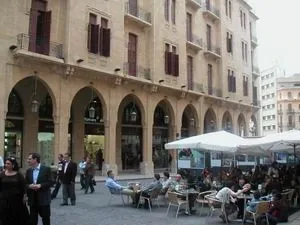
That is why today's Beirut is an amazing mosaic of times, a mixture of architectural styles, where among concrete boxes one can see surreal Roman columns, looking absurd among asphalt and garbage bins. Any tourist visiting the Lebanese capital for the first time has almost no choice as to which place to visit in Beirut first. One way or another, he will end up in an area with the dissonant name of Downtown - an attempt to create a semblance of a historical center in this city. Walking along Avenue de Paris, or Avenue Charles de Gaulle, we reach Place de l'Étoile, which not only repeats the name of its Parisian prototype but also copies its radial system of diverging streets. Here is also the largest concentration of restaurants, cafes, and bistros. In the evening, the square is wrapped in yellow glimmers of lanterns and the sweet smoke of nargile, which, combined with a mass of idle strolling people, create the impression of a never-ending celebration.
However, Lebanon is not famous for hookah alone. Fans of Italian architecture will delight in the view of the Church of St. George, which is copied from the Roman Basilica of Santa Maria Maggiore. And for nostalgic compatriots - welcome to Cannon Square (now Martyrs' Square). In 1772, during a brief landing of Russian fleet sailors, a cannon battery was stationed here. The squadron under the command of Count Alexei Orlov entered the port after the Battle of Chesma - to liberate Beirut from the Turkish garrison.
Despite the city's modern appearance, it is, like a huge puzzle, filled with archaeological monuments that are sometimes very difficult to find. For example, the 'Archaeological Park', where the remains of ancient mosaic baths are located, borders on Rue Weygand, which was once the main artery of the Roman city, crossing it from east to west.
No Eastern story is complete without love. Proof of this is a walk along the beach to the Pigeon Rocks. Locals love to tell the legend of lovers who jumped from there in a fit of passion misunderstood by those around them. However, looking at this stone composition, one involuntarily wonders how the unfortunate lovers managed to climb onto it.
Further, the road leads to the famous Corniche promenade - a favorite walking place for Beirutis. There you can also sit over a cup of strong coffee with a crispy pretzel bearing the name 'ka'ak', which sounds dissonant to the Russian ear. The coffee drink has been elevated to a cult in the Arab world. The capital's residents are confident that they are at the origins of this tradition, since in one of the city's districts archaeologists found fragments of cups with traces of coffee.
Beirut is the financial heart of the oil East, whose beat is felt most on Hamra Street. There are no historical monuments, restaurants, or other attributes of a sightseeing walk here. Only banks and shops, where Russian shopping enthusiasts can satisfy all their most exotic fantasies with such dear-to-their-heart names as Gucci, Prada, Zegna... True, this ecstasy of acquisition will cost about twice as much as in the world's shopping mecca, Dubai.
Walking along the absolutely straight Hamra Street, you begin to believe that Beirut is a modern metropolis, where there is no place for Eastern exoticism and color, but you just need to go a little to the side, and you find yourself in a world of alleys, where buildings draped in rags of the most varied shades, bearing traces of bullets and shells, coexist with such reminders of the transience of existence as one of the oldest mosques in Beirut - the Omari. Once, in the 12th century, the building was a Christian church of St. John the Baptist, before that - a Byzantine temple, much earlier - a pagan Roman temple of Jupiter. For the sake of fairness, it must be said that Christian churches and attributes are found in Lebanon much more often than mosques. Which, however, is not surprising, given that more than half of the country are Christians.
Limiting a visit to Lebanon to Beirut alone is madness. Especially since most of the most famous sights are located in close proximity to the Lebanese capital. It is impossible to deprive yourself and not see the majestic ruins of Baalbek, which are located in the fertile Beqaa Valley, at the foot of the Anti-Lebanon Mountains, 85 km northeast of Beirut. The Baalbek sanctuary in Lebanon is a complex of ancient temples that formed over two millennia. Due to its size, Baalbek is among the most significant temple complexes ever built in the Middle East. Originally, there was a temple of Baal (Vaal) - an ancient deity worshiped in Phoenicia. Baal was considered the god of the sun and fertility. Later, a Temple of the Sun was built here, and Baalbek received the ancient name Heliopolis - the City of the Sun.
There are several cities in the world claiming to be the most ancient, and Byblos (Jbeil) is certainly one of them. Traces of the first human settlements on the site of the present city date back to the 7th millennium BC. At the beginning of the 3rd millennium BC, Jbeil, then called Gubla or Gebal, was already an important trade and religious center. The name Byblos comes from the Greek word for "papyrus". It was from here that the Greeks exported Egyptian papyrus, the trade of which was controlled by Gebal. An important source of the city's prosperity was the timber trade, primarily in Lebanese cedar.
Tired of ruins and exhausting heat - an hour and a half, and you are at an altitude of 1,500 m, where convenient ski lifts will take you to snowy peaks, from where you can not only ski down, but also see the resort town of Jounieh, where high on the mountain stands a huge bronze statue of the Holy Virgin Mary - the guardian of Lebanon.