
According to the Federal Migration Service (FMS), around 20 million migrants come to our country every year, mainly from the CIS, but only 700,000 of them obtain work permits. Accordingly, less than 4% of visitors work officially and pay taxes. As a result, Russia annually loses more than 200 billion rubles due to illegal labor migration. Romodanovsky called the overly complicated registration procedure the main reason for this. The solution proposed by officials is the introduction of notification-based registration, under which any newcomer simply needs to inform the migration service about their employment. The migration service's proposal will soon be considered by the government.
However, many experts are convinced that even if the project gets legal force, it will not radically change the situation. "One cannot say that all those living illegally in Moscow will suddenly rush to register," explained Alexander Belov, coordinator of the public relations center of the Movement Against Illegal Immigration. "Many of them do not know how to write, and I am not even talking about all the certificates that need to be obtained. Therefore, I believe that with this scenario, at most 10% of illegal residents will register. Of course, the adoption of a simplified registration procedure will bring some benefit, for example, additional information about immigrants will appear. But the idea that the problem will be instantly solved in this way is absurd."
At the same time as easing restrictions for guest workers, the authorities plan to tighten the rules of the game for entrepreneurs who receive super-profits from using "black" labor. First of all, capital construction companies will come under close scrutiny. Already today, together with the capital's police, the Moscow construction complex is conducting raids to identify cases of using illegals in construction. Companies caught exploiting migrants automatically become candidates for the so-called black list of the capital's mayor's office. For developers, this threatens the cessation of money flowing from the city budget and, as a result, termination of the contract for construction, reconstruction, or land works.
However, as human rights activist Sergei Biets believes, administrative and fiscal measures are also ineffective in the fight against illegal immigration. "The authorities themselves are interested in maintaining the status quo," Sergei Biets told Novye Izvestia. "After all, as active participants in the construction business, it brings them multi-billion profits. Consequently, guest workers themselves must defend their rights. They need to create trade unions and demand improved working conditions."
Incidentally, similar examples have already occurred in Moscow construction practice. An international team of one of the capital's large companies managed to form a trade union and, with its help, finally achieve the payment of delayed wages. But now the affairs of this workers' association are going not smoothly. It is said that this is due to high staff turnover at construction sites. And besides, families are waiting for them at home, so ordinary workers have no time for "extraneous matters" like the fight for social justice.
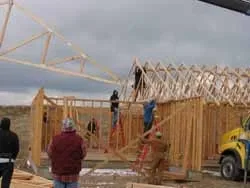
Well, while officials and human rights activists argue about ways to solve the problem, illegals continue to arrive in the capital. The scale of construction is gigantic, and the demand for cheap labor is growing rapidly. According to Sergei Biets, at least four million guest workers from the countries of the former Soviet Union are working in Russia today. Illegals make up more than 90% of the workforce at construction sites. As a rule, no contracts are concluded with them, and guest workers do not pay taxes either. The average salary of a guest worker is $100-$150 per month, and working conditions are terrible. "They keep us like cattle. For a step left or right, we are punished," says Nurlan, a Kyrgyz worker at one of Moscow's construction sites. "They can take away your wages or fire you. They feed us slop like pigs. Sometimes we buy food ourselves at the store. But that turns out to be very expensive." Despite all this, neither Nurlan nor his comrades intend to fight for their rights. "Our business is to endure and save our pennies," the illegals say with a sigh.
Marina OBRAZKOVA, Anna SEMENOVA, Igor ZINATULIN.
Novye Izvestia