
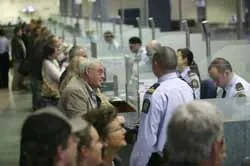
A freelance correspondent of Novye Izvestia, working in the security service of a European airport, tells how absurd the new methods of 'terrorist prevention' sometimes turn out in practice.
For quite a while now, without 'profiling', boarding the planes of Delta, United Airlines, US Airways and many other airlines operating flights to and from the US has been impossible. The procedure is as follows. Before ticket check-in, long lines form at the 'profilers'' (interviewers') counters, and each person is asked the same formal questions: 'Whose luggage is this? Who packed it? Where and when? What were you asked to take with you on the plane to bring to America?' Then the passenger is slightly intimidated: 'We are asking you this question because in the past, it has happened that a passenger received some items from relatives or friends in which explosives were hidden.' This horror story is repeated almost word for word twice with one question in between. A normal person, not suffering from phobias, looks at the employee fixated on the strange idea of bombs being planted by close relatives with undisguised irony.
'Do you have any electrical, electronic, or battery-operated devices?' Everyone has them. So what? Nothing, regardless of the answer. A question for the sake of a question. A kind of ritual, the meaninglessness of which is obvious also because all passenger luggage (including devices) is viewed via X-ray. If necessary, any suspicious item will be taken out of the suitcase and subjected to additional inspection. Finally, the passenger, quite tired from the strange interrogation, is asked whether he or she has anything resembling a weapon or something that could be used as a weapon. It happens that an old man's cane or umbrella is taken away, or an old lady's knitting needles. So that, God forbid, they might not use these items to hijack the plane. In conclusion, the profiler warns everyone: 'Do not accept any deliveries from anyone at the airport! Do not leave your hand luggage unattended! Do not buy anything from street vendors at the airport!'
The degree of absurdity of the last warning is extreme. Because to imagine that someone here will whisper in your ear: 'Hey, you need a mobile phone? I'll sell it cheap' – that is beyond the realm of possibility...
But now, finally, it's all over: answers to all questions have been received, and the passenger can go to boarding with a clear conscience. But that's not the case. At the very approach to the finish line, the same profilers again catch everyone and ask their annoying questions straight to the point: 'While you were walking here, where was your hand luggage? What did you buy at the airport from street vendors?'
After the terrorist attack prevented last year in London, when extremists planned to use liquid components, a real theater of the absurd began at European airports. Almost all cosmetics were taken away from all passengers – creams, mascara, lipstick, perfume, as well as cognac and wine, whiskey and liqueurs. Even nose drops or baby food aroused suspicion, even in the presence of an infant. The amount of expropriated goods was measured daily by dozens of crates filled to the top, which went straight from airports to the dump. Passengers parted with their belongings in different ways. Some sobbed, some made a scene. But the majority resigned to their fate meekly. And they resigned, in my opinion, precisely because people have already become accustomed to not looking for common sense in many actions of airport security services.
How much explosives were found and how many terrorist attacks were prevented as a result of the massive confiscation of cognacs and the checking of shoes (the latter is now very well familiar to Russians as well)? I assume zero. Otherwise, they would have trumpeted something about it. Now everything seems to have entered a civilized channel. Even perfume in hand luggage has been legalized. But the prospects for the development of the theater of the absurd remain. For example, for prevention, one could further ban the carriage of all powdery substances (resembling hexogen) or all pliable ones, like plastic explosive.
In general, the most effective means of combating terrorism in air transport would be to ban all civil aviation altogether. As they say, no aviation – no problem. But until such a ban is in place, what is needed is not a simulation of 'terrorist prevention', but modern methods of detecting both explosives and the 'bombers' themselves.
Fedor ZARUBIN.
Novye Izvestia