
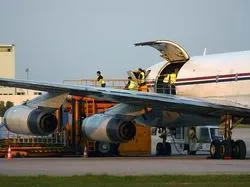
The death of the Cypriot Boeing that crashed in Greece is a Hollywood plot written by life. Agree: an uncontrollable airliner packed with frozen corpses circling over Athens... A title for a blockbuster comes to mind: "Plane of the Dead." And what about Boeing! Take our "Crew" - after the film's release, many pilots claimed that its plot was based on real events. And there are more than one or two cases where aircraft accident investigation materials turn out to be far more thrilling than movie scripts. Each of them is unique in its own way. Where does the invisible line separating real facts from the fantasies of disaster movie creators pass? "Itogi" tried to find it, but never did...
A Passenger Named Hypoxia
One of the most likely causes of the Cypriot Boeing's crash, voiced after the disaster, is considered to be sudden decompression of the cabin and cockpit, as a result of which both pilots and passengers lost consciousness almost instantly. Cases where crew hypoxia (insufficient oxygen supply to the pilot's brain due to cabin decompression at high altitude) becomes the cause of aircraft loss have been recorded in aviation history. In 1999, due to cabin decompression of a light aircraft Learjet 35, its crew was incapacitated. The aircraft continued flying on its own for almost four more hours and subsequently collided with the ground near the destination airport. The investigation, by the way, was unable to determine what caused the cabin decompression and why the pilots could not use the oxygen equipment.
Crew hypoxia caused the crash of a Beach King Air aircraft in 2002. The investigation report of this incident states that the pilot was physically unable to respond to the controller's request after the aircraft climbed above the prescribed 25,000 feet. For several hours the plane flew on autopilot without crew intervention until it crashed to the ground.
Of course, it is hard to believe that the pilots of the Cypriot Boeing, certainly quite experienced, did not manage to use the oxygen masks. But how much time did they have for this? The interval from the moment of cabin decompression to the moment when performing a reasonable action by the pilot becomes impossible is called by aviation medicine specialists "time of useful consciousness." At a flight altitude of about 12,000 meters, it is approximately 15 seconds. The reason for rapid loss of consciousness at high altitudes is related to the mechanism of oxygen penetration into the blood. At altitudes above 10,000 meters, the blood that enters the lungs, instead of being enriched with oxygen during inhalation, actually loses it. And it reaches the brain with a lower oxygen content than when it entered the lungs. For a person at rest, 5-6 seconds of oxygen starvation is enough to become incapacitated.
Passengers and crew have different types of emergency oxygen systems. Passenger oxygen masks drop automatically in case of decompression at an altitude of 14,000 feet. Pilots, however, must put on masks themselves; fortunately, the design of modern airliners allows them to do so within seconds. But why did the Cypriot crew not take advantage of this opportunity? A mystery!..
By the way, pilots have no special training for actions in decompression conditions. One of the technicians at Sheremetyevo Airport told us the following story on this subject: "On a Boeing 737 flying from St. Petersburg to Moscow, the pilots forgot to turn on the engine bleed air system, which led to a loss of their power. A lack of oxygen began to be felt in the cockpit. There was no warning alarm. So the pilots did not understand what had happened. They put on masks and flew on. Only their ears hurt. Upon arrival, when I entered the cockpit, both bleed air switches were in the OFF position, although their normal position is ON. For decency's sake, we put everything back in the reverse position. The specialists, however, had to tinker with replacing the oxygen generators in the passenger cabin, and the pilots had to run to the kiosk."
According to experts, the pressure control system (PCS) is a sore spot for the Boeing 737. Due to malfunctions in it, on average, three aircraft decompressions occur per year. Though not fatal ones. For example, a case was recorded of oxygen masks dropping in the Boeing cabin due to incorrect operation of the outflow valve. Soot had accumulated there, presumably nicotine soot, which is what triggered it.
In the Air Without Air
Cases of decompression during flights are not so rare. For example, it is said that in December of last year, an Il-76 flying at an altitude of 10,100 meters over the Red Sea had its emergency hatch open, and a technician was "sucked out" through it. The pilots almost immediately lost their ability to work. They were saved by the flight engineer, who preferred to keep an oxygen mask always at hand. When the aircraft commander's mouth began to foam, he pressed the mask to his mouth, thereby saving the entire crew and the aircraft. The commander quickly came to and made an emergency descent.
Here is what happened on July 7, 2000, with an An-72 aircraft heading from Mozdok to Moscow. At the 27th minute of the flight at an altitude of 3,900 meters, the "Use oxygen" sign lit up. The crew took the signal as false (there was heavy rain, and powerful cumulus clouds had gathered along the route) and continued to climb. After some time, due to oxygen starvation, the crew and passengers lost consciousness. From an altitude of 8,500 meters, the aircraft began to descend rapidly in a steep spiral. Valery Shalagin, a reserve colonel of the Mil Moscow Helicopter Plant Experimental Design Bureau, who was in the passenger cabin, somehow coming to his senses, with difficulty made his way into the cockpit, moved aside the commander lying on the control wheel, and with incredible effort brought the aircraft to a normal position. There were 1,800 meters left to the ground.
In the 80s of the last century, there was a case when an An-12 depressurized due to a defect in the cargo ramp. The crew flew in circles for three hours in an unconscious state. At some point, the co-pilot regained consciousness and took control of the aircraft. Then the commander also regained consciousness. The co-pilot's words over the radio just before landing were: "Commander, what are you doing, don't interfere..." The plane was landed safely.
"I have been in situations involving failures in the air conditioning system," says a former pilot who flew on the Il-76. "I remember in 1982 we were flying to Tashkent. After climbing to six thousand meters, it became hard to breathe, and stars began jumping before my eyes. We put on masks. Since the flight was short, we got there safely. After landing, it turned out that the crew cabin outlet valve had frozen. By the way, the Il-76 manual says that the pilot flying must wear a mask after climbing past four thousand meters (though this rule is rarely followed), so in theory it's impossible to pass out immediately, unless, of course, a large hole has formed, for example if a hatch was torn away."
There were cases when everything seemed to lead to disaster, yet it was avoided. For example, in the 80s, within one year, two similar cases occurred in Hawaii.
A Boeing was flying to Honolulu when, due to depressurization, its skin opened up - actually tearing off a third of the roof near the first cabin. The pilots managed to land the plane, and the only fatality was a flight attendant who was sucked out through the hole. The other passengers were buckled up. They got very cold, but landed alive and well.
A few months later, another Boeing took off from the same airport. During the flight, there was suddenly a loud bang and a rumble. The co-pilot went into the cabin to see what had happened and saw... the sky. Six rows of seats with passengers were sucked into the hole that had formed in the fuselage skin. But even this time, the pilots managed to land the plane.
All sorts of incidents happen
"Air transport carries about a billion people a year. Any aviation accident or emergency situation in the air always happens suddenly," says Boris Rybak, director of a consulting agency in the field of civil aviation, a former leading engineer in the projects department of the MiG Design Bureau. "Equipment itself rarely fails unless you help it do so. After all, all instruments on board an aircraft are duplicated. The equipment itself will never lead an aircraft to fatal consequences. Aircraft control is designed on such a principle that even if you release the control wheel at high altitude with the autopilot off, nothing terrible will happen and the aircraft will not go into a spin. Therefore, as a rule, it is only a combination of several factors that leads to sad consequences. Moreover, there is no systematic factor in any aviation disaster. They are all unique in their own way."
It's hard to argue with the last statement. In 2002, the absence of a single bolt on the elevator of a DC-8 caused a tragedy. When the crew began takeoff, the trim jammed. The crew tried to return to the airport, but the aircraft acquired a deadly bank, collided with the ground, and broke up. The entire crew perished.
Another case. During the takeoff of an A-320 from Frankfurt, the aircraft suddenly banked sharply to the left. Subsequently, while studying the incident, the German Federal Bureau of Aircraft Accident Investigation found that during maintenance of the onboard computer, two pairs of wires had been swapped.
And here is what happened once on board a Boeing 747 flying over the ocean. The crew recorded the spontaneous opening of the door handle! It turned out that even the day before departure, one of the pilots noticed that the handle, due to some defect, did not fully lock the hatch. In response, a technical service representative assured the commander that internal pressure would not allow the door to open. But the opposite happened, and for the entire time remaining until landing, a flight attendant held the handle in place with all his might.
And this story was told to Itogi by an employee of Sheremetyevo airport, who once flew as a passenger from Adler to Moscow on a Tu-154: "We had just taken off, climbed to about five thousand, when - bang - a terrible whistle started from the front entrance door. I call the senior flight attendant, but he himself doesn't know anything. He says: 'When we took off from Sheremetyevo, there was the same nonsense.' I tell him: 'When you get a chance, ask someone from the crew to come over.' About an hour and a half later, when Moscow wasn't so far away, we ran into a thunderstorm, lightning all around, and that whistling again. Well, I think, I'm done for... And then the cockpit door opens, and the co-pilot comes out. I ask him about the whistle. He answers cheerfully: 'There's a little sucking from outside under the gasket; it's worn out, the damn thing, on the door.' We landed safely, and I didn't see that plane for a month after that - probably went for repairs."
And another scene from real life. Told by an eyewitness. In flight, the aircraft commander left the cockpit, as he said, for a minute (to the toilet, to stretch, etc.). About 20-30 minutes later, an alarmed co-pilot called the flight attendant to check if everything was okay with the commander. "He's sleeping!" was the answer. The commander was sleeping the sleep of the righteous in business class, covered with a blanket! And more than 200 passengers were sure everything was under control.
In the mid-80s, an engine began to disintegrate on a Tu-134 aircraft at an altitude of 10,000 meters. Fragments of turbine blades pierced the fuselage skin, leading to depressurization. The co-pilot with difficulty extended the landing gear and put the aircraft into a steep descent mode. At an altitude of about three thousand meters, the pilot leveled the plane and landed on one engine at Rostov airport.
There was a case when an Il-86 in the United Arab Emirates landed without landing gear at all - they simply forgot to lower it. This year in Russia there were two cases when an An-24 lost its propellers during flight. Only by lucky chance did they fly off to the side. How can such situations be anticipated?
- Still, a significant share of aviation accidents is due to the human factor, - says Rafail Aptukov, vice president of the non-profit partnership "Flight Safety". - Any pilot is prepared for emergency situations, but, as statistics show, when they get into them, people become lost. If we recall the A-310 crash near Mezhdurechensk, after it, pilots of the Gromov Flight Research Institute reproduced that situation on simulators. And they proved that from the moment the airliner went into a spin until the moment it hit the ground, the pilots could have pulled the aircraft out of a dive seven times. Maybe it is connected with human psychology, but, in my opinion, it is a shortcoming in the training system.
The feeling of flight
We did not aim to frighten readers with "tales from the aerial crypt". No alternative to the airplane has been invented yet. And means of combating aerophobia are as old as the very first flying apparatus. Just think that pilots and flight attendants take to the sky almost every day. For us, each flight is a bright event. For the crew, it is everyday routine work. And if an attack of aerophobia overtakes you, remember this - and it will be blown away as if by the wind. The best way to fight the fear of flying, as pilots joke, is to take a train ride (about two days, preferably in a reserved-seat carriage). Aerophobia is cured instantly.
One pilot told Itogi how his acquaintance was cured of aerophobia. She tried to understand the source of the force that lifts a heavy airplane off the ground. After rereading a lot of popular science literature, she made an important conclusion for herself: air holds the airplane like water holds a boat. And then she imagined herself in the place of the airplane - flying freely in space, lying on an air cushion as if on a feather bed. Now she enjoys every flight. With the feeling of lightness, height, freedom...