
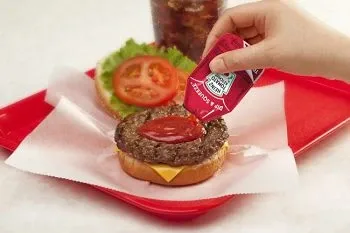
Americans themselves love ketchup and do not limit their guests to it
We asked Quora.com users the question: "What is free in your country but costs money abroad?" The answers not only reveal where and what you can get for free, but also uncover some surprising features of local culture.
USA: Lots of Free Ketchup
It is said that the concept of fast food spread worldwide from the USA, but the free sauces and condiments that generously season food there have not taken root everywhere. In American fast food restaurant chains, condiments are given out in unlimited quantities.
American John Baldwin encountered this when he stopped at a McDonald's drive-through in the UK and noticed that the standard set of sauces was missing from his food bag. "Sorry, you forgot the ketchup," he said to the cashier. "But instead of reaching for ketchup packets, she first rang up 50 pence on the cash register." To make matters worse, it turned out that 50 pence was charged for just one packet of sauce. "In the US, ketchup is not only free, but you can also ask for ten packets if you want. Literally a full handful of ketchup."
Dave Holmes-Kinsella says that his American wife "is infuriated by the selective tax on condiments" applied in his native New Zealand, especially considering that salt and sugar are free there.
North India and Pakistan: A Handful of Cilantro and Green Chilies
In virtually all grocery stores in this part of the world, customers get a generous portion of fresh cilantro and green chilies for free, which are often used in local cuisine to make spicy curry sauce and sweet-and-sour chutney.
"In most of North India, the expression 'dhaniya-mirch' (cilantro and chili) is synonymous with the word 'grocery store,' says Khusrau Gurganvi from Varanasi. According to him, it is so common that the phrase 'I need to go to the grocery store tomorrow' sounds like 'Kal dhaniya-mirch lana hai.'"
An anonymous user confirmed that this tradition also exists in Pakistan. "When buying vegetables, the seller will give you a handful of green chilies and cilantro for free," he says. "If they don't give them to you, just ask."
India: The Country of Advice
Not all the "bonuses" mentioned by users are material. Apparently, Indians have an inexhaustible source of free advice.
"In other countries, there are wedding planners. Here we have aunts, uncles, and uncles of uncles who will advise you completely for free," explains Megul Manot from Kolkata. He adds that instead of travel agencies, there are relatives who buy tickets, and instead of stylists, fashionable friends.
However, advice is not given only by friends and relatives. "In other countries, you have to pay for consultations, but in India you can get them completely free – in tea shops, at weddings or family celebrations, on trains or buses – from almost anyone," says Kanchan Saxena, who now lives in the US. "We love giving advice."
Singapore: Chili Sauce – As Much as You Want
In this small country, another condiment is generously given away. "At any fast food outlet or food court, we have free unlimited access to chili sauce," says local Joseph Lee. "We add it to literally any dish – from traditional chicken rice to hamburgers at McDonald's."
By the way, McDonald's even produces garlic chili sauce specifically for Singaporeans, known for their love of spicy food.
Australia: Cool Off at a Water Park
In Australia, famous for its beautiful nature, there are plenty of free opportunities to spend time outdoors.
"Many city and national parks have free barbecue grills," says Christopher Mardell from Adelaide. "You bring your own meat or other food, press a button, and go about your business. After about 20 minutes, the grill automatically turns off, and you have to press the button again." Visitors are only required to keep the area clean, and most people, according to Mardell, follow this rule.
Residents of Australia's Northern Territory have a unique opportunity to escape the heat. "Since there are crocodiles in the water bodies, locals can cool off in free water parks," suggests Jane M., a UK native. As just one example, Leanyer Park in Darwin, the capital of the Northern Territory, features three large slides (including a 124-meter long raft ride), a water play area, and a pool – all completely free.
Slovakia: Drink Some Mineral Water
In some countries, residents are supplied with free tap water, but mineral water usually costs money. That is not the case in Slovakia and neighboring Czechia, which are rich in mineral springs.
"Each region has a number of mineral springs open to the public where you can take water for free," says Juraj Spišák, who now lives in Brussels. "Each mineral spring has its own unique taste. Some have more sulfur, others are rich in manganese or iron." Water can also be bought in stores, but residents usually fill bottles at local springs.
Norway: Free Mushroom Picking
In this Scandinavian country, there are specific laws that make nature and all its benefits a public asset.
“We have a set of laws known as the ‘Right to Roam legislation’,” explains Eivinn Kjørstad. According to these laws, local residents can freely move along roads, rivers and lakes, pick mushrooms, berries and wildflowers, and also camp in tents (provided they are set up at least 150 meters from the nearest building).
“We divide the land into categories ‘innmark’ and ‘utmark’, which literally mean ‘adjacent’ and ‘remote’,” explains Kjørstad. “The difference between them is that ‘innmark’ is cultivated and actively used, and includes gardens, fields, parks and roads. ‘Utmark’ is everything else: mountains, forests, marshes, tundra, bogs, beaches, lakes and rivers.” The nature laws apply to ‘utmark’, even if the land is privately owned.