
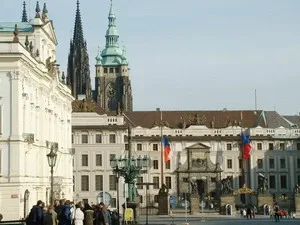
Prague Castle //Photo by Dmitry Onishchuk.
It is good to walk around Prague in sunny, rainy, and even snowy weather. The air of the city is imbued with cheerfulness that helps you not notice fatigue from hours of walking tours. From the observation deck, a magical panorama opens before you - bridges across the Vltava, wisps of smoke over the rooftops, lights of old lanterns. This beautiful picture will surely remain in your memory for many years to come. However, Prague does not need extra proof of its beauty. If you have not been there yet, pack your bags - and immediately set off.
First of all, visit Hradcany - the oldest district of Prague, where Prague Castle is located and lush royal palaces spread out. In early spring, ornamental trees turn green around, cherry orchards are drowned in white-pink lace of blossoms, neatly trimmed bushes are fragrant, fountains splash, birds sing, and tourists wander. Passing through an arch, you involuntarily tilt your head before the majestic mass of St. Vitus Cathedral, whose architecture blends Gothic, Empire, and Baroque, and the sooty figures of devilish monsters are colored by reflections of multicolored stained glass.
Once upon a time on Golden Lane, medieval alchemists tried to find the philosopher's stone and the elixir of eternal youth, and today there are tiny souvenir houses - to enter them, you have to bend over double. At the end of the street stands the stone watchtower Daliborka. It is damp inside, light penetrates only through narrow loopholes, the ambiance has not changed since the times of knights. At the exit, in a small courtyard, you will see a strange bronze sculpture: a naked man, standing on his elbows and knees, holds a huge skull on his back. What could that mean?
Classical music concerts are announced on every corner. Small pieces are performed in churches and cathedrals, symphonies and oratorios at the Rudolfinum, a concert hall on the Vltava embankment. Variety performers can be seen at almost every crossroads. On the famous Charles Bridge, sword swallowers, clowns, and jugglers perform, and sounds of flute and accordion are heard. A long queue has formed at the sculpture that brings happiness - a dog polished to golden shine, molded on a blackened bas-relief. How can one miss the chance not to stroke a talisman capable of fulfilling unrealizable dreams? And a ten-minute walk from Charles Bridge, on the crowded Old Town Square, every hour the windows of the legendary clock open and mechanical characters appear. The bony Skeleton rings a bell, measuring inexorably flowing time. Twelve apostles make a procession, the Miser shakes his purse, the Vain admires himself in the mirror, the Turk shakes his head negatively: I do not want, they say, to follow Death.
The heart of old Prague beats on Old Town Square, rows of stalls stretch, laden with all sorts of goods: shaped candles and Bohemian glass, ceramic toys and copper bells, wooden dolls and musical clowns. The greatest demand is for jester's colorful caps. There are all kinds - with bells and horns, in the shape of crowns and fool's caps, embroidered with stars, coats of arms, little animals. The air is mixed with aromas of punch, grog, and mulled wine. As snacks - roasted chestnuts and sausages in hot sauce, boiled corn and suckling pig from a spit. You down a glass of strong drink, and the square begins to reel: gingerbread houses start dancing, bell towers sway, and even the stone Jan Hus squats slightly to the creak of an old carousel and the music of a street jazz band.
Not by beer alone
The similarity of the Czech language to Russian begins with the greeting "dobrý den" and continues with the words "čaj" and "pivo". The Czech word "ovotsi" (ovoce) means fruit, while the Russian word "ovoshchi" means vegetables, "káva" is coffee, "jídelní lístek" is a menu, and the expression "pozor prosím" means you are asking for attention. In general, in any Prague cafe or restaurant you can easily explain yourself to the waiter and navigate the assortment of delicacies. The main problem is to choose one of thousands of establishments that serve huge portions of dishes of solid and hearty Czech cuisine. Try the national bread dumplings, seasoned with meat and sauce, as well as smažený sýr, fried cheese. The cheese is simple to prepare: pieces are breaded in flour, beaten egg, and breadcrumbs, then fried on both sides. In some restaurants, the choice is especially difficult: the selection may include hundreds of items. Among the most popular delicacies are roast goose and hare, roast venison, and fruit pancakes.
City of myths and legends
Mystical Prague has its own face even in house numbering. Blue plaques count off real numbers, while the digits on red plaques preserve half-forgotten tales. A Praguer can live in a house with both No. 8 and No. 26 at the same time - this causes some confusion, but adds to the city's unusualness. On summer evenings, when artificial lighting is switched on, Gothic churches and aristocratic palaces are enveloped in a fairy-tale veil. It seems as if the clay Golem and the White Lady are about to appear from an archway, and noble knights and evil robbers, monks, burghers, artisans - heroes of ancient Prague legends - will walk along the cobblestone streets.
On Charles Bridge, the ghost of its builder, Master Parler, comes to life. They say he built the bridge twice, but each time the capricious Vltava washed it away. And when the bridge was built a third time, the devil himself appeared to the architect and proposed: your creation will stand forever, but in return you will give me the soul of a living creature that crosses the bridge first. And so, on the day of the bridge's opening, before the start of the festive ceremony, Parler saw with horror his grandson running across the bridge. The resourceful master tricked Satan: he grabbed a rooster that was walking nearby, caught up with the child, and threw the bird ahead of him. That time the devil got only a rooster, but later he took possession of the soul of Doctor Faustus - a sorcerer, philosopher, and black magician. You can go into the Faust House in Prague and see with your own eyes the hole in the ceiling through which the Antichrist, with Faustus's soul under his arm, flew up to heaven.
Here is Kampa Island - a pretty and quiet corner of Prague that was once considered a bad place. The little river separating it from the city, the Chertovka, is named after a noble lady who had a house nearby and had a hand in the mysterious disappearance of many young men. And here is the restaurant "U Katů", where a headless Templar appears - the former leader of the Order of the Knights Templar. Envious rivals brought about his execution, but after death the knight began to restore justice and punish malice and greed. According to legend, exactly at midnight, dressed in a steel chain-mail shirt, he walks through the streets, pressing his helmet to his chest with his left hand and holding his severed head in his right.
However, not all amazing phenomena in Prague are connected with the gloomy times of the Middle Ages. Strolling along the Vltava embankment, you will surely see a shaggy dog running after its owner on a bicycle, clutching a pack of cigarettes in its teeth. Smile and wave your hand after them, keeping in your soul this humorous Prague picture.