
About Eagles and Cows
Albania had long attracted travelers. As “Voyazh i otdykh” notes, it was since the days of an old Soviet film about the great warrior Skanderbeg and outline maps in geography lessons. “A strange country,” teachers would say, “sort of socialist, but it did not maintain diplomatic relations with the USSR. It withdrew from participation in Comecon, and in 1968 it also left the Warsaw Pact. It has only 28,700 sq. km of territory, and 3 million inhabitants are building a communist society under the leadership of the leader and teacher Enver Hoxha. They say its high-rise buildings are drab and gray, and across the country there are hundreds of thousands of pillboxes and bunkers in case of an enemy attack.”
Then other times came: the end of the communist system, the collapse of the Soviet Union, bloody wars on the soil of a Yugoslavia torn to shreds. The whole world learned about the “Kosovo problem” - a Serbian territory populated mostly by Albanians - and was horrified by the bombing of Belgrade.
Eight years passed, much water flowed under the bridge in the turbulent waters of the great rivers Buna and Drin, but the prejudice remained. “What will you think of next! Go to Albania? That’s the ‘European Chechnya,’ a country of drug traffickers, the birthplace of a mafia that has entangled all of Europe in its webs! They shoot there!!” - that’s how literally all our relatives, friends, and colleagues reacted to the idea of visiting Albania.
Reality, as always, turned out to be not so terrible, much more complex and multifaceted than the established clichés. Albania seems to be a country of amazingly beautiful, kind and generous people, lean cyclists and hard-working peasants, delicious food and pristine nature. But the very first thing we saw on the land of Shqipëria - the Land of Mountain Eagles (as Albanians call their homeland) - was... a cow! Yes, yes, a big black cow lazily chewing grass on a roadside lawn. It just chewed and chewed, paying no attention either to the luxurious two-lane highway (built with EU money as a gift to the Albanian people), or to the new bridge (a personal gift from Berlusconi to the Albanian people), or to the cluster of “people’s Albanian cars” - used Mercedes. It was used to it...
Land of Colored Houses
We are sitting in a border cafe, examining with interest the worn banknotes of Albanian leks (exchange rate 123 to €1) and sipping the signature beer “Tirana”. Before our eyes, another myth about Albania is crumbling: the myth of a country that “produces nothing but drug traffickers and prostitutes.”
We never saw either. But in recent years, in “producing nothing” Albania, modern industrial zones have stretched for many kilometers along the motorways. Driving past them, we could not manage to read the names of new local manufacturers of food products, drinks, detergents, clothing and footwear, electrical components, aluminum profiles, not to mention building materials. Entire dynasties of artisans have survived in the country almost since the Middle Ages - jewelers, woodcarvers, coppersmiths, gold embroiderers, gunsmiths, carpet weavers...
Prices for Albanian goods - both industrial and “souvenir” - are 2-3 times lower than European ones, and the quality is quite comparable. The Albanian economy is one of the fastest developing in Europe. GDP growth is 7% per year, and in terms of per capita income, Albania is already rapidly catching up with the fragments of neighboring Yugoslavia - the country we envied so much in Soviet times.
Population growth in Albania is also the highest in Europe (3-5 children per family), which is why the streets of towns and villages of the Land of Mountain Eagles are filled with kids and teenagers: children run, ride bicycles, and play football. By the way, the average life expectancy in Albania is 72 years.
The laws are quite strict: a thief must go to prison! That is why the crime rate in Albania is low; you can safely wander around Tirana even at night. They say the “new Albanians” are so intimidated by the strict legislation that they are even afraid to vacation at resorts in their own country - they go to neighboring Montenegro so that no one asks them about “sources of income sufficient to pay the bills of an expensive hotel.” That’s the “terrifying poverty and instability”!
We continue to look closely at the black cow. To its left rise steep mountains - the very Pindus celebrated by Byron. To the right is a vast lowland stretching tens of kilometers in length and width all the way to Greece. On this plain lie all the country’s largest cities; most Albanians, who for some reason are still called highlanders, now live here...
Local peasants grow the world’s most delicious grapes and huge olives, and carefully tie sheaves of corn. Urban Albanians abundantly breed houseplants. One might think, why such an abundance of domestic flowers in an evergreen subtropical country? But no - on every windowsill of a Shkodër or Tirana house there are at least 5-8 flower pots. Flower pots are the best-selling item at Albanian bazaars, and in terms of profitability this activity is probably surpassed only by the business of private gas stations.
Yet the mountains still occupy a large part of Albania, and for the locals they mean more than a landform. Every peak reaching into the sky is associated with some legend, each has its own soul. Here, deep in the gorges, Albanians hid from numerous invaders: ancient Greeks, Romans, Byzantines, Turks, Italians. After all, they are one of the most ancient nations on earth. The Albanians are the last remnant of the ancient Illyrians, who competed on equal terms with the Hellenes and Romans. The world they come from has long disappeared: the Trojan War has thundered away, the Colosseum of the Eternal City has half crumbled... And the Albanians, contemporaries of Hannibal and Caesar, Aristotle and Socrates, are still intact. Among Europeans, only the Basques, the Irish, and the Greeks resemble them in this respect.
Hoary antiquity, beautiful architectural monuments against the backdrop of almost untouched picturesque nature are everywhere in Albania: stones on the ancient paving stones of Gjirokastra - a city entirely protected by UNESCO. The ruins of the ancient Roman polis in Durres or the legendary Rozafa fortress on the outskirts of Shkoder - an amazing city, on whose main square - Rruga Ndre Mjeda - stand a huge mosque, a Catholic church and an Orthodox cathedral. Contrary to another common misconception, Albanians are not only Muslims. Among them, 12% are Catholics (northern Albanians, Ghegs) and 18% are Orthodox (southern Albanians, Tosks). By the way, the country's president, Alfred Moisiu, who speaks Russian excellently, also belongs to the Orthodox community of the country.
However, the main symbol of modern Albania is a building under construction. The whole country literally resembles a giant construction site: peasants are erecting huge multi-story buildings in a typical Mediterranean style – with spacious balconies, courtyards entwined with grapes, and verandas. In cities, real skyscrapers of glass and concrete stretch toward the sky like mushrooms after rain. A favorite technique of modern Albanian architects is round balconies on the corners of houses or some original elements like "falling" walls. A two-room apartment in such a "block" costs about €100 thousand.
Many of the new houses are painted in bright, unimaginable, even garish tones: bright orange, juicy light green. And the old gray five-story buildings of Enver Hoxha were also painted in all the colors of the rainbow - with cubes, squares, overlapping, diagonally. So now Albanian cities cannot be confused with any others! There is another detail: under the windows of many Albanian houses hang... large soft toys - elephants, bears, Pokemon. Albanians believe that all this mysticism will protect homes from the evil eye.
Star from the Sky
The pediment of the Historical Museum on the main square of Tirana is decorated with a beautiful mosaic panel that briefly reflects the entire history of Albania: from muscular Illyrian archers who gave the world the "Albanian Caesars" - Diocletian, Claudius and Justinian, to the heroic struggle for freedom under the leadership of the Communist Party. The panel is stylish, although it does not feature other great Albanians: the Egyptian reformer Mohammed Ali and Ali Pasha Tepelena, celebrated by Dumas himself in "The Count of Monte Cristo." Agnes Gonxha Bojaxhiu (Mother Teresa), writer Ismail Kadare, Hollywood actors John and James Belushi. It is not surprising that most of them became famous outside their native country - today, of the 10 million Albanians scattered around the world, only a third live in Albania itself. In addition to Kosovo, the main centers of the Albanian diaspora are Italy, the USA, Germany, Greece, Egypt, Turkey, Macedonia and Montenegro.
However, Mother Teresa gave her native country an entire multi-story university, and today it bears her name. To the left of the entrance stands a monument to the great nun with outstretched arms, as if to give her love to all humanity.
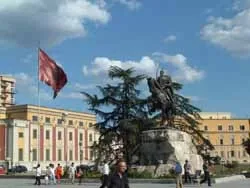
Opposite the Historical Museum is the Palace of Culture building, a Soviet gift to the Albanian people from the time of Nikita Khrushchev, and an ancient mosque with a clock tower. Against its background, the famous monument to George Kastrioti (Skanderbeg), the country's main hero, who stubbornly resisted the Turks for thirty years, looks magnificent. A little further is a pyramid of glass and concrete, the mausoleum of dictator Enver Hoxha. True, Hoxha himself has not been there for a long time: as a result of political changes, he was buried without much honor, and an exhibition center and the bar "Mummy" were opened in the tomb. This is how Albanians, laughing, said goodbye to the terrible past.
From here it is best to start walking tours of the rapidly changing Albanian capital. Admire its ancient streets with modest tile-roofed houses, in places turning into a real oriental bazaar. Taste local pastila, baklava and roasted corn in small restaurants where life flows slowly and measuredly. Visitors can sit all day over a cup of coffee or a glass of beer, discuss news, and a good lunch will cost no more than a thousand leks.
When socialism collapsed, egg-headed Balkanists predicted for the poorest country in Europe great bloodshed and disintegration into Muslim, Catholic and Orthodox "appanage principalities" like neighboring, much richer Yugoslavia. But Albanians turned out to be wiser than both the "scientists" and their own neighbors - the Yugoslavs and brothers from Kosovo, and did not take out their anger on their neighbors. On the streets of Tirana one can see touching scenes: three little men with beards and in short trousers, of a completely "Wahhabi" appearance, walk toward each other. And towards them are two nuns in white-and-blue habits from the order of Mother Teresa. They smiled at each other and peacefully parted.
"If you please Albanians, they will not only share their last with you, but also get a star from the sky," we were warned back in neighboring Montenegro. They warned not in vain - the owner of one of the restaurants, having learned where we came from, asked:
"Very few tourists come to us from your country. You are the first ones I see! Why do you have such sad faces? Didn't you like Tirana?"
We explain that we did not find souvenir T-shirts with the Albanian flag - the black eagle of Skanderbeg on a red field.
"Come with me!" The restaurateur, through acquaintances, arranges to delay the departure of the tourist bus for half an hour and leads us somewhere deep into the streets, across half the city, until we find those very T-shirts. That is what Albanian hospitality is like.
The Republic of Albania is located in the western part of the Balkan Peninsula, on the coast of the Adriatic and Ionian seas. The country borders Montenegro, Serbia, Macedonia and Greece. The narrow Strait of Otranto separates the country from Italy. The population of Albania is 3.2 million people. The majority are Albanians, there are also many Roma, there are Greeks, Macedonians, Romanians and Montenegrins.
The climate is subtropical Mediterranean. The average January temperature in the lowlands is +8-9 degrees, the average July temperature is +24-25. The summer season in Albania is usually very long, from April to the end of October.
The official language, Albanian, is unlike any other language in the world; it belongs to the Albanian language group of the Indo-European family. Many Albanians who have worked in the USA or Germany also speak English and German.
The monetary unit is the Albanian lek. It consists of 100 local kopecks - qindarka. Exchange rate: €1 - 123,4 leks, $1 - 96,4 leks. There are banknotes in 100, 200, 500, 1.000 and 5.000 leks.