
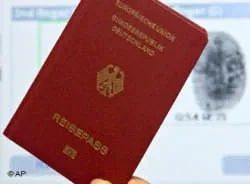
Fewer and fewer foreigners are receiving German passports
“Citizenship/nationality – German.” This line appears in the identity card of a German citizen. “The bearer of this passport is German” is stated in international passports. Citizenship and nationality become synonymous in this case. Every foreigner who receives German citizenship automatically becomes... German, regardless of origin, religion, or skin color.
Who can obtain citizenship
Children automatically receive German citizenship if at least one parent, mother or father, is a German citizen. Children of foreigners born in Germany after January 1, 2000 can also automatically obtain citizenship if one parent has lived in Germany for more than 8 years and has a permanent residence permit. However, since Germany generally does not recognize dual citizenship, they must choose by the age of 23 which country they want to be citizens of: the one their parents came from or Germany.
Foreigners living in the country can also obtain German citizenship. To do so, they must submit an application. However, obtaining citizenship comes with a number of conditions. They must have lived in the country for at least 8 years and have a permanent residence permit. They must support themselves and their family members financially. They must not have a criminal record.
And finally, they must pass a German language test or present a certificate of completion of an integration course or attendance at a German school. Since September 1 of last year, they also need to pass a test on knowledge of German history, the state and the way of life. Many migrant organizations cite this test as the main reason for the decline in the number of foreigners wishing to obtain German citizenship.
For example, the test for foreigners includes a question: “In the GDR, the abbreviation ‘Stasi’ referred to: a) parliament; b) Ministry of State Security; c) the ruling party; d) Ministry of Education.”
There are 300 such questions, each with multiple-choice answers. To pass the test, one must answer at least 17 out of 33 questions randomly selected from the entire catalog. “Stasi” is, of course, the Ministry of State Security of the GDR, an analogue of the Soviet KGB. But does a native of Uganda who married a German woman 20 years ago and works as a baker need to know this?
Another example: “Germany is a state governed by the rule of law. What does that mean?” Here are the answer options: a) that all residents of the country and the state must obey all laws; b) that the state is not obliged to obey laws; c) that only Germans must obey laws; d) that courts pass laws.
Of course, both all residents and the state must obey the laws. And knowing this is probably not superfluous for any future citizen, especially if he comes from a country where “telephone law” prevails.
One can argue whether every new citizen needs to know where to register a dog if he does not have a four-legged friend and does not foresee one. However, overall, the test is quite simple. 98% of foreigners pass it on the first try. The entire citizenship application procedure costs on average about €255 for adults and €51 for minor children.
The problem of dual citizenship
According to polls, about a third of foreigners permanently residing in Germany refuse to obtain citizenship precisely because they do not want or cannot renounce the citizenship of their birth country. States such as Iran, Afghanistan, Algeria, or Morocco generally refuse to allow renunciation of citizenship. Exceptions have been made for natives of these countries.
Other countries, such as Russia, have established rather complicated rules for renouncing citizenship. One must fill out a lengthy application with 17 items, submit various certified certificates of birth, name changes, a certificate of tax payment in Russia, proof of deregistration from the previous place of residence in Russia, and so on. Many of these documents are practically impossible to obtain by mail.
And even after all the documents are collected and accepted, processing the application takes at least six months. Moreover, the procedure is not cheap – €450 per person.
Many foreigners are not ready to renounce their country's citizenship for emotional or property reasons. The simplest solution would be to grant them dual citizenship. Some politicians have long advocated for this model. However, the Christian Democratic Union, the ruling party chaired by German Chancellor Angela Merkel, opposes dual citizenship.
Alexander VARKENTIN.
Deutsche Welle