
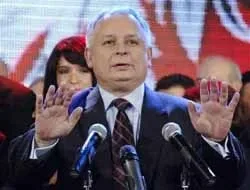
Mr. Kaczyński's initiative is doubly surprising, since depriving a state of the right to punish criminals with death is one of the basic conditions for EU membership, and the community's old-timers abandoned the ultimate punishment back in the 1960s.
Warsaw only joined the EU in 2004, and the current Polish president has been in power for less than a year. Nevertheless, Lech Kaczyński is in a hurry to call into question the fundamental values of the European community. The conservative arguments of 57-year-old Lech Kaczyński in favor of the death penalty are not new. He stated that abandoning this measure 'rewards the criminal with an unimaginable advantage over his victim - the advantage of life over death.' Mr. President intends to arrange a discussion on this topic in the EU, because 'the ban on the death penalty is a dead-end path of development.' And in general, the Polish leader is worried that the development of European civilization and culture 'may reach a dead end.'
Today, the death penalty is provided for by the laws of 87 countries, including 38 US states, Japan, India, Korea, China, Egypt, Iran, Saudi Arabia, and most of the former Soviet republics. At the same time, public opinion usually does not coincide with the opinion of politicians: the death penalty is supported by 88% of Britons, 80% of US citizens, 76% of Lithuanians, 72% of Poles, 58% of Czechs, and 64% of Hungarians. More than 70% of Russians support the abolition of the moratorium on the death penalty introduced in 1996. But this did not prevent the 57th session of the Parliamentary Assembly of the Council of Europe in June from again strongly recommending that Russia legally enshrine the abolition of the death penalty.
The Polish president's initiative has largely devalued the moral pathos of these exhortations - it turns out that Europe is calling on Russia to follow norms that have already been called into question by European politicians themselves.
However, Warsaw's political ideals are increasingly diverging from European standards. Even when he was mayor of the Polish capital, Lech Kaczyński opposed European liberalism and admired the authoritarianism of Józef Piłsudski, who established a regime of strict personal rule in 1926. Kaczyński suppressed gay demonstrations and patronized protests against sexual minorities. Experts associate his name with the rise of anti-Semitism currently observed in Poland and the strengthening of the political weight of Catholicism. It is noteworthy that Lech Kaczyński made his first foreign visit as president of Poland to the Vatican. However, Lech Kaczyński does not accept the increasing criticism of his conservatism. He is convinced that 'Europe will yet thank him for his ideas and solutions.'