
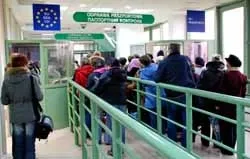
Photo «Ukrinform»
The tightening of requirements on the part of Poland was dictated by two factors. First, Poland must join the Schengen area. Second, a recent journalistic investigation caused no small amount of trouble for the Polish embassy in Ukraine.
At the end of July, journalists from the Polish 'Gazeta Wyborcza' together with their Lviv colleagues from 'Vysoky Zamok' organized a provocation. One Ukrainian journalist received a Polish visa in exchange for $130 handed over to an intermediary. This despite the fact that visas for Ukrainians had until then been free. In Ukraine, of course, no one paid attention to the publication, but in Poland a serious scandal erupted. The Polish Ministry of Foreign Affairs sent groups of inspectors to Lviv to conduct an investigation. Employees of the Polish Foreign Ministry have already reported that they found no evidence of involvement of consulate staff in Lviv in illegal intermediary actions regarding visa issuance.
The Polish embassy in Ukraine refrained from commenting for a long time, and then Ambassador Jacek Kluczkowski stated that after the introduction of the Schengen visa in the near future for trips to Poland, fraud in visa intermediary services will be minimized.
The Ministry of Foreign Affairs of Ukraine issued a statement that the Foreign Ministry will 'defend the interests of Ukrainians in negotiations with Poland on the visa regime'. 'During the negotiations, the Ukrainian Foreign Ministry will do everything necessary to ensure that changes in Poland's visa regime do not become an obstacle for Ukrainian citizens in their intention to visit Poland in the near future,' the statement said.
Currently, about 3,000 Ukrainians work legally in Poland. Experts estimate the illegal labor market at 150,000-300,000 people. So for many of them, the promised help from the Foreign Ministry will come in very handy. Moreover, the tightening of the visa regime with Poland may backfire quite unpleasantly for the leading political forces of Ukraine. In the midst of the election campaign, most of them list among their personal achievements the 'simplification of the visa regime,' which so far exists only 'on paper.'
In June 2007, Ukraine signed an agreement with the European Union on simplifying the visa application procedure. The main achievement of this document was that Ukrainians will now be able to obtain visas much faster (they promise within 10 days). The cost of visas to all European Union member states will be fixed at €35. Previously, a number of embassies of Western European countries demanded that the price be at least €65. Free Schengen visas will be available to citizens who have close relatives living in EU countries, students, disabled people, journalists, and pensioners. However, this document has not yet been ratified by all countries that are members of the European Union.
Currently, according to the website of the Ukrainian Foreign Ministry, among the CIS countries, a visa regime exists for Ukrainians only with Turkmenistan. Ukrainians can travel to Russia and Belarus even using internal passports. Among countries not part of the CIS, Ukraine has a visa-free travel regime with Mongolia, Malaysia, and Ecuador. This despite the fact that Ukraine, for its part, has long made all possible concessions. President Viktor Yushchenko abolished visas for all EU member states, Japan, the USA, and others. Citizens of these countries can stay in Ukraine without registration for up to 90 days. As for the CIS countries, visas are required only for citizens of Turkmenistan, and even after the 90-day period, registration is not needed.