
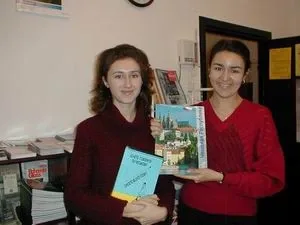
Photo by Ekaterina PROVOZINA.
The model of the future world is today's united Europe. Among Russian linguists, the concept of "student languages" has recently been circulating, meaning languages that today's young people master fairly quickly in order to set off with a merry company somewhere "over the nearest hill." What languages are these? Well, if we recall the May holidays in Prague, the autumn rock festival in Budapest, or Christmas in fairy-tale Krakow...
Reading Schweik in the original
Young Kyivites can learn the Czech language at the Czech Center. "Altogether, there are 17 Czech centers in the world, operating in 15 countries. Their task is to present the Czech Republic abroad, primarily in the field of culture and education, support foreign economic ties, and provide information monitoring on all aspects of the country's life," says Czech Center employee Anna Birkovskaya. "Our language courses have been running since 2000. The first group numbered 20 people, and now there are many more who want to enroll. The basic course consists of 25 sessions of one and a half hours each (50 academic hours). The cost is 200 hryvnias.
Under the guidance of experienced teachers from the Department of Slavic Studies of Taras Shevchenko National University of Kyiv, during the basic course students master the basics of pronunciation and grammar and acquire the vocabulary necessary for everyday communication. Enrollment in the courses takes place twice a year – in September and January-February. Students are provided with study materials, and they can also purchase the textbook "Would You Like to Speak Czech?". The textbook consists of four sections, each devoted to one season and the story of a relationship between two young people associated with it. Thus, while learning the language, you also become acquainted with Czech realities. Each lesson, besides the introductory text, grammar, vocabulary, and exercises, also contains original Czech texts that are excerpts from works by Czech writers or folk poetry. At the end of the textbook there is a glossary in English, German, French, and Russian.
As a rule, six months of study is enough to gain conversational skills, learn the basics of grammar, and learn to read. But many are interested in the opportunity to obtain higher education in the Czech Republic: as is known, for foreigners who study in Czech, it is free. Therefore, if there are those who wish to continue their studies on our courses, we form a group with in-depth language study. Of course, Czech Center staff provide advice on specific issues, but more detailed information on studying in the Czech Republic can be obtained from the staff of the Czech Embassy in Ukraine.
In addition, all students have the opportunity to use our mini-library and take video cassettes home. We definitely invite them to all our cultural events: Czech film days, concerts by jazz performers, literary evenings. Come to us – you have a wonderful chance to discover a new language!"
Little Bulgaria – for adults and children
On a quiet green Bereznyakovskaya street, a little Bulgaria – the Bulgarian Cultural Center – is cozily nestled. Here at your service is a library with books and fresh Bulgarian periodicals, newspapers of Bulgarian communities in Ukraine, audio and video cassettes. You can read the materials at the center or take them home – all for free.
The next hall is a museum of Bulgarian history and culture. Here visitors are greeted by colorful booklets, works of folk craftsmen, national costumes, embroidery, and paintings. By the way, nearby in a cozy corner decorated in national style there is a kitchen where national Bulgarian dishes are prepared for holidays. The center also has a large hall, a rest room, and a resource room.
"In total, more than a hundred people gather at our center. These include members of various Bulgarian societies that exist in Kyiv, as well as simply those who are interested in Bulgarian culture," says center employee Tatyana Georgieva. "We also have a youth club, mostly students gather there. The young people organize meetings with interesting people and various cultural events. For each of them, we try to prepare something interesting.
Bulgarian language courses currently run only for children – middle school students. They are free; the children study twice a week – on Saturdays and Sundays – and quite seriously: they write dictations and essays, actively study grammar, and improve their spoken language. It is possible that in the future we will try to organize such courses for adults as well. Although Bulgarian is close to Russian, it has quite a few pitfalls, and studying it is a serious matter. Therefore, expanding the curriculum to include adult students requires serious methodological preparation."
The Polish House invites you to visit
At one time, what made me learn Polish was... a love of detective stories. Yes, yes, it was in Polish that I first became acquainted with Chase, Gardner, and Joanna Chmielewska! This is, of course, a joke, but since then the cultural life of Poland has gradually interested me more and more. And today, the Polish House awaits curious people like me.
"The Federation of Polish Organizations of Ukraine was established in 1992. Its goal is to introduce everyone interested to Polish culture, promote the expansion of Polish-Ukrainian ties, and popularize the Polish language among young people," says Maria Sivko, a member of the federation's board and director of the Polish House. "And from the very first days of our federation, we became the Polish House – a place where the Polish spirit lives, where an atmosphere of warmth and cordiality prevails, and where guests of the most diverse nationalities are welcome.
Among our events are literary competitions, meetings with Polish cultural and artistic figures, youth evenings, contests and olympiads. For example, our students regularly win prizes at the annual Polish studies olympiads. This is a very serious and demanding event, whose winners receive the right to free education at the best higher education institutions in Poland. Very popular with us are the recitation contest Kresy and the contest of “musical” families, where families demonstrate their art, all members of which play musical instruments or sing. We also take part in serious scientific events. Recently, a scientific conference dedicated to the 110th anniversary of the birth of Jarosław Iwaszkiewicz was held in Kyiv under the patronage of the Consul General of Poland. In the Polish House, conference participants were greeted by a cordial atmosphere of communication, a piano concert, and a screening of the film Panny z Wilka. And how much fun our Christmas holidays, youth fortune-telling Andzejki, and Easter meetings are!
Polish language courses are one of our most serious areas. The total number of students is more than 140 people, and our tuition is almost free (the only costs are for copying educational materials). Thanks to a clear class schedule, excellent methodological preparation, and a wonderful teaching staff, 10 groups of different levels study at the Polish House. We receive all textbooks and methodological materials from Poland, and among our teachers there are two Poles - graduates of the University of Warsaw. An excellent library was sent to us from England - a gift from the Polish community. Once you discover the Polish language, you will not only be able to communicate in it during a trip abroad, but you will also discover all the riches of Polish culture and art!”
As life shows, learning foreign languages is not only a pleasant hobby, but also sometimes a financial interest. The other day I met an acquaintance. “Sorry, I’m in a hurry - I’m running to Hungarian courses,” she proudly threw at me. And in response to my bewildered “Why? You know English perfectly well!”, she condescendingly explained: “English is for bread, Hungarian is for butter. In Kyiv, by the way, you can’t find a good Hungarian translator for love or money!” And you say - weekend, travel, romance...