
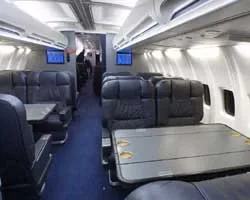
"Would you like to dine on board? Pay another 300 pounds and fly British Airways," say proponents of low-cost strategy with undisguised glee. In response, the old guard of the aviation market offers first-class passengers dishes from Paul Bocuse in an almost restaurant interior. In general, the design of airliner cabins has now become no less fashionable a topic for discussion than the works of Philippe Starck. According to some data, the delay in the delivery of the first superjumbo A380s to airlines is caused by the fact that carriers, seeking to outdo competitors in refinement and comfort, are trying to develop the most memorable design and original furniture. For each of them, the A380 will become a flagship, and no one wants to lose face before rivals.
Flying bedroom
Airlines try to keep details of their aircraft interiors a secret until the very last moment. Therefore, the new design becomes known only when the plane has already begun carrying passengers. Although the main "furniture" trend, which to one degree or another is being implemented today by all market participants, is already known - the seat is being turned into a bed by all possible means. Apparently, airlines are guided by the example of Sir Winston Churchill, who, revealing the secret of his own longevity, said that he never stood when he could sit, and never sat when he could lie down.
It is symbolic that British Airways claims the title of pioneer in the idea of sleeping places - company representatives claim that they were the first in 2000 to begin this kind of cabin re-equipment. Not long ago, the British announced the launch of a large-scale program for the next upgrade of business class on long-haul flights, into which they plan to invest 100 million pounds. One of the Japanese carriers installed in the first class of the Boeing-777 under construction seats resembling bathtubs: the bed unfolds between two sides, one of which has a built-in TV screen. Qatar Airways preferred seats in which during lunch or dinner you can turn to face each other - thus creating an atmosphere as close as possible to a restaurant (then the seats fold out into a bed). For the complete happiness of its passengers, the airline even equipped the seats with a "massage" function. "The price of one such seat is comparable to the cost of a good car and can reach $40-50 thousand. But such expenses are quite justified, since first and business class clients can afford to pay $2-6 thousand for a ticket," says Boris Rybak, director of the consulting agency Infomost.
To bring the atmosphere in the aircraft cabin as close as possible to that of a passenger's bedroom, Boeing specialists have developed a mini-shower. True, they plan to install it mainly in business jets. For the mass consumer, they have come up with touch-sensitive aircraft plumbing that allows avoiding unnecessary contact with handles and taps.
Movies, wine and casino
Another lure for passengers is the on-board entertainment system. Apart from the delights of food and wine lists (that is a separate topic), its main principles are standard: a socket for radio headphones in the armrest of the seat, individual video systems for first and business class passengers, and a common video system for economy class passengers. An individual monitor built into the back of the seat in front is mainly intended for "expensive" clients, although, for example, Singapore Airlines offers such entertainment on long-haul flights in economy class as well, with a choice of up to 300 programs. Another option is handing out DVD players with a certain set of films to passengers. In May of last year, Boeing announced the development of a new service - the ability to watch up to four live TV channels during the flight. The service will be provided as part of a wireless Internet access service without additional payment, and signals from satellites can be received using portable computers.
For passengers who prefer not only to relax but also to work during the trip, carriers offer a socket built into the seat for connecting a portable computer, as well as the Internet and telephone. German Lufthansa in April 2004 began providing wireless Internet access services; a year later, Dutch KLM offered the ability to send e-mail and SMS messages. Communication means are available to all passengers for a certain fee, however, as practice shows, airline clients expect improvements in technology and, consequently, a reduction in the cost of such services.
So far, new devices for rest and work are primarily installed on long-haul aircraft - after all, during a three-hour flight, a passenger will not have time to use even a small fraction of the proposed innovations. Further introduction of the latest technologies will primarily depend on the financial condition of each airline. "In the European and American markets, all efforts are now focused on reducing costs, so it is unlikely that many carriers will be too keen on 'comfort' technologies. But Middle Eastern airlines, on the contrary, can afford such expenses. It is quite possible that their economy class in terms of comfort will soon approach the business class of Europeans or Americans," believes Oleg Panteleev, an analyst at the Aviaport agency.
Although new entertainment and communication systems are now being adopted mainly by major network carriers, the possibility of such services appearing at low-cost airlines should not be ruled out. As Novye Izvestia reports, the head of the largest discount carrier Ryanair, Michael O’Leary, recently stated that in the future passengers will be able to fly for free, and airports will subsidize carriers (from revenues from airport operations and services). At the same time, one can make money on in-flight entertainment. The ambitious Irishman even plans to organize gambling on board starting in 2007. It is unknown whether it will come to casinos, but some carriers are already selling lottery tickets in the air. They say the product sells very well!