
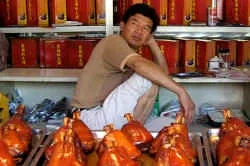
The most famous Chinese dish is Peking duck
Chinese people are calm and unhurried. They know that human life is nothing. Mastery is eternal. The power of life lies in the ability to create something from the ordinary. That includes food. Therefore, Chinese cuisine is a kind of culinary 'surrealism': meat that tastes like fish, fish that tastes like vegetables...
And eating in China is not just a meal. It is a subject for classical drama, paintings, philosophical debates. 'Cooking a small fish is as difficult as governing a great nation,' believed the famous Chinese philosopher Lao Tzu. A real chef must not only decide what and how to cook today, but also how to make the food attractive, harmoniously combining taste and color. He must alternate cold and hot dishes to maintain the balance of 'yin' and 'yang' principles.
'Yin' and 'yang' are not only concepts for denoting the feminine and masculine principles. According to centuries-old tradition, the inhabitants of the Celestial Empire also divide all products and dishes into 'yin' and 'yang'. Cold and soft are 'yin'. Abundant and hot are 'yang'. Pork, potatoes, fruits, milk are 'yin' products. Beef, eggs, chicken, mushrooms are 'yang' products. This philosophical division has an unexpectedly practical meaning for the Chinese: the choice of products depends on mood and well-being. For example, when tired or in a bad mood, one should eat 'yin', and during physical and mental exertion, 'yang'.
Chinese people treat food with reverence. Even one of the traditional greetings sounds like: 'Have you eaten yet?'
There is no single Chinese cuisine as such. What is served in Chinese restaurants is merely a mosaic of trendy exotic dishes. You don't wear Cossack trousers at home, do you? In fact, China has a variety of cuisines. Northern China is salty, the south is sweet, the west is spicy, the east is sour. Besides geographical differences, there are others. For instance, all Chinese dishes are divided into everyday, festive, and ceremonial ('imperial') cuisines. The difference lies not only in price but also in the degree of refinement.
Delicacies such as bear paw, bird's nests, shark fins, sea cucumbers, scallops belong to imperial cuisine. They are not found in every restaurant and are very expensive. The more festive the dish, the more mysterious its name and appearance. Every product carries a hidden meaning. Oranges symbolize the sweetness of life, noodles its length, ducks fidelity and joy, and fish prosperity and wealth. One must be prepared for chickens to be called phoenixes, snakes dragons, pigs boars... For example, the famous 'dragon-tiger fight' — 'longhudou' — is just a soup with small pieces of chicken and a little snake. For connoisseurs, cat may be cooked instead of chicken...
Dishes of Guangdong cuisine are roughly what you can try in Chinese restaurants around the world. It was from the south of the country that most Chinese emigrated, opening their restaurants in different parts of the planet. This cuisine uses a lot of sugar and syrups, and the dishes have a mild taste. Sweet and sour pork is one of the most popular dishes.
Sichuan (western) cuisine is spicy. Chefs generously sprinkle all products with black and red ground pepper. Typical dishes are 'mapo doufu' (a snack made from bean curd), chicken smoked on camphor tree sawdust. Chairman Mao remained faithful to Sichuan-style fried pork belly, heavily seasoned with red pepper until the end of his days. And he lived to ninety-two, swimming in the sea every day.
Eastern cuisine is also famous for seafood dishes. In this regard, the Olympians were recently lucky: the Chinese even tested their sports nutrition on mice. Particularly good are Shanghai 'hairy crabs'. They have very tender and tasty meat, but this delicacy is extremely expensive. And in Shanghai, they also offer 'century eggs'. Duck eggs are kept for more than a month in a special container with straw, lime, ash, and clay. The white and yolk thicken, the eggs become brown-black and translucent, and needle-like compact formations appear inside. This wonder is cut into thin slices and served with soy sauce.
The most famous dish of northern cuisine is, of course, Peking duck. The birds are kept on a special diet of grains and soybeans, and in the weeks before slaughter, they are not allowed to move and are fed a special nutritional mixture. This feeding makes the duck's skin very thin and the meat tender. Then the carcass is coated with sweet syrup and roasted until golden brown.
Eating the duck is a special ritual. The chef brings out the whole bird to show the guests how well it is cooked. After the demonstration, he carves the duck into small pieces so that each piece consists of meat and skin. Thin unleavened pancakes, leeks, and a special sauce are also served. Pieces of duck with leek are placed on a pancake, sauce is poured on, the pancake is rolled into a tube and sent into the mouth. It is incredibly tasty.
Unfortunately, real Peking duck can only be tasted in Beijing. In Chinese restaurants in Kyiv, a dish with a similar name is very distantly reminiscent of the original. But then again, real Ukrainian borscht – with pampushky, buckwheat, garlic 'zatirka' and homemade sour milk – is better tasted somewhere near Poltava, 'in a cozy garden where cockchafers buzz over the cherry trees.'
And Qi Baishi really was very fond of shrimp. Not exotic marine beauties, but ordinary river ones, transparent-greenish modest ones. And he painted them every day. And he lived to ninety-two. And he was very sorry that only at the end of his life did he finally understand how to depict them.