
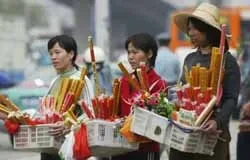
It cannot be said that the Chinese authorities are delighted with this trend that has swept virtually all provinces. The Chinese government is even drafting a new version of legislation on ritual services. And while transportation of the deceased in traditional form is still allowed, the new law will ban offering sacrifices to the dead, and those who intend to burn mock-ups of earthly goods will face severe punishment. But it is unlikely that state bans will force people to abandon their traditions, especially since in modern China huge sums of money are made on them, and not counterfeit ones.
Dead Souls
Currently, a new type of business has become extremely popular in China, widespread in the provinces. Entrepreneurial intermediaries offer inconsolable parents who have lost, say, an unmarried son, to unite him in marriage for a fee with a potential bride. Naturally, also deceased. This operation is called 'minghun', or posthumous marriage. Its roots lie in the cult of ancestor worship, according to which a person does not die but acquires a new quality of life. And relatives are obliged to care for him as if he were alive. All this is connected with traditional Chinese views on family and marriage. Allegedly, an unmarried person is spiritually deficient and therefore unhappy. That is why many parents who have lost a bachelor son are seriously concerned that their offspring will face an evil fate in the afterlife. In Confucianism, there is a postulate such as 'sense of responsibility towards a son'. It is this that drives parents to break all prohibitions – people believe that the tradition of 'minghun', sanctified by ancestors, is more important than the decrees of earthly authority.
The whole difficulty is where to find a 'soulmate' who has passed on to a better world and how to negotiate with her relatives to hold a wedding ritual. The fact is that in China, where since time immemorial the birth of a male heir was considered happiness, as a result of the 'one family, one child' policy, a serious shortage of newborn girls has emerged, and consequently, of potential brides. In some regions of the PRC, approximately every fourth adult man is unmarried. Sometimes these bachelors pool money to buy one wife for three. What can we say about deceased men – brides for them are just as scarce.
However, enterprising Chinese have found a way out here too: the problem can be solved by paying a bride price. The rates depend on the actual demographic situation in a given area. After all, the gender imbalance persists both among the living and the dead – if fewer women are born than men, then fewer die.
On average, the groom's family must pay the intermediary and the bride's relatives slightly more than 10,000 yuan (about $1,200). This is equivalent to a four-year income of an ordinary Chinese farmer – an exorbitant amount of money for the Chinese provinces. The scale of the wedding ceremonies also depends on the clients' wealth. Usually, the 'newlyweds' are buried together. Wealthier people also hold a wedding-funeral, slaughter a pig or sheep for the close friends of the 'newlyweds'. The less well-off celebrate 'minghun' modestly. Unable to pay for a bride, they sometimes replace her with a straw or clay figure. However, everyone understands that such a 'straw wife' is unlikely to bring as much happiness to the groom as a 'real' one.
This strange business creates various problems, including criminal ones. Chinese media have increasingly reported cases of grave desecration for the purpose of reselling the bodies of the deceased. A huge resonance in the press was caused by the creepy story of a woman from the town of Yangquan who was going to buy the body of a deceased little girl whose relatives had not managed to pick her up from the hospital. The woman explained her criminal actions simply: she said she was fulfilling the request of her brother, who died a bachelor. When the investigator asked how she knew about such a request, the woman replied that he constantly visited her in her dreams and persistently demanded that she find him a wife.
By and large, all these wedding rituals, as well as the revival of the ancient tradition of eternal rest in the earth, called 'returning to the mountain', are very symptomatic of modern China with its rapidly growing economy. The fact is that until recently in the PRC, apart from remote rural areas, all deceased were cremated as a mandatory procedure. So to speak, with proletarian asceticism. An exception was made only for the highest officials of the country – for them, a special necropolis 'Mountain of Eight Riches' was opened in western Beijing. However, most top functionaries preferred to 'go to meet Marx' through the flames. A different option was chosen for the 'great helmsman' himself. Literally a month after Mao's death, the Memorial Hall was built on Tiananmen Square. Since then, the leader's body has rested in a crystal sarcophagus. But he is remembered mainly by tourists – Mao's few relatives are not allowed by law to visit the mausoleum on the Qingming Festival. This festival, one of the most revered in China, celebrated on April 5, is not a public holiday. However, after the abolition of communist rituals, it began to be celebrated with the same grandeur. Likewise, traditional funeral rites revived. And consequently, the associated business flourished.
Thus Spoke Confucius
Any person raised within the framework of Judeo-Christian civilization will certainly be shocked by all this Chinese afterlife exoticism. However, if we proceed from the context of Eastern spiritual practices, there is nothing barbaric or blasphemous in these customs. For any Chinese, even the most advanced, by virtue of their mentality, is drawn to the ancient transcendent experience of spirit communication.
If you look into any modern Chinese dictionary, you will find the concept 'zongjiao' - 'religion'. But the paradox is that the Chinese themselves put a completely different meaning into it than people of Western civilization. The term 'religion' itself came to China only in the 19th century from Japan (perhaps this is one of the few borrowings from the island neighbors). Initially, this term served only to designate foreign religions - Catholicism, Protestantism, Orthodoxy, Buddhism, and Islam. The Chinese themselves understood religion in a completely different sense.
'Zongjiao' literally means 'teaching of ancestors' or 'teaching inherited from ancestors.' Every spiritual teaching in China is based solely on the attempt to establish a connection with ancestors, to resonate with them, 'to penetrate the spirit' or 'to make contact with spirits.' The Chinese have no faith in the sense that it exists in Western religions. However, there is 'trust' in the spirits of ancestors, who supposedly actively influence the earthly world. The inhabitants of the Celestial Empire have no institution of prayer as a form of direct address to God, just as there is no Creator or anyone who even approximately occupied his place in the sacred space. It is no coincidence that when translating the Bible into Chinese, they had to resort to the term 'shang-di,' that is, 'supreme spirit,' or more precisely, 'supreme ancestor.'
Even the concept of 'society' in the minds of the Chinese has a completely different meaning than in ours. The term 'shehui' literally translates as 'gathering of people around the altar of ancestors.' Confucius, who believed that relations in the state should in everything be like relations in the family and said: 'Let the ruler be a ruler, the subject a subject, the father a father, the son a son,' strongly encouraged the cult of ancestors that arose before him as a means of maintaining loyalty to the state. For the living, by visiting the graves of ancestors, maintain an invisible connection with them. And they, in turn, protect the seeds of new life and are able to ensure the well-being of the living. In this understanding, for the Chinese, the world of the living and the dead is one whole, and therefore a 'wedding' arranged by the living for the dead seems more touching than wild.
From foreign tourists (mostly Europeans) who flock to visit the 'Terracotta Army' of the first Chinese emperor Qin Shi Huang near Xi'an or the tombs of Chinese emperors near Beijing, one has often heard the bewildered question: 'Why did the Chinese need all this?' The inhabitants of the Celestial Empire answer this provocative question importantly and thoroughly: they say, by recreating a giant army of the Yellow Emperor from clay, the ancestors were not so much helping the ruler wage war in heaven as protecting themselves and all subsequent living generations (in other words, us) from the immortal forces of evil. So go figure these Chinese...