
Aphrodite's Bouquet
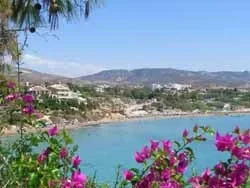
Cyprus is beautiful. At any time of year. In December, anemones bloom there and ripe oranges fall from the branches; in January, the hillsides are covered with pink clouds of almond trees and white stars of daffodils. In spring, the island turns the sunny color of mimosa, and in summer it becomes pink with oleanders. After the first autumn rains, it blossoms again like spring, covered with a delicate carpet of purple cyclamens and yellow daisies.
This ever-flowering island was inhabited so long ago that gods and heroes came to its shores following shepherds and peasants. Having settled on Cyprus, the gods made sure that nature delighted the eye and cheered the soul, that clouds did not darken the skies, and storms did not disturb the sea's surface, so that mountains and valleys were covered with flowers all year round. First and foremost, the beauty Aphrodite took care of this. 'Aphrodite Anthea' - the locals called her - 'Aphrodite the Blooming'. It is said that in honor of her love, the island of Cyprus was first covered with unprecedented flowers, turning into a luxurious carpet thrown at the feet of the goddess and the young man Akamas. The goddess liked the carpet, and since then she has kept it in perfect condition.
Cyprus is a true paradise for flower lovers. In terms of wildflowers, it is one of the most generous places in Europe. The British come here on special 'flower tours' to walk in the mountains and admire buttercups. East and West meet on Cyprus, and along with the typical Mediterranean flora, plants of Asia Minor thrive. The Cypriot carpet accommodates about 1,800 species of flowers, of which 110 species and 20 subspecies can be found only here. The island grows agaves, laurels, peonies, and 44 species of orchids. Of course, these are not tropical orchids from Singapore, but they are still beautiful and interesting: the dark-red helleborine, pyramidal, Iberian and bee orchids, the pollen head, and lady's slipper.
Botanists explain this miracle by Cyprus's geographical position, its origin from the Taurus mountain range in Turkey, the wonderful climate, and the healing water. And also by the fact that on Cyprus there are fewer sheep and goats than in Greece, which tend to trample meadows. But true Cypriots know that it is not about goats at all, and certainly not about the distant Turkish Taurus. It is all about the jokes played by Aphrodite, a true Cypriot, now living somewhere here among her admirers.
Strolls on Olympus
Besides flowers, Cyprus has mountains. They are so cleverly positioned that not all guests of the island get them into their field of vision. For example, vacationers in Ayia Napa and Protaras can only guess at their existence. But adherents of Limassol and Paphos, when coming out of the sea, admire the hills of the foothills and distant peaks.
The peaks of the Cypriot mountains are thoroughly smoothed by time. In the middle of the island are the highest mountains, called Troodos. The main peak is officially called Olympus, and informally Chionistra. Chionistra means 'snowy'; from January to March there is indeed snow, and skiers ski. The Olympic height does not boggle the imagination: it is 1,951 meters, but the views in Troodos are magnificent. These mountains are covered with dense forests of Aleppo pine and Cyprus cedar, which is found only here. Every single Cypriot is convinced that the Cyprus cedar is much more beautiful than the Lebanese cedar. Probably, the Lebanese disagree, but they cannot do anything about it.
The Cypriot forests have their own names, marked on maps. Near Olympus is the Troodos forest, around the Machairas monastery - the Machairas forest, in the southern foothills - the Limassol forest. The largest and most beautiful is the Paphos forest, covering the western spurs of the mountains. The main pride of the local foresters is the Cedar Valley, which all guidebooks inevitably call 'famous'. It is hard to say what this claim is based on. It is also hard to find differences between this valley and neighboring ones with the naked eye. However, people with a trained eye claim there is a difference: this is the last large cedar forest of natural origin on Cyprus.
Large animals in these areas include mouflons. They are quite difficult to encounter in the forest, but very easy in the village of Stavros tis Psokas, where a small reserve has been created for their breeding. In this village is the Paphos forest ranger station, founded in 1882.
Wild West
The Troodos mountains do everything that self-respecting mountains are supposed to do. For example, they trap clouds and moist westerly winds. As a result, the west of the island, represented by the glorious city of Paphos and its no less glorious surroundings, resembles a tropical garden more than the dry and hot eastern part. In Paphos, the vegetation is lusher than in Limassol, and the air temperature is slightly lower. Another remarkable western feature is that over the mountains there are almost always bizarre clouds piled up, turning the sky into a work of art.
In the vicinity of Paphos, bananas, guava, avocados, and other tropical fruits are grown. The market in Ktima can stagger any imagination. They sell strawberries the size of a fist, oranges the size of a child's head. Ripe figs ooze purple juice, guavas exude a delightful scent, in wicker baskets lie Brazil nuts and walnuts, pecans and almonds. One can walk through the market as if through a botanical museum, and also a museum of marine life, which has a separate exhibition in the covered part.
Another botanical museum is the hotel 'Asia', named after the owner's daughter, not after the continent of the same name. The hotel has its own plantations with luxurious gardens. From time to time, excursions to these gardens are organized for guests with a detailed tasting of exotic fruits. Guests like these excursions even more than trips to the Kykkos Monastery.
On the gentle Paphian hills, almost no forests remain. They are adorned with olive groves and vineyards, crooked low pines and junipers, and small half-abandoned villages hide around bends in the road. Here the air is sweet and clean, filled with thyme and wormwood wind, and the smell of juniper mixed with smoke from a village yard where bread is baked in a round oven or kleftiko is made. This is one of the most beautiful places in the world, and not seeing it means not seeing Cyprus.
Closer to the city and the sea, the hills are built up with villas, and this is another botanical museum. White elegant houses are immersed in bougainvilleas, and in courtyards open to view, you can see exotic plants from around the world. On bright manicured lawns, sculptures neighbor them. The warm climate and abundance of water allow any floral extravagances, but Cypriots do not consider flowers an extravagance at all and easily spend money on them.
Village houses are decorated more simply, with trees and flowers typical of Cyprus and the Mediterranean in general. First of all, luxurious roses. Modest Cypriot old women in their invariable black stockings and headscarves are well versed in flowers. Large, tall, surprisingly bright roses bloom with them from March to December, or even all year round, reaching their peak in October. Village old women do not have enough courtyards: they place pots with amaryllis, fragrant geraniums, begonias under windows, on stairs, and along walls.
Land of Akamantas
The westernmost part of Cyprus is the Akamas peninsula, named after the glorious youth Akamantas, son of Theseus. This strange peninsula sticks up like a rhinoceros horn, the wildest place on the island. Usually tourists enter it from the northern coast, from Polis, and do not go inland further than the Baths of Aphrodite. There is another route, even more impressive: from Paphos, that is, along the western coast.
Almost the entire territory of the peninsula has been declared a national park, only in its central part have half-empty villages survived. Some residents left them after the Cypriot-Turkish conflict, some even earlier, after the earthquake that occurred here.
A dirt road leads along the coast, small islands stick out in the sea. The shores here are rocky, indented with coves, and the beaches are sandy. The rocks are composed of different rocks, making them resemble a layered cake in places. In Lara Bay there is a small reserve where sea turtles lay eggs. A rescue station with an incubator has been set up for them. The eggs are carefully dug out of the sand and transferred to the incubator, and when the turtles hatch, the babies are released into the sea.
You can travel through Akamas on horseback: at the end of the asphalt road leading along the coast, there is a ranch. On the same road there is a bird park with a private collection of local and exotic birds.
You can also see birds on Akamas: funny little sandpipers live in the coastal rocks, kingfishers are often seen, flashing like piercing azure lightning over the water. Eagles soar in the sky, large crested larks run across the road, and colorful hoopoes perch on bushes.
Along the Coast
Another incredibly beautiful place is in the east of the Greek part of Cyprus, between Ayia Napa and Protaras. This is Cape Greco, also a protected area. There are no turtles in its coves, but on the light sandy bottom red starfish glow, and lazy octopuses lie curled up like gray stones. Large gray lizards live in the coastal rocks, and transparent geckos call out to each other on the sun-warmed walls.
Between the far west and the far east, many wonders await nature and scenic view lovers. From Paphos to Limassol along the coast lie chalk mountains, dazzling white, sparkling in the sun, covered with dark patches of bushes. A road leads through them, lined with yellow broom and pink oleanders, along which you encounter not villages but pens for goats and sheep. The white mountains either plunge in ledges into the sea or recede from it. One of the most beautiful places in this part of the coast is Kourion, where the ruins of a city-kingdom are preserved on a high cliff.
The salt lakes near Limassol and Larnaca were once lagoons. In summer the lakes dry up and become covered with a layer of salt, but in autumn they fill with water again. In late autumn and early spring they turn pink from flocks of flamingos or white from thousands of herons. These are birds resting while flying across the sea to the Nile Delta, or, conversely, from Egypt to Europe.
Beyond Larnaca begins Kokkinochoria - a huge plain with red soil, with windmills and neat rows of potatoes. It stretches to Ayia Napa, to the unexpectedly high Cape Greco rising above the sea, to the emerald coves and golden beaches of Protaras. The circle closes, the road that began by the sea leads back to the sea, and Cyprus lies in your hands like a ripe orange - a sunny and joyful, cloudless and carefree island.