
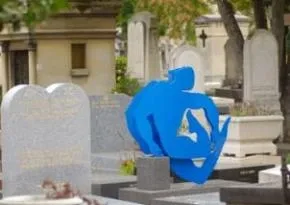
Montparnasse Cemetery has become a resting place for local residents, with tombstones placed for no apparent reason.
Montmartre Cemetery
The sprawling Père-Lachaise resembles a romantic and secluded park (albeit heavily cluttered with crypts and tombstones). The Montmartre cemetery, on the other hand, gives the impression of wild stone jungles, only occasionally enlivened by sparse vegetation. Montmartre Cemetery is located at the very foot of the hill in a kind of depression that resembles a road to hell. A fairly significant part of it is even under a wide bridge with quite heavy traffic, which clearly does not contribute to tranquility and peace.
This surprising and very unfortunate location is explained by the fact that the Montmartre cemetery was opened in 1825 on the site of a former gypsum quarry. Over several hundred years, a lot of gypsum had been mined, and a considerable pit had formed here. The main demonic quality of this place lies precisely in the fact that most of its territory lies significantly below ground level. Space in the pit is limited, so tombstones literally pile on top of each other, and the excessive crowding of burials will only increase: the cemetery area is only 10 hectares, four times smaller than Père-Lachaise, yet the number of people wishing to be buried here is no less.
No less significant is the difference between the cemeteries in terms of social composition. The bulk of burials at Père-Lachaise (aside from the aforementioned writers, poets, and artists) are politicians, generals, and public figures little known to Russians, and apparently quite forgotten by the French themselves. There are also many ordinary citizens at Père-Lachaise. But at Montmartre, in keeping with the bohemian reputation of the district, the dead are mostly artists. And to get into this unprepossessing cemetery after one's death, one must have made at least a modest contribution to world art.
Navigating the terrain and at least somewhat making sense of the labyrinth of tombstones and crypts at Montmartre Cemetery is much more difficult than at Père-Lachaise. And without a map, it is simply hopeless. So upon entering the cemetery, do not forget to take one from the attendant's booth at the entrance (they are also issued free of charge). Montmartre Cemetery has only one entrance, under the aforementioned bridge.
Almost immediately, visitors find themselves at a round square. Starting clockwise around it, at the first corner one can find the grave of La Goulue, the famous dancer of the Moulin Rouge cabaret at the end of the 19th century. Further along the same circumference is the tombstone of Émile Zola, although his remains were moved to the Pantheon quite some time ago. Turning onto the next alley, at its end one can find the grave of Théophile Gautier, an elegant writer of the mid-19th century.
Diving under the hideous bridge and wandering a bit among the massive crypts, one comes to the final resting place of the singer Dalida. She lived on Montmartre for many years, and it is said that her grave can be seen from the windows of her former apartment. The singer's monument is superb and in no way reminds one of the sad place where it is located. No notes are written to Dalida, but there is always a basket of fresh flowers from fans.
Near Gautier lies the grave of the great composer Hector Berlioz. Moving along the alley named after him, on the left one can find a tombstone with the name of the brilliant Heinrich Heine, who ended his days in a foreign land. 50 meters further are the graves of Alexandre Dumas fils and the legendary dancer Vaslav Nijinsky. Notably, the same cemetery holds the remains of Alphonsine Plessis, the prototype of the main heroine of Dumas fils' novel The Lady of the Camellias. According to legend, Dumas himself wished to be buried near the woman who made his name world-famous.
Turning sharply left, we come to the tombstone of the great Stendhal and the graves of the Goncourt brothers, located next to a fountain.
Along the Allée de la Croix is the final resting place of a woman whose name is forever linked with Russian culture. This is Pauline Viardot, a singer, muse and friend of Ivan Turgenev. Their relationship is still actively discussed by literary scholars and the general public, but one thing is certain: Viardot widely popularized Russian literature in France.
A walk along the perimeter of the small cemetery would also not be superfluous. Here lie the final resting places of the brilliant artist Edgar Degas, composers Léo Delibes and Adolphe Adam, director François Truffaut, and inventor of the saxophone Adolphe Sax.
Montparnasse Cemetery
Montparnasse Cemetery is the most "lived-in" in Paris. No contrasts catch the eye here; everything is peaceful, without particular pretensions, and almost homely. If we compare it with Père-Lachaise and Montmartre, the Montparnasse burial ground occupies an intermediate place between them. It is neither a luxurious park on a hill like Père-Lachaise, nor a congestion of stone crypts in a former quarry like Montmartre.
It is simply a place of rest for local residents, with tombstones placed for no apparent reason. At least, the French treat it exactly that way. I noticed numerous mothers with strollers cheerfully chattering in the shady corners of the cemetery, and well-groomed elderly couples sitting on benches sipping wine from glasses while keeping an eye on their grandchildren running around. Young people were kissing on benches as if nothing was out of the ordinary, and teenagers were energetically discussing their teenage problems, sometimes even turning on their mobile phones with obligatory rap music for accompaniment. And no one is the least bit shocked!
Montparnasse Cemetery is flat as a table, with extremely neat alleys and the traditional layout of a regular French garden.
Immediately to the left of the main entrance are the graves of Jean-Paul Sartre and Simone de Beauvoir. This is a pilgrimage site for intellectuals from around the world. The second such place is the final resting place of the brilliant and unfortunate "cursed poet" Charles Baudelaire. You can reach it by moving from the main entrance along the wall always to the right. His grave is right next to a drinking fountain. Here there are as many flowers and notes as at Sartre's.
The third most significant and visited (mostly by the French) is the grave of Serge Gainsbourg, a singer and composer, known as a womanizer, alcoholic, and passionate smoker. As many believe, it was he, the son of immigrants from Russia, who embodied the true French character. On his grave, besides the inevitable notes, there are packs of cigarettes, perhaps not superfluous for Gainsbourg in his afterlife.
Approximately at the same distance from the central square (also circular, by the way) on opposite sides of it found their final resting place the notorious Symon Petliura and the great chess player Alexander Alekhine. During the Cold War, both were half-abandoned, but nowadays both are maintained in the best condition.
In general, there are plenty of foreigners at the Montparnasse Cemetery. This is further evidence that Paris was and remains a truly international city.
For example, three famous Romanians are buried here: playwright Eugène Ionesco, poet Tristan Tzara, and sculptor Constantin Brâncuși, who significantly changed the face of modern art in their time. Literally a few meters from Ionesco lies the tombstone of his colleague in creating the "theater of the absurd" – the Irish writer Samuel Beckett. There was also a place for our compatriots – artist and sculptor Ossip Zadkine and writer Henri Troyat (Tarasov). Nearby are the graves of two great Latin Americans – Argentine writer Julio Cortázar and Mexican dictator Porfirio Díaz, who most likely would not want anything to do with each other even in the afterlife.
Besides this international company, dozens of remarkable figures of art who glorified France worldwide are buried at the Montparnasse Cemetery. Among them are poet Leconte de Lisle, sculptors Houdon and Bourdelle, writers Huysmans and Guy de Maupassant, composer César Franck, and many others.
A trip to Paris is an event of heightened romance, and if you want to raise that romance to infinity, you simply cannot do without a walk through the Parisian cemeteries. The aforementioned romance, albeit not without a touch of necrophilia, can be loaded here by the wagonload. Grateful human memory hovers everywhere over crosses and tombstones, besides it is simply quiet, peaceful, green, and the air is very clean. Drop in here and you will not regret it.
This concludes my overview of Parisian cemeteries. Finally, I note that entry to them is free, and they are open until half past five in winter and until six in all other seasons. Enjoy your trip.
Read also material on the topic: WALKS THROUGH PARISIAN NECROPOLISES
Piotr SYTENKOV.
Gazeta.Ru er="0">