
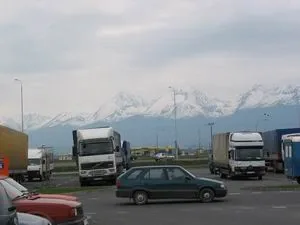
We should warn right away: it makes no sense to drive to Spain with the purpose of lying on the beach. For such cases, it is cheaper, easier and faster to use a plane, and for local trips - to rent a car (if the company is large, renting a minibus will do). But if you want to see the continent, and not just the beaten tourist spots - you can try going in your own car.
"Green Card" and domestic driver's licenses
For a trip to Europe, it is quite enough to have our license issued at any traffic police office. Moreover, it does not have to be a plastic card - a driver's license with a glued-in photo would suffice. The owner's surname and first name are duplicated in Latin script, and the databases of European police contain both versions of domestic licenses.
There are also international licenses - they can be obtained at a local traffic police office for a similar amount. They allow driving throughout Europe (these licenses look like a booklet larger than a passport with entries in various languages, including Japanese, Chinese, and Arabic). First, such a document is necessary if for any reason your domestic license has been confiscated - for example, it was taken away 10 km before the border for driving into the oncoming lane. It is clear that in such cases the bribe amount increases severalfold, and to avoid unnecessary expenses, it is better to play it safe and have an international license with you - our temporary permit is not valid abroad.
The second required document, without which you simply will not be let into Europe, is a civil liability insurance policy. Almost all of Europe is part of the "Green Card" system, so it is enough to buy a single insurance policy that is valid throughout the territory.
Pay and Go
Once you enter continental Europe, you face the problem of toll roads. They can be divided into two conditional categories. In France, Italy, Spain, and Croatia, the fee is charged for using specific roads, and it is per kilometer. In Austria, Hungary, Slovakia, and the Czech Republic, you need to buy a vignette at a gas station, which indicates the payment of the road toll. The price of this sticker for 15 days is two to eight euros depending on the country. However, in Austria, some mountain passes and tunnels are toll-based. Of course, you can not buy a vignette, but in that case, if you are caught on the autobahn, you will have to pay a fine of about 150 euros. Is it worth relying on chance?
To the west of the border, toll roads always have free alternatives. The thing is, they are narrow, pass through populated areas, and in Austria through the mountains. So you will not save: first, you can lose a lot of time, second, burn too much gasoline. And fuel in Europe is expensive - a euro per liter. In France, Croatia, Italy, and Spain, you have to pay not only for liters but also for kilometers: on motorways, they charge for the distance traveled. There, the roads turn out to be relatively expensive. For example, the road from Milan to Bologna (247 km) will cost 10.9 euros, while a trip of similar distance in France - from Paris to Tours (238 km) - 19.1 euros. But on a toll road, if there are no traffic jams, you can get there in just two hours (on a free road you will lose at least four hours plus greater fuel consumption). In Spain, prices are closer to French ones - a trip from Valencia to the resort of Salou (247 km) will cost 17.75 euros. Road prices depend very much on the terrain - in the mountains they are more expensive. For example, the route from Genoa to San Remo in Italy will cost 11.7 euros, even though it is only 150 km. And 90 km from Barcelona to Salou in Spain costs 7.82 euros.
Is it far to Tallinn?
The Baltic countries are now members of the European Union. Latvia and Estonia share a border with Russia, but at the main border crossings - Sebezh - Zilupe and Narva - Ivangorod - queues usually form. It is easier to make a detour of 50-100 km to a neighboring crossing and cross the border calmly, without waiting. To enter Lithuania, you will have to go through Belarus (which, among other things, means a mandatory transit fee of $20) and, accordingly, buy local insurance - in the Baltics, the "Green Card" does not yet apply, and each country has its own mandatory insurance.
Driving in the Baltics is convenient - distances are short, and you can calmly drive around the country, seeing its sights. Moreover, Soviet traditions are still preserved there - sometimes you can agree with police officers on a fine for half the amount without a receipt, and they flash their headlights to warn of a radar ambush. This Soviet tradition, by the way, originated precisely from the Baltics - in the 60s, one of the generals of the USSR traffic police went to Lithuania, after which he wrote in Pravda about the bad habit of local drivers - showing oncoming drivers with headlights about an ambush of traffic police officers. Naturally, Pravda was read everywhere, and this trick took root across the vast territory of the USSR.
Fans of interesting travel can visit Eastern Europe. The only problem is that each country requires its own visa, including transit visas. The exception is Poland - you can enter it with a visa of one of the neighboring states (Schengen, Czech Republic, Slovakia).
Finally, beach lovers can go to Bulgaria by their own car. Since the ferry from Ilyichevsk (near Odessa) to Varna runs irregularly, it is easier to drive there. The choice of routes is rich. The simplest and most direct one goes through Moldova - a country of greedy traffic policemen. But this shortens the route through Romania - a poor country where attacks are possible. If you exclude Moldova, you will have to make a detour and cross the border near the Ukrainian city of Reni, and then go along the Danube. You can increase the Romanian part of the route to 500 km if you enter this country near Chernivtsi - then you will have to cross the Carpathians. But from resort Bulgaria (if you take care of a double-entry visa in advance) you can go to Istanbul: from Varna it's only 500 km, and from Sunny Beach even less. However, such routes are more for big fans of road trips - it turns out to be quite long and expensive compared to flying. So if the educational goal is not the top priority, then it is still better to go by traditional plane, or in extreme cases, by train.
To the north, to Iceland, or to the south, to Syria
Finally, if traditional European routes have long been explored, Eastern Europe does not attract, and your soul asks for something new - you can try extreme travel to the north. Suppose you want to go “north to Iceland”. No problem. Drive to Finland, and from Stockholm across all of Sweden - straight to Norway. From Stockholm you need to head to the western port of Bergen - a bit over 1,000 km of beautiful road. Then you board a ferry that sails for more than a day to the Icelandic city with the difficult-to-pronounce name Seyðisfjörður. Then - along the main road around Iceland, the land of geysers. It is, by the way, not as small as it might seem when looking at a map. The road from Seyðisfjörður to the capital - Reykjavik - will take 600 km, whether through the north or the south.
And on the way back, the ferry will make two more stops: first it will call at the Danish-owned Faroe Islands - a three-hour stop is just enough to explore a good half of the islands, including the capital - Tórshavn. The second stop is the British-owned Shetland Islands. From there you can either return to Bergen or cross over to “mainland” Britain - to Scottish Aberdeen. If returning the same way is not interesting, you can drive through England, take a ferry in Dover and arrive in continental Europe - at the French port of Calais.
Finally, another route popular with a small group of extreme road trip enthusiasts. Using the already known way (through Bulgaria) you get to Turkey, and then head towards Syria, where you visit the ancient Muslim cities - Aleppo, Damascus.