
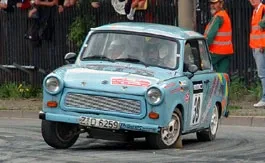
Trabant - symbol of an entire era
Many people love things that come back from the past. It's nice to get something that reminds you of old times, only in a new package. As Газета.Ru writes, once upon a time, half of Eastern Europe drove around in little rattling shapeless boxes called Trabant. However, in 1990, production of these cars was halted, and they gradually faded into oblivion.
Despite this, the car remained a symbol of a bygone era, having fans not only in Germany but also in other countries around the world. Understanding this, the German automotive components manufacturer IndiKar, together with the company Herpa, which makes souvenir miniature car models, decided to revive the iconic model. The small budget car from the 80s should replicate the success of the new VW Beetle, Fiat 500, and Rover Mini.
The first Trabants began production in East Germany in 1957. The car was equipped with an inline two-stroke two-cylinder engine without a carburetor, with a displacement of 0.5 liters and 26 hp, running on a mixture of oil and gasoline, just like makita chainsaws. This 'miracle' of automotive engineering was met with clear distrust even by not-too-spoiled Soviet motorists. Because the car body was made of plastic, it weighed only 620 kg.
To purchase a Trabant, an East German citizen had to, according to communist tradition, stand in a queue that could drag on for up to 15 years.
The new Trabi - as the car is planned to be called - should inherit the external resemblance to its predecessor and retain its simple construction. But at the same time, company representatives promised that the Trabant would meet current European environmental standards and safety requirements.
A scale model of the future car, reduced ten times, was displayed at the last Frankfurt Motor Show. The toy had a sky-blue body and a white roof. The little car was a five-door hatchback, in which one could discern the family traits of the 'classic' budget car from the Cold War era - angular shapes, a well-recognizable large radiator grille and round headlights.
At the moment, the partners are busy searching for a manufacturer who could be interested in this unusual, albeit risky, project and bring it to life. The price of the newTrabi, according to plans, should not exceed €10,000.
Despite all the 'cult status' of the Trabant, some are inclined to believe that it will not go into mass production, like the newBeetle, Fiat 500, and Mini. If these cars were in demand because they were truly beautiful, then the Trabant, being a frankly bad car, was bought so massively only because there was essentially no alternative to it. And therefore the new Trabant will evoke associations with communism, the Berlin Wall, and poor quality.
Be that as it may, German enthusiasts are set on victory; they intend to show a pre-production Trabant already in 2009 at the Frankfurt Motor Show.