
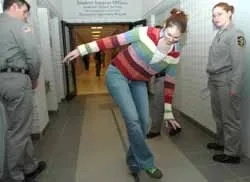
The other day in Los Angeles, the heiress of the Hilton hotel empire and TV star Paris Hilton will again appear before the court. In January, she already pleaded guilty to driving under the influence. Her driver's license was suspended, and the judge gave her a three-year probationary period. Recently, the police stopped her again for speeding and driving without headlights. True, there was no alcohol in Paris's blood this time, but for violating the court-imposed restrictions, she faces big trouble.
The number of such reports, the ease with which many Americans treat them, and the fact that most do not deny themselves the pleasure of having one or two drinks before getting behind the wheel, gave me a wrong idea of the consequences of drunk driving in America. For a long time I was convinced that it was just a trifle. And only a story that happened to a colleague, a close friend and namesake, made me look at the situation with completely different eyes.
It all happened a little over a year ago, on March 8. In the USA it is not a holiday. But in all Washington offices related to the CIS, customs are alive, and if you get there, not to drink to the health of the beautiful ladies is as impolite as in Moscow or Kyiv. My unlucky namesake encountered this tradition. One hospitable office, another... and suddenly he remembered that he had not bought a gift for his wife, who was returning from vacation in the morning. On the way, he met an old acquaintance he hadn't seen in several years. They went into a café, downed a shot. Time flew by quickly in conversation. The friend, like a true gentleman, offered to give the lady a ride, especially since he wanted to say hello to her husband and see the new house the couple had just moved into. He drank one more cup of coffee and a shot of cognac for the road. Oh, if only he had known how it would all end.
On the way to Alexandria (a suburb of Washington in Virginia), at some point he cursed: he was going to the old address of his acquaintances, but he needed to go to Springfield, along Route 395. How to turn around? He changed into the left lane, but doubted whether there was a U-turn there. He returned to the right lane, but then remembered - just half a mile down the left lane he could turn. A series of pointless lane changes alerted the police, who were peacefully cruising along the shoulder. They turned on their flashers and stopped the strange car. In short, hearing the sacrosanct question, 'Have you been drinking by any chance?' the friend said, yes, that had happened. He felt fine, didn't feel any signs of intoxication, and was sure he hadn't exceeded the legal limit of 0.08 blood alcohol content. He was asked to get out. In the headlights of two more police cars that arrived as backup, he touched the tip of his nose as required, moved his eyes following a pencil that the officer moved back and forth, then walked in a straight line placing heel to toe. And everything seemed fine until the breathalyzer test. It showed 0.12 - four hundredths above the legal limit. The treacherous last drink had taken its toll. And then the nightmare began.
After a brief 'You are under arrest,' they put handcuffs on him and took him for a control test at one of the stations. There the alcohol meter turned out to be broken. The policeman spent a long time calling someone. Finally, in the middle of nowhere, they found a working device. But it essentially confirmed the tube's reading - 0.11. Then, of course, the report was drawn up and he received a summons to the Alexandria court in a week. Late at night, he was allowed to take a taxi home. This night ride cost my friend $80, considering the urgency of the call and the considerable distance.
The countdown of financial losses began. Next, he faced a minimum fine of $250 and a one-year driver's license suspension. The fine was okay, but how to live in America without a car! Experienced people unanimously said: look for a lawyer. He won't do the impossible, but he can negotiate a minimum punishment with the prosecutor. The first calls to law firms horrified him - they asked for five, eight, and even ten thousand dollars for a simple, straightforward case. When a lawyer was found who agreed to two and a half thousand, my friend was almost happy, although he didn't really know how he would pay it. He took a taxi to sign the contract - another $50 for the ride. Then he remembered: it was time to pick up his car, which had been towed at night. At the impound lot, they charged him $260...
«Я - алкоголик!»
The first appearance in court was purely formal. The defendant was asked only one question — whether he understood the nature of the charges against him, and the date of the hearing was announced. It did not suit my colleague at all, because a long-planned business trip fell during that period. The lawyer said, 'No problem,' and the next day reported a new date, May 25. Until that date, nothing special happened, his license was not taken away, life went on as before.
The second appearance in court, where we went together, was also unremarkable. Except for the complete acquittal by Judge Jones of those errant drivers whose arresting police officers did not appear in court as witnesses. We already knew that the lawyer and prosecutor had agreed on the punishment for Nikolai if he did not deny his guilt: a minimum fine and retention of his license during a one-year probationary period with travel restrictions - to and from work, to court, and to classes in a special anti-alcohol program. The court verdict confirmed expectations - a $325 fine, including court costs.
True, it turned out that the payment for the anti-alcohol program lessons is another 400 "greenbacks." In addition, its component part is attending meetings of "Alcoholics Anonymous." Nikolai was ordered to attend two such meetings. The usual dose is ten meetings, but sometimes the court orders 20, 30, or even 40 attendances. He went to the first session alone. He returned armed with information that there are at least 35 million alcoholics in the US and that it is a colossal problem for the country. His impressions interested me so much that I tagged along with him to the second meeting. It took place in the Church of Christ in the same Alexandria.
From the noisy main street, we entered some special world. Many had known each other for a long time and behaved as if in a prestigious club. When we were introduced (only first names are used there, no last names) everyone responded in chorus: "Hello, Nikolai." The meeting itself consisted of two parts. First, reading in turn excerpts from the peculiar bible of this society - a thick volume called "Alcoholics Anonymous." And each new reader, before beginning their part, would say: my name is so-and-so, I am an alcoholic!
We painfully waited for our turn. First, we couldn't bring ourselves to call ourselves what we are not, and second, we didn't know if he would get credit for attendance if he refused. Fortunately, it didn't come to us. The second part began. People started telling their stories. The content was standard: I am so-and-so, I am an alcoholic. At the end: thank you for listening to me. And we all in chorus: thank you for sharing your story with us.
On the one hand, it was a kind of "surreal": a distant echo of Soviet comrade courts and critiques at union meetings. On the other hand, the stories of many people struck with living suffering. Besides random birds of passage like us, there were mainly people truly experiencing the drama of alcohol addiction and trying all means - from prayer to communicating with their peers - to get rid of the harmful habit. Be that as it may, our meeting ended with almost complete unity of souls: holding hands and forming a huge circle, everyone recited: "Our Father, who art in heaven..."
"Now I'm paying the price"
Then it got worse: it turned out that probation was not an empty formality. In terms of anti-alcohol efforts on the roads, Virginia turned out to be almost the strictest state in the US. In short, Nikolai learned that he was obliged to communicate with his supervising court officer as often as the latter wished, and to provide a monthly report. Besides the usual information about himself, home, change of residence, he was required to report how many miles he drove in the reporting period, information about salary, expenses, large purchases (over $500), all bank accounts and balances, as well as the presence of post office boxes and safe deposit boxes in banks, the names of his immediate supervisors at work and their phone numbers.
While Nikolai was getting used to the moral burdens of his new life, another financial blow followed. A letter from the state Department of Motor Vehicles informed him that because of his violation, he had lost the right to drive a car within Virginia. To restore it, he needed to pay a $160 fine and fill out form SR22 with his insurance company. Simply put, this meant an increase in insurance cost of $500 per year. And the third condition was attending the same anti-alcohol program classes. In case of non-compliance, the case threatened to be returned to court with unpleasant consequences, the most sensitive of which was the revocation of his driver's license. He had to go to acquaintances asking for a loan.
Meanwhile, the time came for the anti-alcohol program classes. There are ten weekly lessons of two hours each. Their preparation and conduct are handled by a special commission under the local city hall. It also prepares a standard interactive textbook. On the first page is the question: "Why do you think you ended up in this group?" My friend answered: "I had a drink and got behind the wheel - now I'm paying for it." You can miss no more than one class. In that case, for an additional fee of $25, the absentee will be sent to another group to cover the missed topic. If you miss two or more lessons, you have to start all over.
It works on some
The classes discuss not only the harm of alcohol but also drugs. The point is to lead a person through all stages of potential threats, awaken their consciousness, and bring them to a decision - how to deal with alcohol or drugs going forward, to adopt some plan of action to prevent a repeat of driving under the influence. Here it is enough to familiarize oneself with Virginia's penalty code. For a second offense of driving under the influence within ten years of the first, the offender faces a fine of $500 or more, revocation of driver's license, and at least ten days of imprisonment. In the group, there was one such girl, and she was happy that the judge allowed her to serve her sentence on weekends and holidays. That way she could at least keep her job. But if the second offense occurred within five years, the prison term automatically starts at 20 days with no allowances for weekends or holidays.
So, given our legal literacy, we do not envy Paris Hilton; she cannot get her driver's license back for three years, the fine could be $2,500, and most importantly, the heiress faces two to three months in prison.
Probably, the millionairess can afford such expenses and pastime. But people like my friend hardly can. If anyone hasn't added up the amounts mentioned above, know that it's almost $6,000. His fellow sufferers have roughly the same expenses, though there are some who paid 10,000 and even 15,000.
And now Nikolai thinks only about never ending up here again. Our hero plans to reflect these thoughts in his final written work, which he must present at the last class. And then, God willing, in another month the probationary period will end and he can go wherever he wants, without restrictions and police reports. But he will always have to remember that a "trace has been left", and now he is stuck in the database for a long time, and the next alcohol-related incident promises the most severe consequences.
And perhaps the most important thing we have learned: Americans are very concerned about the problem of drunk driving. For this reason, in 2005, 16,885 people died, or 40% of all traffic accident victims. The organization "Mothers Against Drunk Driving" is gaining strength in the country. Under its pressure, many states are toughening punishments, and Virginia is at the forefront. They treat as they can - with dollars and prison time. It works on some.