
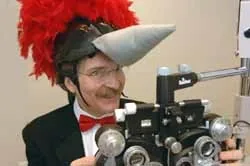
In fact, many of the Ig Nobel Prize laureates had no intention of joking and were trying their best to solve a serious scientific problem. But one doesn't preclude the other. For example, three chronobiologists from the University of Buenos Aires were genuinely concerned with finding a remedy for jet lag - the abrupt change in time zones during long flights. As a result, a scientific paper appeared on how sildenafil helps restore the disrupted circadian rhythm. All serious: they mention the hypothalamus, the suprachiasmatic nucleus (these are all in our brain and are somehow related to those very rhythms), and hamsters were used as experimental animals. But one tiny nuance turns the article into a joke: after all, sildenafil is the active ingredient of the famous Viagra for women or men, which enhances potency. In short, it turned out like the joke about scientists crossing an elephant with an elephant: no use to science, but interesting to watch. But the Argentinians honestly deserved the Ig Nobel Prize in aviation.
The prize in physics went to Harvard scientist L. Mahadevan and Chilean Enrique Villablanca. They worked at the intersection of strength of materials and topology and studied the laws by which an 'elastic sheet' crumples. As a result, serious scientific journals published papers with titles like 'Geometry and Physics of Crumpling', which seemed to the Ig Nobel committee worthy of a full prize. And the award in medicine was given to Briton Brian Witcombe and American Dan Meyer for their work 'Sword Swallowing and Its Side Effects'. Executive Director of the International Association of Sword Swallowers Meyer acted here as a scientific consultant. And Witcombe, apparently, was just doing his job: he works in the National Health Service and by position deals with various diseases and injuries of Britons. By the way, having studied the experience of 46 sword swallowers, the co-authors came to a very interesting conclusion: it turned out that the risk of damaging the esophagus or stomach in these circus performers is higher than in an ordinary person, but such wounds heal faster than common ulcers.
Dr. Johanna Bronswijk from Eindhoven University in the Netherlands received the prize in biology. The researcher's field of interest is very broad: insects, arachnids, and even fungi. The main thing is that they live where humans sleep - in our beds. According to the Ig Nobel community, the professor from Eindhoven conducted a 'census of all mites, spiders, insects, pseudoscorpions, crustaceans, bacteria, algae' etc., 'with which we share our bed every night'. On the other hand, the research is quite academic: after all, living creatures are found everywhere, even in sheets, and why shouldn't a biologist study this, in Johanna Bronswijk's words, 'bed ecosystem'?
But the 'hit' of the Ig Nobel season was, of course, the peace prize. It was awarded to the Wright Laboratory in Dayton, which is part of the US Air Force. The local minds proposed (note, only proposed, it seems it never got to development) to invent a 'gay bomb'. This weapon was to be a chemical substance that changes the sexual orientation of enemy soldiers. After its use, according to the military scientists, something like a mass homosexual psychosis would occur in the trenches and foxholes, and the enemy personnel would engage with each other instead of fighting. The hippies of the 60s, who coined the slogan 'Make love, not war', never dreamed of such a cynical realization of that crazy idea.
But the Dayton researchers entertained themselves not only with military-erotic fantasies. In the memo referenced by the Ig Nobel organizers, there are other equally fascinating ideas. For example, they proposed using chemical compounds that would attract various 'annoying creatures' to enemy positions, such as biting insects, rodents, or large animals. Perhaps the Wright Laboratory should join forces with Dr. Bronswijk, who knows a thing or two about mites and pseudoscorpions and could provide invaluable help to American military chemists.