
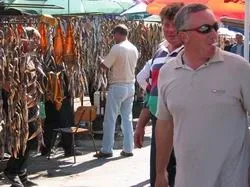
As the newspaper “Vremya Novostei” reports, officials explained this extraordinary decision by concern for our smaller brothers. According to the Latvian authorities, sellers cannot provide “good keeping conditions” for this live product.
In small cage-aquariums installed in stores, too many fish are placed, which then try to survive in this cramped “room”. Many fail, and carp and crucian carp suffocate and die right in the aquarium. In addition, officials cited complaints from buyers, who are, allegedly, shocked that sellers scrape scales off live fish right on the spot.
Naturally, this decision by officials did not please the fish industry, which, fearing for their business, proposed a compromise: not to ban the trade in live fish, but to introduce strict rules for the keeping of store tanks. For example, it would be good to introduce standards for “population density” - the number of individuals per cubic meter of the tank - or to establish the minimum required oxygen content in the water so that the fish do not suffocate. The agency did not report the reaction of the Food and Veterinary Service to these initiatives.
This decision of the Latvian service fits well into the general nature-protection trend of the modern Western world. It is even surprising that Riga, in its fight for fish rights, unexpectedly turned out to be ahead of all Europe - until now, no country in the Old World had adopted such regulations. Apparently, the hindrance was that in the mind of the ordinary person, fish is a kind of “live vegetable”, whose pre-death suffering and emotional experiences can be ignored. True, crustaceans, not too far from fish in intelligence, have already attracted the attention of animal rights activists: some time ago in Europe and America a scandal arose over traditional methods of preparing crayfish and lobsters, which “cruel” chefs throw into boiling water while they are still alive.
As for fish, ecologists usually contented themselves with promoting “humane fishing”: Europeans have already become accustomed to the fact that a worthy member of society, having caught a fish on a hook, should carefully remove it from the hook and immediately throw it back into the water. There are even less “barbaric” hooks, on the tip of which there are no barbs that tear the lips of the caught fish. However, at least one example of the fight for fish rights implemented in the city legislation of Italian Turin is known. In the very thick code of local rules for handling pets, a strict ban on the sale of aquarium fish in plastic bags is spelled out.
In general, from the point of view of animal rights activists, almost all methods of economic exploitation of our smaller brothers invented by mankind are inhumane and barbaric. Naturally, first of all, animal defenders are outraged by the existing procedures for killing animals in slaughterhouses and fur farms. But hunting causes no less complaints. For example, in February, in Britain, after many years of battles in parliament, the classic aristocratic pastime - fox hunting with dogs - was finally banned. And in Canada, environmental movements recently protested against the authorities' decision to increase quotas for the clubbing of seal pups: activists claimed that hunters continue to kill animals by the most barbaric methods. And in Russia, three months ago, animal rights defenders dared to stage an anti-Islam demarche: one of the environmental organizations appealed to Moscow's mayor with a demand to ban the traditional sacrifices accompanying the Muslim holiday of Kurban Bayram.
There are, however, even more radical proposals in the field of animal humanism. For example, since this year, Israel has banned force-feeding geese. This practice was invented in France at one time: fattening geese greatly increases their liver, which is necessary for making the delicacy foie gras. However, the court ruled that this agricultural know-how is nothing less than mockery of poultry. And animal rights activists accuse Australian sheep breeders of actually performing vivisection: in their opinion, when shearing sheep, they cut the wool so roughly that they practically tear off the animals' upper layer of skin. It is possible that soon we will hear about the need to introduce more humane standards for preparing scrambled eggs or about how to avoid excessive cruelty when boiling milk.