
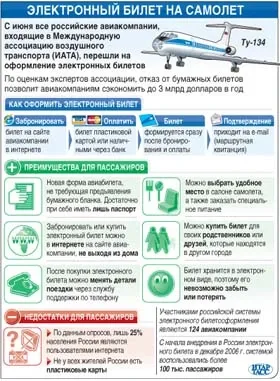
The transition from paper to electronic tickets (e-ticket) is considered one of the most significant opportunities to reduce airline costs. IATA (International Air Transport Association) specialists expect that as a result, carriers' expenses will decrease by $9 per passenger due to the elimination of branded forms and the need to process them. In addition, the innovation should simplify passengers' lives: an electronic ticket cannot be lost or stolen – the main information is securely stored in the airline's electronic database; to check in for a flight, it is enough to present a passport.
And although IATA's requirements apply specifically to international flights, the e-ticket technology is increasingly being used for domestic flights as well. However, a complete transition to paperless technology is still far off – not all regional airports are ready to serve passengers with electronic tickets. And for passengers who do not trust the new tickets, the option to exchange the itinerary receipt for a classic paper ticket will be retained, although carriers intend to introduce a small fee for this service.
You can purchase an electronic ticket both via the Internet and at regular airline offices. In the first case, the passenger will receive the itinerary receipt with flight information by fax or email. Payment will be transferred from the passenger's bank card, and payment information will be stored in the client's bank. When making a purchase at an office (or travel agency), a printout with the flight number and departure time will be given directly to the passenger, along with a payment receipt.
• It should be noted that from now on, you can also pay for an electronic ticket with electronic money. For example, advanced users have long been using the Webmoney service, which allows you to buy wmz and pay with them for any services or goods on the Internet, including airline tickets. If necessary, you can also exchange webmoney, as well as withdraw electronic money to your bank account.
Upon arrival at the airport, the passenger can use the classic check-in counter, where an airline employee will find the passenger's information in the database (a passport must be presented for this). Airlines also place their own kiosks at airports, connected to the common database. There, passengers can independently print their boarding pass using the electronic ticket number indicated on the itinerary receipt. However, self-check-in is available and convenient only for those passengers who travel with only hand luggage.
It is better to keep the printed itinerary receipt with you throughout the entire trip. In disputed situations during passport control, it will confirm that the passenger has a return ticket. This is most relevant for flights abroad.
The International Air Transport Association (IATA) includes 240 companies that carry out 94% of scheduled international traffic. The Association acts as a coordinator and representative of the interests of the air transport industry in the areas of flight safety, tariff policy, maintenance, aviation security, development of international standards jointly with ICAO, etc.
The decision to gradually abandon paper tickets in civil aviation was made in 2004 as part of the IATA program called Simplifying the Business. The electronic ticket provides passengers with a number of significant advantages and reduces airline costs. In addition, it has a positive impact on the environment. According to IATA, abandoning paper tickets will save 50,000 trees annually.
Initially, the transition to e-ticket was planned for January 1, 2008, but the level of readiness forced the Association to postpone the date by five months.
_