
Riding a bus standing up, holding onto a handrail or a neighboring passenger's elbow in hopes of not falling, you will agree, is not a very pleasant experience. It is clear that during rush hour it is hard to avoid such a fate, especially for residents of megacities. They simply have to put up with such inconveniences. It is interesting to see what people's reaction will be when they have to face the problem of a shortage of seats during an airplane flight as well? Imagine, instead of the usual 'take your seats' during takeoff, a polite flight attendant will ask the passenger to brace his feet firmly on the floor and buckle him not to a seat, but to an adjacent wall.
Journalists of The New York Times believe that in the near future we will see exactly such a turn of events. Rising aviation fuel prices are forcing carriers not only to increase ticket prices, but also to save space on board in every possible way in order to transport as many passengers as possible at a time. Previously, savings were achieved mainly by reducing the seat pitch. But the limit when even a person with not the longest legs has become securely pressed against the seat in front was reached long ago. Now carriers are experimenting with the width of the backs of these very seats. Fortunately, companies specializing in seat development never tire of improving their design. Super-strong and lightweight materials have made it possible to significantly reduce the thickness of the seat back. This allows six new seats to appear in the cabin of a regular Boeing-737, and twelve in a Boeing-757. It is clear that the reconfiguration affects exclusively economy class. Business class passengers, who bring airlines their main profit, know nothing about new inventions in the field of 'seat building'.
Passengers should not hope that new super-spacious airliners will fix the situation. Michael Bogan, president of B/E Aerospace, which outfits aircraft cabin interiors, explains: "People are told about new planes that will have bowling alleys and barbershops. But that doesn't happen. On a real airline, on a real route, you have to earn money."
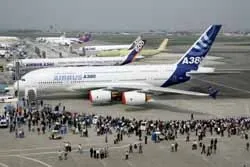
Still, even the emergence of new seat modifications is a rather conservative way to solve the problem. According to The New York Times, quite recently the European aircraft manufacturer Airbus presented its plan to save airlines money. Specifically for some of its Japanese and Chinese customers flying short distances, Airbus proposed to reconfigure aircraft so that they would have no seats at all. They will be replaced by standing places. The passenger will lean against a special backrest. He will be strapped to it with seat belts.
In fairness, it must be said that not a single Asian airline has yet given the go-ahead to the super-profitable proposal of the aircraft builders. Russian carriers, on the other hand, simply smile at Airbus's initiative: "This is madness. How can you fly standing up?" marvels Aeroflot press secretary Irina Dannenberg. "Even flying from Moscow to St. Petersburg this way is unrealistic, not to mention longer distances. And then there's safety. This would be a violation of all standards." Agreeing with her is Andrei Lipovetsky, a representative of the leasing company Ilyushin Finance Co: "This all looks more like an American journalist's canard."